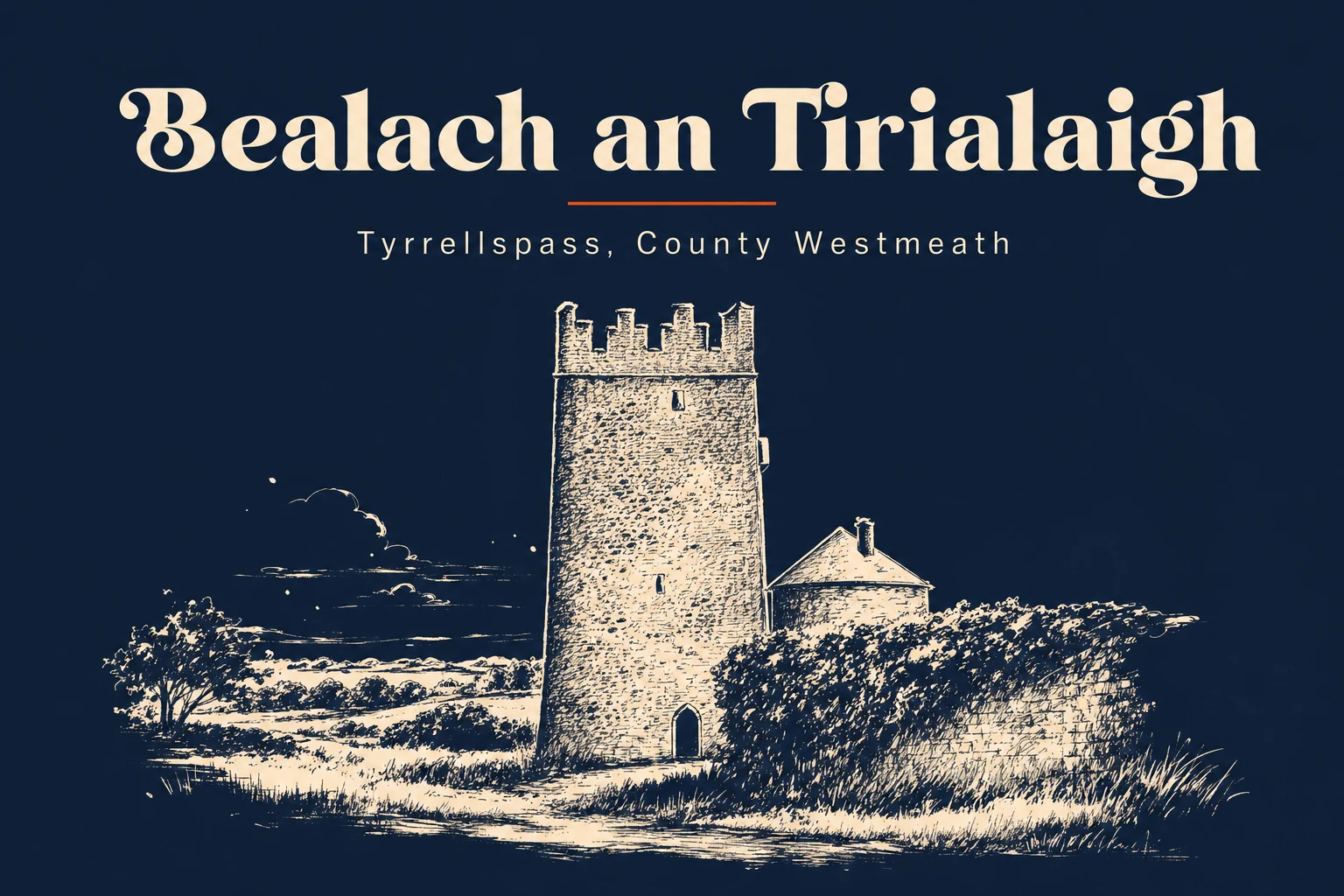
Bealach an Tirialaigh · Co. Westmeath
A crescent of Georgian houses around a green, with a 1597 ambush in the field memory.
Tyrrellspass is the kind of village you nearly drive through and then realise, half a mile down the R446, that you should not have. Pull in. The whole point of the place is the curve - a long Georgian crescent of houses around a sloping green, with a small Church of Ireland at one end and a tower house off the corner. It was laid out as a single piece of work in the late 1700s and finished by Jane, Countess of Belvedere, around 1810. It is still, more or less, what she drew.
The other half of the place is the bog road. In 1597, in the middle of the Nine Years' War, Captain Richard Tyrrell ambushed an English force of around a thousand on the only passable strip of dry ground through the surrounding wetland. The accounts vary on the numbers, but the standard telling is that one English soldier walked away. The bog has been drained, the road is now the R446, and the village that grew up at the pass took its name from the captain.
There is not a great deal to do here. That is part of it. Walk the crescent, look at the church, look across the green, drive five minutes to the tower house, eat lunch at Browne's on the Green, drive on to Kilbeggan or Mullingar. An hour and a half well spent. Two hours if the church is open.