Yola, unbroken since c.1751
The Kilmore Carols
This is the reason to know Kilmore exists. A cycle of thirteen Christmas carols, sung each year in St Mary's church since around 1751, when the parish priest Very Rev. Peter Devereux introduced them. They are sung in Yola - the dialect of Middle English that evolved in south Wexford after the Norman invasion and clung on in the baronies of Forth and Bargy long after it died everywhere else. Six local men, traditionally including a member of the Devereux family, divide into two groups of three and sing alternate stanzas, unaccompanied. The first carol is sung at Christmas Day Mass, the last on the Sunday nearest Epiphany. Several of the old tunes were lost over the centuries, so a number of carols now share the surviving melodies. RTÉ filmed them in 1977 and 1981. They have been sung without a break for more than 250 years. If you can be in Wexford at Christmas, this is worth rearranging a trip for.
William Day, 1798-1802
St Mary's church
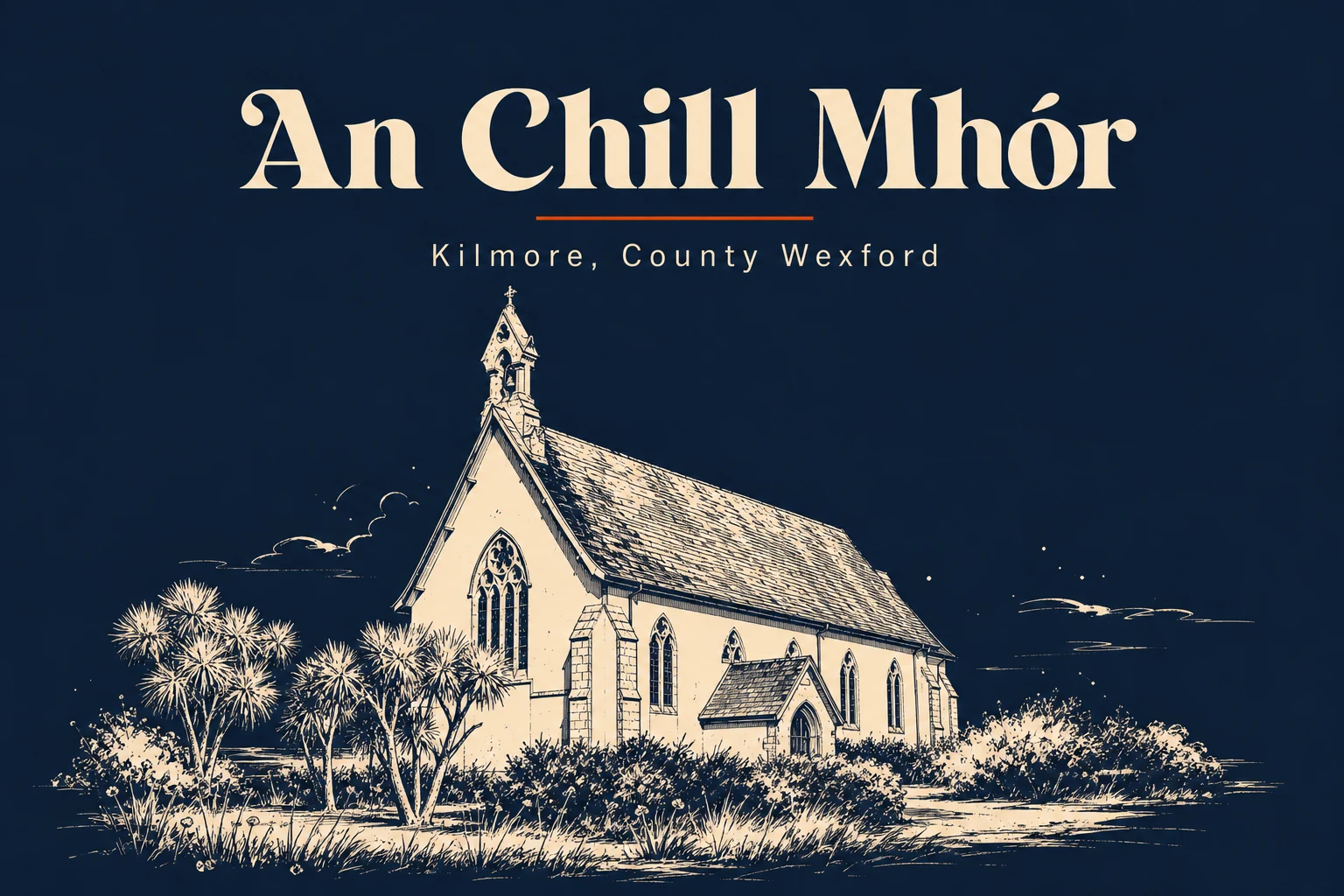
The parish church was built between 1798 and 1802 to designs by William Day, a plain Gothic Revival building in the Diocese of Ferns. A tower was added in 1889, an annexe in 1898 and a vestry in 1935; the later work is attributed to the architect Thomas Joseph Cullen. The east window, dated 1884, is by the French stained-glass maker Lucien-Léopold Lobin of Tours. The church is on the Wexford County Council Record of Protected Structures. It is a modest country church doing an immodest job - it is where the carols are sung, and that is what packs it once a year.
Cill Mhór - the big church
The old church at Grange
The name An Chill Mhór means the big church, and the original is a ruin. In the townland of Grange, inside an old ecclesiastical enclosure, stand the remains of the former parish church - probably of early medieval origin, with a handful of early 17th-century memorials still legible inside. The parish itself is recorded from 1245. Add the ringforts scattered through the surrounding townlands of Sarshill, Lannagh and Rickardstown and you have a corner of country that has been settled, prayed in and buried in for the better part of a thousand years. None of it is dressed up for visitors. Bring boots and read the stones.
Same name, different village
The two Kilmores
Kilmore the inland village and Kilmore Quay the harbour village are not the same place. They share a parish and a name, but they are about two kilometres apart on different roads. The quay grew up around the fishing pier and the lifeboat station in the 19th century - thatched cottages, working harbour, the ferry to the Saltee Islands, pubs like Kehoe's and Mary Barry's, a chipper and a seafood restaurant. The inland Kilmore is older, smaller, and what the people of the parish meant when they said home before the harbour pulled the centre of gravity south. If a sat-nav sends you to one when you wanted the other, check before you set off.