County Wexford Ireland · Co. Wexford · Murrintown Save · Share
POSTED FROM
MURRINTOWN
CO. WEXFORD · IE

Murrintown
Baile Mhúráin, Co. Wexford

The Ireland's Ancient East
STOP 04 / 06
Baile Mhúráin · Co. Wexford

A village on the edge of a Gothic Revival castle, and not much else. The castle is enough.

Murrintown is a small village ten minutes south of Wexford town, on the road that runs out toward Kilmore Quay. The official spelling is Murrintown; the older one, still seen on signs and used by Wikipedia for Johnstown Castle's address, is Murntown. Either is correct depending on who you ask. It has a pub, a primary school, a church, a community centre, a shop. The 1885 Wexford Guide and Directory lists it as a stop on the mail-coach road; today most cars going through are heading to the castle.

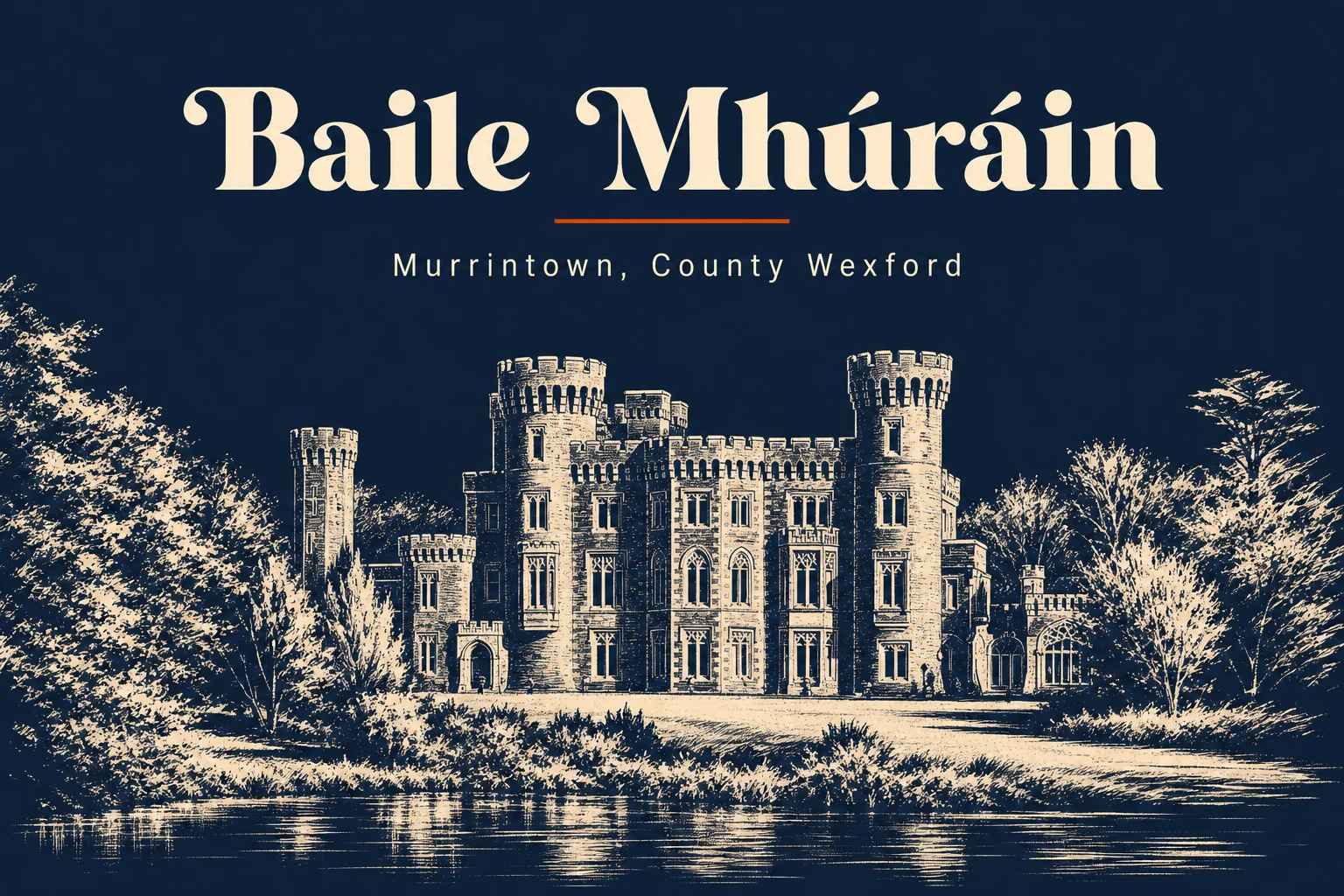
The castle is the reason a page exists for Murrintown at all. Johnstown Castle is a Gothic Revival pile on a 150-acre estate just outside the village, redesigned in the 1830s by Daniel Robertson - the architect who also laid out the terraces at Powerscourt. The family that built the original tower house here in the late twelfth century were the Esmondes, Normans from Lincolnshire. The family that turned it into the romantic neo-Gothic confection you see now were the Grogans, who married the place into their hands and hired Robertson to dress it up. In 1945 the last of them, in lieu of death duties, handed it to the State. Teagasc had its soils laboratory in the castle until 2019. Now it is a heritage site again.

Stay in Murrintown long enough to walk the village in five minutes and you will have seen the village. The Johnstown Castle estate, the gardens, the museum, the lakes - that is the day. Then back to Wexford for dinner.

Population
Small village - a few hundred
Walk score
Pub, school, church, shop - a few minutes end to end
Coords
52.2761° N, 6.5147° W
01 / 06

At a glance.

Three things every local will eventually mention. Read these and you've already understood more than most day-trippers do.

02 / 06

Stories & lore.

The reason to come back. The things every local will eventually tell you about, usually after the second pint.

Esmondes, Grogans, a Gothic Revival

Johnstown Castle

Geoffrey Esmonde, one of the Normans who came in after the 1169 invasion, built the first castle on this ground in the late twelfth century - a plain tower house, no architectural ambition. The Esmondes held it through the medieval period. By the seventeenth century the estate had passed through marriages and confiscations to the Grogan family, and in the 1830s Hamilton Knox Grogan-Morgan hired Daniel Robertson to remake the castle in the Gothic Revival style then fashionable in Ireland. Robertson - the same man who designed the gardens at Powerscourt - turned a workaday country seat into a battlemented, turreted Gothic confection. Work ran from roughly 1836 into the 1870s. In 1945 the estate was handed over to the State in lieu of death duties under the Johnstown Castle Agricultural College Act, and the Department of Agriculture (later Teagasc) used the building as a soils research laboratory for decades. It opened to the public as a heritage site in 2019, managed by the Irish Heritage Trust.

Austin O'Sullivan's life's work

The Irish Agricultural Museum

The museum was the idea of Dr Austin O'Sullivan, a researcher with the Agricultural Institute (now Teagasc) who spent years driving back roads collecting old machinery, hand tools, dairy gear and farmhouse furniture that no one else thought worth keeping. President Patrick Hillery opened the museum in the estate's converted farm buildings in 1979. It has grown to nineteen exhibition spaces and 1,900 square metres of gallery - tractors, carts, threshing machines, creamery equipment, a full Famine exhibition tracing the potato and the emigrations that followed. It is run by the Irish Heritage Trust and got full accredited museum status from the Heritage Council in July 2022. Not glamorous. Genuinely important.

Murrintown House and the rebellion

The 1798 hostelry

Murrintown House, now a private dwelling on the village edge, was in the eighteenth and early nineteenth centuries a hostelry and shop on the mail-coach road south. The Wexford Guide and Directory of 1885 and later parish histories record it as a stopping point used by soldiers during the 1798 rebellion - the year of the Wexford Rising, when much of the county rose against the Crown and the fighting around Vinegar Hill and New Ross marked one of the bloodiest episodes of late Georgian Ireland. The building survives. The story attached to it is local. The 1798 county is everywhere around here.

03 / 06

Things to do outside.

Wear waterproofs. Bring a sandwich. Tell someone where you're going if it's the mountain.

Johnstown Castle gardens Robertson laid out the gardens along with the castle - terraces stepping down to ornamental lakes, walled garden, statues, a sunken Italian garden. Three lakes on the estate, mature trees, peacocks. The whole estate runs to about 150 acres. Pay at the visitor centre; the ticket covers the gardens, the museum and the castle interior.
50 acres of designed groundsdistance
1.5-3 hourstime
The walled garden loop If the full estate is too much, the walled garden and the immediate castle terraces are the dense, photogenic part. Glasshouses, herbaceous borders, the moat below the castle. Wheelchair access on the main paths.
~1 km inside the estatedistance
30-45 mintime
04 / 06

When to go.

There is no bad time. There are different times.

Spring
Mar-May

Daffodils through the estate, the walled garden coming back, school groups but never crowds. Best light on the castle's stonework.

◉ Go
Summer
Jun-Aug

Peak visitor season at Johnstown Castle. Coach tours, family days, the museum busy in school holidays. Go early or late in the day. The gardens absorb crowds; the castle interior does not.

◐ Mind yourself
Autumn
Sep-Oct

The estate's colours are the reason to come in October. Quieter weekdays. The museum is genuinely better when it is half empty.

◉ Go
Winter
Nov-Feb

Check opening hours before driving out - winter hours at the estate are reduced and some weeks the museum closes mid-week. The gardens are still walkable in fair weather.

◐ Mind yourself
05 / 06

What to skip.

Honestly? Don't bother.

If a local was sitting beside you, this is the bit where they'd lean in.

×
Treating Murrintown as a destination on its own

The village is a village. Five minutes' walk and you have seen it. Come for Johnstown Castle and the museum, pair it with Wexford town, Kilmore Quay or the south Wexford lagoons. Do not book a night here expecting a place to wander.

×
Showing up at the castle without booking in summer

Castle interior tours are timed and capacity-limited. In July and August the slots go. Buy ahead on johnstowncastle.ie rather than turning up and standing in the courtyard with a sandwich.

×
Skipping the Famine exhibition because museums about machinery sound dull

The Famine section is the heart of the museum, not the tractors. It is serious, well laid out, and tells the south Wexford emigration story properly. Give it the hour it asks for.

+

Getting there.

By car

Wexford town to Murrintown is 10 minutes south on the R733 / Rosslare road, then west on the local road to Johnstown Castle. From Rosslare Harbour it is 15 minutes northwest. The castle entrance is signposted off the main road.

By bus

No useful regular bus serves Murrintown village. Wexford Bus and Bus Éireann run the Wexford-Rosslare corridor; a taxi from Wexford town to the castle is short and cheap.

By train

Nearest station is Wexford (O'Hanrahan) on the Dublin-Rosslare line. Then taxi or car.

By air

Dublin Airport is 2 hours by car. Waterford Airport is 1 hour but has no scheduled commercial service at the moment.