County Wicklow Ireland · Co. Wicklow · Bray Save · Share
POSTED FROM
BRAY
CO. WICKLOW · IE

Bray
Bré, Co. Wicklow

The Ireland's Ancient East
STOP 09 / 09
Bré · Co. Wicklow

The DART ends here. So does the city, mostly.

Bray is a large seaside town on the Wicklow/Dublin border that has never entirely decided which county it belongs to. The DART brings Dublin into it every 25 minutes. The Wicklow Mountains rise directly behind it. The result is a place that is too big and too working-class to be a resort, too coastal to be a suburb, and too close to the city to be properly wild. It makes the best of this and the best is pretty good.

The Esplanade is a kilometre of Victorian seafront in various states of repair: amusements at the north end, a shingle beach, a headland at the south that gives the town its skyline. The Harbour Bar has been at the bottom of the sea wall since 1872 and was once described by Lonely Planet as the best bar in the world. Whether that's still true depends on the night, but on the right night it still applies. James Joyce's family lived at 1 Martello Terrace on the seafront from 1887 to 1891 - the Christmas dinner scene in A Portrait of the Artist as a Young Man was set in the house. A plaque marks it.

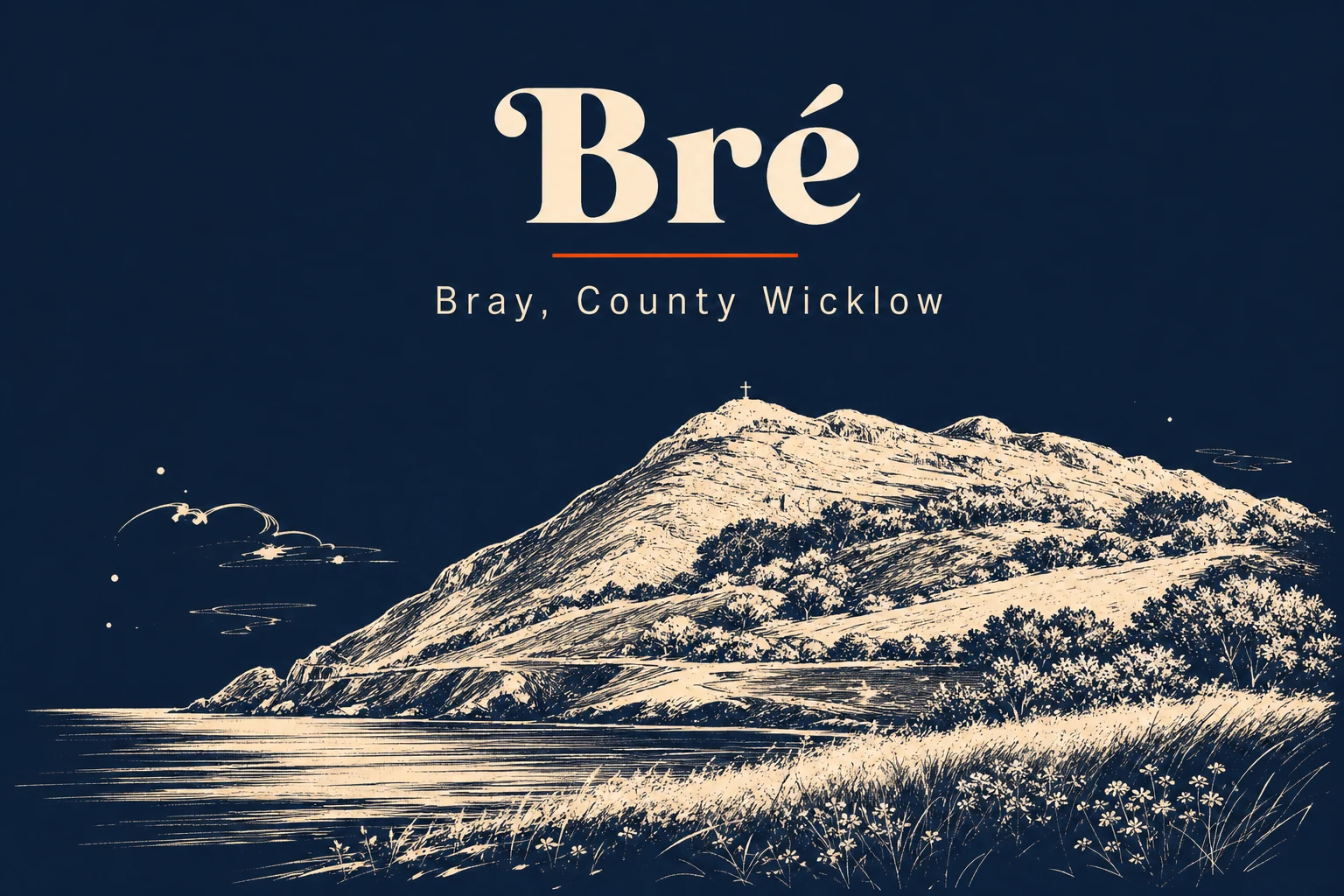
The cliff walk to Greystones is closed - has been since 2021 when the headland started sliding. It will reopen eventually; check before coming. The hill itself is open. Climb to the cross at the top and you'll understand why Bray is where it is: the whole of north Wicklow lies behind you, and Dublin Bay is a grey sheet in front.
Population
33,512
Walk score
Seafront to Bray Head in 25 minutes
Founded
Medieval; Victorian resort from c.1854
Coords
53.2009° N, 6.0988° W
01 / 09

At a glance.

Three things every local will eventually mention. Read these and you've already understood more than most day-trippers do.

02 / 09

The pubs.

None of these are themed Irish pubs, because they don't need to be. A few that earn the trip:

Harbour Bar

Seafront institution
Pub, est. 1872

At the base of the Esplanade, right on the sea wall. Named by Lonely Planet as one of the world's best bars in 2010. Old timber, good Guinness, a function room upstairs that has seen things. A reason to come.

The Porterhouse

Lively, all ages
Craft brewery pub

The Bray building was the original Porterhouse - two cousins bought it in 1989 and the chain grew from here. The Bray branch still feels like the original. Their own ales on tap.

03 / 09

Where to eat.

PlaceTypeLocal note
Killruddery Farm Shop & Café Farm café €€ At Killruddery House, 2km from the town centre. The estate farm grows much of what the café serves. Open most days; worth the walk for the setting in the walled garden.
04 / 09

Where to sleep.

PlaceTypeLocal note
Killruddery House Self-catering in estate apartments The Brabazon family have lived at Killruddery since 1618. The formal gardens - laid out in 1684, one of the oldest intact garden designs in Ireland - are open to visitors April to October. Self-catering accommodation in the estate buildings.
Various B&Bs on the seafront B&B A number of guesthouses on the Esplanade and nearby streets. Prices vary; the ones with sea views charge accordingly. Booking.com covers most of them.
05 / 09

Stories & lore.

The reason to come back. The things every local will eventually tell you about, usually after the second pint.

1 Martello Terrace, 1887-1891

James Joyce at Bray

The Joyce family lived on the seafront when James was five to nine years old. The Christmas dinner scene in A Portrait of the Artist as a Young Man - the argument about Parnell, the family fracturing over politics and religion - is set in the Bray house. A blue plaque marks the terrace. The sea he looked at from the window is still there.

How a fishing village became a Victorian destination

The Dargan railway and the resort

William Dargan built the Dublin-Wicklow railway and extended it to Bray in 1854, then personally funded the Esplanade to give passengers somewhere to go. The town grew around the railway in one generation - hotels, boardinghouses, the bandstand. It was the Dún Laoghaire of south Dublin for half a century. The railway is still the reason for everything.

A Holy Year marker

The cross on Bray Head

The cross at the summit of Bray Head was erected in 1950 for the Catholic Holy Year - the same year dozens of hilltop crosses went up across Ireland. A previous structure, a Victoria's Jubilee obelisk from 1887, was blown up in 1933 by republican activists. The cross has been there since. The climb takes 45 minutes from the seafront; the view is the whole point.

The best walk in north Wicklow, temporarily not a walk

The cliff walk closure

The coastal path from Bray to Greystones - 7km along the cliff edge above the Irish Sea - was one of the great short walks in Leinster. Landslides on the north face of Bray Head closed it in 2021. Wicklow County Council confirmed in early 2026 that it will remain closed for several more years. The route at the top of the head, away from the cliffs, is still accessible. The views are there; just not from the edge.

06 / 09

Things to do outside.

Wear waterproofs. Bring a sandwich. Tell someone where you're going if it's the mountain.

Bray Head Summit From the Esplanade, climb the south face of Bray Head to the cross at the summit (241m), continue along the ridge, descend back to the town via the inland path. Good views of the Sugar Loaf and Dublin Bay. Not the cliff walk - that section is closed - but the summit is entirely open.
5 km loopdistance
2 hourstime
Bray to Greystones (when open) Closed since 2021 due to cliff instability. When it reopens, this will again be one of the finest short coastal walks in Ireland. Check wicklowcoast.ie before planning.
7 km one-waydistance
2.5 hourstime
Seafront and Harbour Along the Esplanade from the DART station to the Harbour Bar and the base of the headland. Flat, wind-dependent, best in the morning before the amusement stalls open.
2.5 kmdistance
45 mintime
07 / 09

When to go.

There is no bad time. There are different times.

Spring
Mar-May

Quiet, the Esplanade nearly to yourself, the Harbour Bar as it should be. Killruddery opens in spring and the formal gardens are at their clearest before the summer growth.

◉ Go
Summer
Jun-Aug

The beach fills up, the DART is busy, the Bray Air Display on the first Saturday of August brings 140,000 people to the seafront. It is spectacular and it is also a lot of people on a kilometre of promenade.

◐ Mind yourself
Autumn
Sep-Oct

The town empties. The sea gets serious. The Harbour Bar gets back to itself. Bray Head on a grey October morning - the cross in the mist, the town below - is the best version of it.

◉ Go
Winter
Nov-Feb

The DART keeps running and Bray is underrated in winter. The seafront in a gale is an experience. The pubs are quieter.

◉ Go
08 / 09

What to skip.

Honestly? Don't bother.

If a local was sitting beside you, this is the bit where they'd lean in.

×
The cliff walk to Greystones (currently)

Closed since 2021. It will reopen. It hasn't yet. Check before making it the plan.

×
The amusements end of the Esplanade on a summer Saturday

Perfectly fun if that is what you want. If you want the Harbour Bar and the headland and the Joyce plaque, it is the opposite end of town and a different experience.

×
Driving from Dublin when the DART runs

The DART from Connolly takes 50 minutes and drops you at the Esplanade. Driving the same route on a summer weekend and parking takes considerably longer.

×
The amusement arcades as a recommendation for children

They are there and children use them. For a better afternoon, Killruddery House has farm animals and a playground in the walled garden, and the beach is free.

+

Getting there.

By car

Dublin city centre to Bray is 30-45 minutes on the N11/M11. Parking on the seafront or in the town car parks.

By bus

Multiple Dublin Bus routes and Bus Éireann services. Route 84 from Dún Laoghaire; routes 45, 145 from Dublin city centre.

By train

DART from Connolly or Pearse to Bray Daly station, 45-55 minutes. The station is 2 minutes from the seafront.