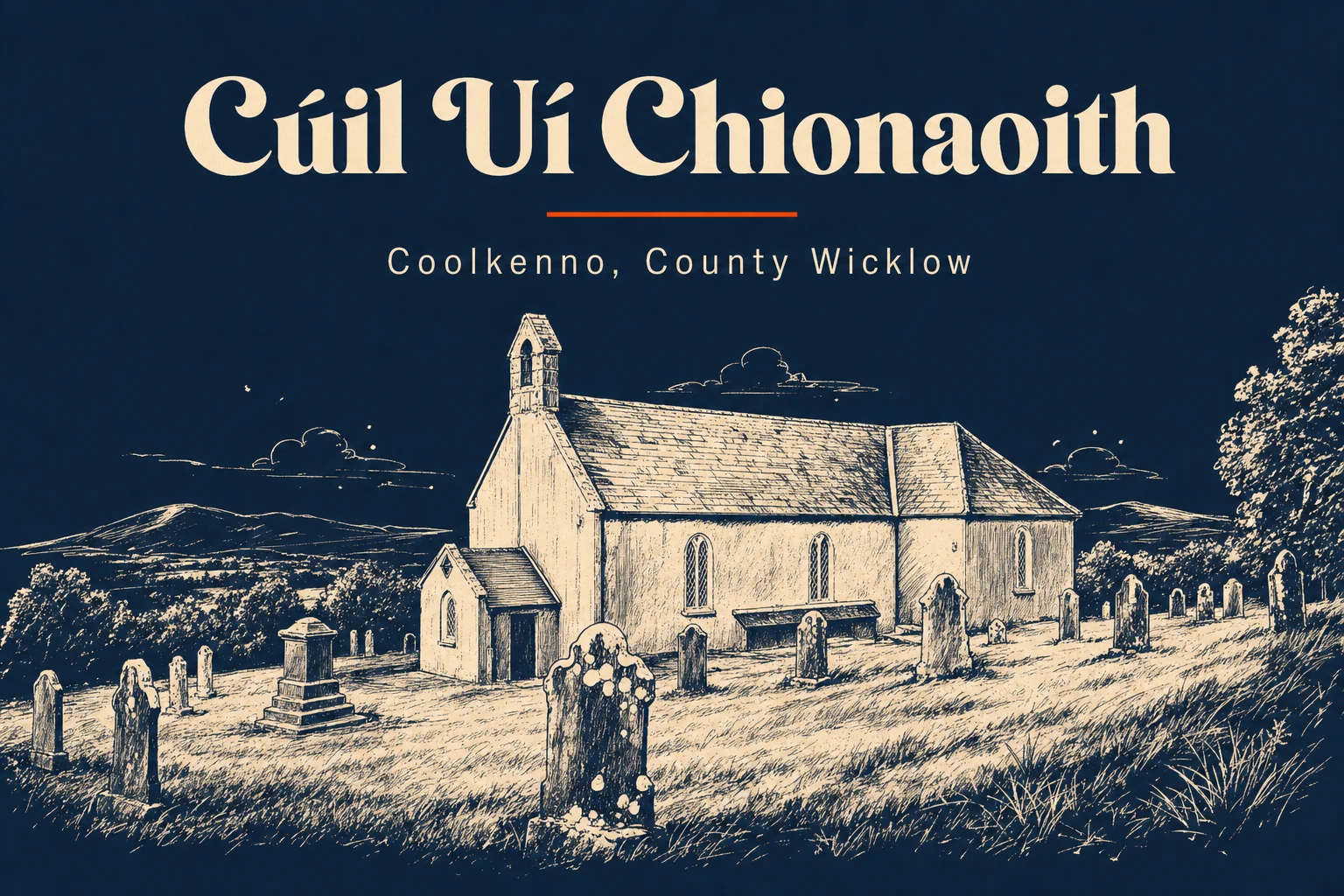
County Wicklow Ireland · Co. Wicklow · Coolkenno Save · Share
POSTED FROM
COOLKENNO
CO. WICKLOW · IE

Coolkenno
Cúil Uí Chionaoith, Co. Wicklow

The Ireland's Ancient East
STOP 06 / 06
Cúil Uí Chionaoith · Co. Wicklow

A scattered south Wicklow townland halfway between Tullow and Shillelagh, with a thousand-year-old church and a Bronze Age hillfort hiding in the fields around it.

Coolkenno is not a village in the way most people mean the word. There is no main street, no row of shops, no square. It is a townland and a scattered farming settlement in the civil parish of Aghowle, in the south-west corner of Wicklow, roughly halfway along the back road between Tullow in Carlow and Shillelagh. The name in Irish is Cúil Uí Chionaoith, the nook of the Uí Chionaoith, an old tribal name worn smooth by a thousand years of use.

What it lacks in a built centre it makes up for in what is buried in the fields around it. A kilometre and a half to the south-west, in a field off the road, stands Aghowle Church - a granite ruin of around 1100 on the site of a monastery said to have been founded by Finnian of Clonard in the sixth century. Up on the hill toward Shillelagh is Rathgall, a Late Bronze Age hillfort that turned out, when archaeologists dug it from 1969 on, to have been one of the busiest metalworking sites in prehistoric Ireland. For a place with no shop, Coolkenno carries an unusual weight of history.

The living settlement is the GAA club, the school run to Ballyconnell, and the farms. Coolkenno GFC was founded in 1980 and merged with Shillelagh in 2010; the parish takes its football seriously. Christabel Bielenberg, who wrote The Past Is Myself about her years in Nazi Germany and her husband's part in the plot against Hitler, spent the second half of her life farming here, from 1948 until her death in 2003. She is buried in the parish.

Come for the drive and the two ancient monuments, not for amenities. The road through Coolkenno toward Kildavin and Tullow is good, quiet south Wicklow, and in autumn the detour earns itself. But this is base-and-explore country: stay in Shillelagh, Tinahely or Tullow, and use Coolkenno for its church and its hillfort.

Population
~562 (Shillelagh rural area, 2006)
Coords
52.7819° N, 6.5961° W
01 / 06

At a glance.

Three things every local will eventually mention. Read these and you've already understood more than most day-trippers do.

02 / 06

Stories & lore.

The reason to come back. The things every local will eventually tell you about, usually after the second pint.

A sixth-century monastery and a granite church of c. 1100

Aghowle Church

Aghowle sits in a field 1.7 km south-west of Coolkenno, near the tributaries of the River Derreen. Tradition holds that Finnian of Clonard - one of the major figures of early Irish monasticism - founded a monastery on the site in the sixth century, with monks living in beehive huts around a wooden church. The granite ruin that survives today dates to around 1100 and was one of the largest rural parish churches of its era, eighteen metres long and over seven wide. The west doorway is lintelled on the outside and arched within, with Romanesque detail; two round-headed windows survive in the east wall under hood mouldings. North-east of the church stands St Finden's Cross, a granite high cross about 2.8 metres tall on a pyramidal base, dated to roughly the tenth century. Beside it is a large pre-Norman granite font, around 130 cm across, whose water was once said locally to cure headaches. The church stayed in use by the Church of Ireland until about 1716. It is open ground, free, and usually empty.

Late Bronze Age metalworking, around 1000 BC

Rathgall hillfort

Rathgall - An Ráth Geal, the bright fort - stands on a low hill near Shillelagh, within reach of Coolkenno. It is a national monument: four concentric ramparts of stone and earth, the outer one enclosing some 7.5 hectares, about eighteen acres. Professor Barry Raftery began excavating it in 1969, and what came out was extraordinary. The site had been a major Late Bronze Age settlement and workshop, turning out bronze axeheads, spearheads and swords, gold and glass beads, and pottery on an industrial scale - over 50,000 pottery fragments were recovered. Radiocarbon dating points to intense activity between about 1200 and 1000 BC. The concentration of evidence has not been matched at any other Irish hillfort. It is a quiet hill with a long view and a deep past; most who pass it have no idea what was made there three thousand years ago.

The author of The Past Is Myself farmed here for fifty years

Christabel Bielenberg's Wicklow

Christabel Bielenberg was an Englishwoman who married a German lawyer, Peter Bielenberg, lived through the Third Reich in Berlin and the Black Forest, and watched her husband be arrested for his part in the July 1944 plot to kill Hitler. Her memoir of those years, The Past Is Myself, became a classic and was filmed by the BBC as Christabel. After the war the Bielenbergs came to Ireland and bought a farm at Coolkenno, where they lived from 1948 until their deaths in the early 2000s - Christabel in 2003. She wrote a second volume, The Road Ahead, about the Irish years. For half a century one of the great memoirists of wartime Europe was a south Wicklow farmer, and the parish was simply home.

03 / 06

Things to do outside.

Wear waterproofs. Bring a sandwich. Tell someone where you're going if it's the mountain.

Aghowle Church The ruined granite church, high cross and ancient font, 1.7 km south-west of the Coolkenno crossroads. Park on the verge and walk in across the field - it is open ground, no facilities, often empty. Boots after rain. Worth twenty minutes for anyone with an interest in early Irish churches.
Short field walk from the roaddistance
20-30 minutestime
Rathgall hillfort The Late Bronze Age hillfort near Shillelagh, signposted off the local roads. A walk up to the concentric ramparts and a long view over south Wicklow and the Carlow border country. Working farmland around it - keep to the path, mind stock and gates. No visitor centre; come knowing the story.
Short uphill walk to the rampartsdistance
45 minutes to 1 hourtime
Tomnafinnoge Woods Not at Coolkenno but a short drive away between Shillelagh and Tinahely - the last surviving fragment of the great oak forests of Shillelagh, a Special Area of Conservation. Four marked trails through ancient oak, deer often about. The nearest proper woodland walking, and the best of it in spring and autumn.
Four waymarked trails, 1.3 km to 3.2 kmdistance
30 minutes to 1.5 hourstime
04 / 06

When to go.

There is no bad time. There are different times.

Spring
Mar-May

The south Wicklow farmland greens up and the back roads are quiet. Bluebells in Tomnafinnoge a short drive away. Good light for the walk in to Aghowle.

◉ Go
Summer
Jun-Aug

Long evenings and dry ground for the field walk to the church and the climb to Rathgall. This corner of Wicklow sees a fraction of the traffic that hits Glendalough and the coast.

◉ Go
Autumn
Sep-Oct

The best time. October light on the Tullow road and the south Wicklow hills, the oaks at Tomnafinnoge turning, the monuments to yourself. The detour earns itself in autumn.

◉ Go
Winter
Nov-Feb

Short days and muddy fields. The monuments are still there and still free, but the walk in to Aghowle can be wet underfoot and there is nowhere indoors to shelter. Fine if passing; not a reason to travel.

◐ Mind yourself
05 / 06

What to skip.

Honestly? Don't bother.

If a local was sitting beside you, this is the bit where they'd lean in.

×
Looking for a village centre

There isn't one. Coolkenno is a townland and a scattered settlement - a crossroads, a church, a GAA pitch and farms. No main street, no shop, no pub in the centre. Come for the monuments and the drive, and base yourself in Shillelagh, Tinahely or Tullow.

×
Expecting facilities at the monuments

Aghowle Church and Rathgall are open ground on working farmland - no car park, no signage to speak of, no centre, no toilets. Park sensibly on the verge, wear boots, mind gates and stock, and read the history before you arrive.

×
Driving past Aghowle without stopping

From the road the church is a low grey ruin in a field, easy to pass. It is a thousand years old, on the site of a sixth-century monastery, with a high cross and a pre-Norman font beside it. Twenty minutes on foot is the whole point of coming.

+

Getting there.

By car

Tullow (Co. Carlow) to Coolkenno is about 15 minutes east on local roads via Kildavin. Shillelagh is around 10 minutes north-east, Tinahely about 15 minutes north. Dublin is roughly 1 hour 30 minutes via the M9/N81 or the N11 and across. A car is the only practical way in - the roads are quiet and unsignposted in places.

By bus

No useful scheduled service through Coolkenno itself. TFI Local Link covers parts of south Wicklow and the Carlow border infrequently; check locallinkckw.ie. For all practical purposes this is car country.