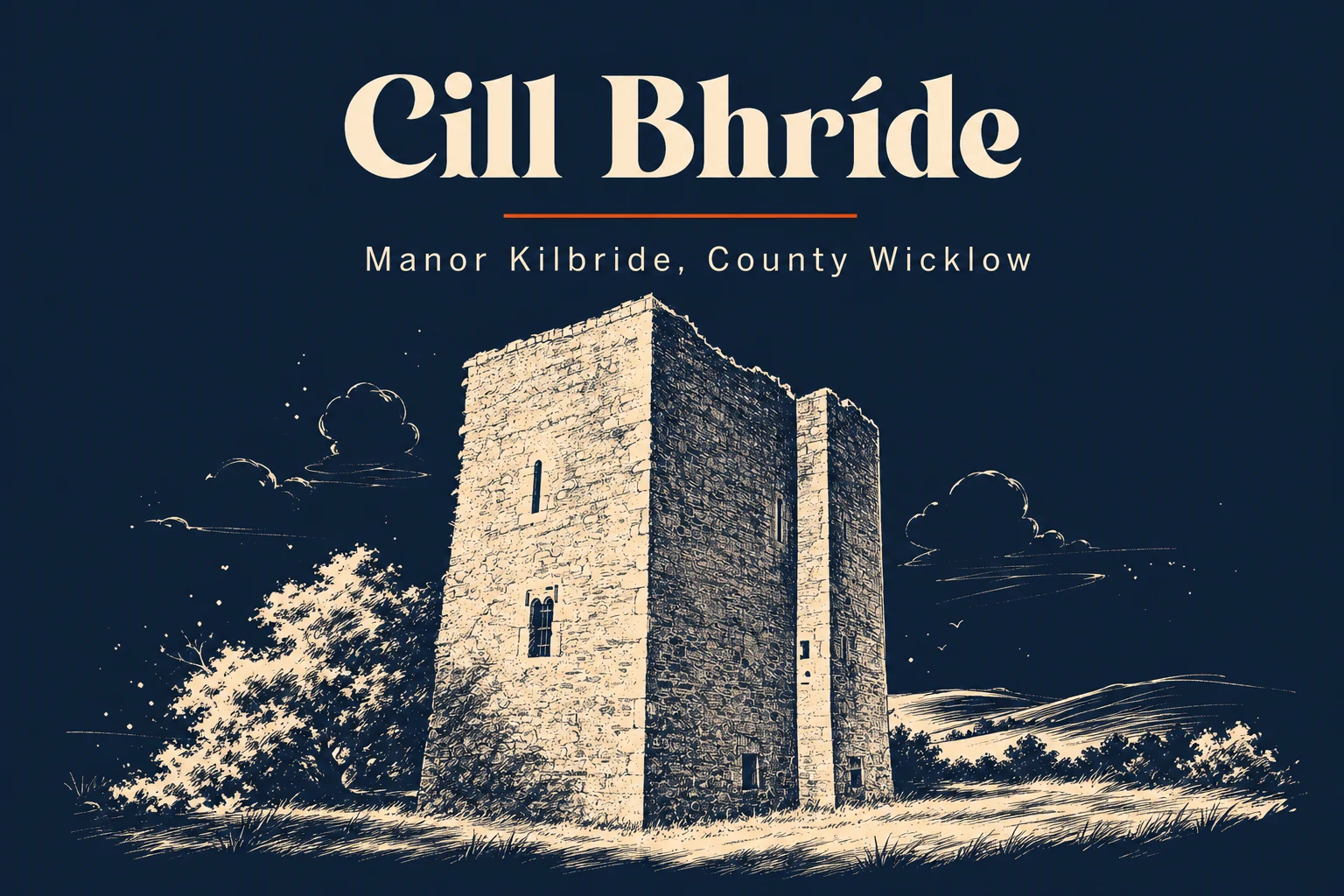
Cill Bhríde · Co. Wicklow
The first settlement on the young River Liffey, in a green valley below Kippure at the western edge of the Wicklow Mountains. A scattered country parish, not a tourist village.
Manor Kilbride is barely a village in the way most people mean the word. It is a church, a graveyard, a scatter of houses and a former school, set in a valley at the western foot of the Wicklow Mountains where the Brittas River runs into the young Liffey. The civil parish counted under a thousand people at the last full reckoning, spread across a lot of hill country. There is no main street to walk. There is a river, a bridge, and a great deal of sky.
The name carries its own history. Cill Bhríde means the church of Brigid, and a church here was recorded as Kylbryde in 1291, when west Wicklow was dense forest held by the Archbishop of Dublin and the lordship of Kilbride belonged to the Knights Hospitaller at Kilteel. The Manor was bolted on in 1824, when George Ogle Moore, a Dublin barrister and MP, bought the estate and commissioned a Tudor Revival house from the architect Thomas Cobden. The Moore family held the place into the 1950s. The Catholic chapel went up in the village in 1776, was enlarged in 1835, and was replaced by the present church in 1881.
Come for the country, not for a day out. The Liffey rises in the bog on Kippure a few kilometres east and reaches this valley as a real river for the first time. Above the village, Seefin carries a passage tomb built around 3,300 BC - a stone cairn on a bare summit with a chamber you can still get into, no fence, no ticket office, just a steep climb and a long view. The R759 climbs east out of the valley toward the Sally Gap and the Military Road, one of the great high mountain drives in Leinster. Blessington and its lakes are ten minutes south. Most people see none of it because they take the N81 and never turn off.