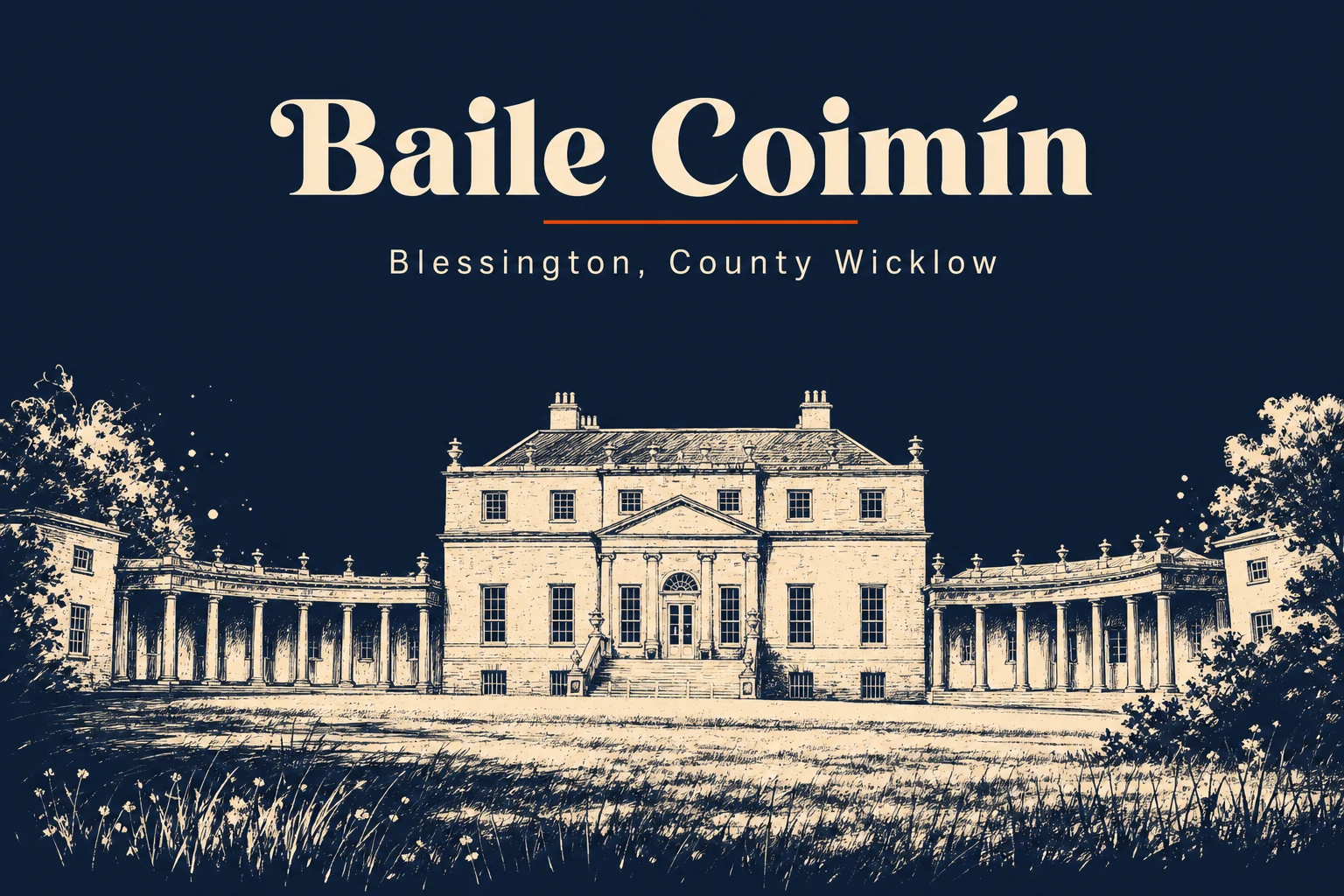
Baile Coimín · Co. Wicklow
A wide-streeted market town beside a reservoir that drowned three villages in 1940. The nearest Palladian mansion was robbed four times.
At ten o'clock on the morning of 3 March 1940, water began rising in the Liffey valley below Blessington. The ESB had dammed the river at Poulaphouca to feed a new hydroelectric station, and in the two years before, 76 houses had been demolished and three bridges blown up to prepare for the flood. The village of Ballinahown went under. So did most of Poulaphouca village, several thousand acres of farmland, a 12th-century stone cross - later moved to a Blessington cemetery - and a waterfall that had been one of the scenic landmarks of Wicklow. The reservoir that formed is now the largest artificial lake in Ireland. It supplies most of Dublin's water. Nobody consulted the seventy-odd families who had lived in the valley before it filled.
Three kilometres south of town, and visible from the reservoir's western shore, stands Russborough House. Richard Cassels designed it between 1741 and 1755 for Joseph Leeson, who would become the 1st Earl of Milltown. The frontage runs to 210 metres. The ceiling plasterwork in the saloon was done by the Lafranchini brothers, who also worked at Powerscourt. Four paintings by Claude-Joseph Vernet - Morning, Midday, Sunset, Night - were commissioned for the drawing room in the 1750s and have never left it. In 1952, a mining heir called Sir Alfred Beit bought the house to put his art collection in it. The collection included a Vermeer, a Goya, two Gainsboroughs, works by Rubens, Velázquez, Murillo, and Sargent. It was one of the best private collections in Europe. Then it was robbed.
The first robbery was on 26 April 1974. Rose Dugdale, daughter of a British millionaire and Oxford PhD turned IRA operative, knocked on the side door with a story about car trouble. Her gang entered around nine in the evening, tied up the staff and the Beits, and left with nineteen paintings including the Vermeer and three Rubens. They wanted to exchange them for the release of two IRA prisoners. The paintings were recovered; Dugdale was jailed. In May 1986, Martin Cahill - the General - did it differently. His crew set off the alarm, retreated into the bushes, waited until the gardaí had come and gone, then went back in. Six minutes to take eighteen paintings. Cahill demanded £20 million for the Vermeer. Nobody paid. Most of the paintings were eventually recovered. The house was robbed again in 2001, and again in 2002. Four times in twenty-eight years. In 1987, the Beit Foundation donated seventeen of the finest paintings to the National Gallery of Ireland, where they are considerably harder to steal. The Vernet paintings stayed.
The town itself is a straightforward west Wicklow market town, bigger than it looks on a map - 5,620 people by the last census, double what it was in 2002 - with a wide main street, a couple of decent pubs, and the Route 65 Dublin bus running from Poolbeg Street in about ninety minutes. It is not a village that has dressed itself up for visitors. The reason to come is the reservoir walk and Russborough, and those are reason enough.