County Antrim Ireland · Co. Antrim · Belfast Save · Share
POSTED FROM
BELFAST
CO. ANTRIM · IE

Belfast
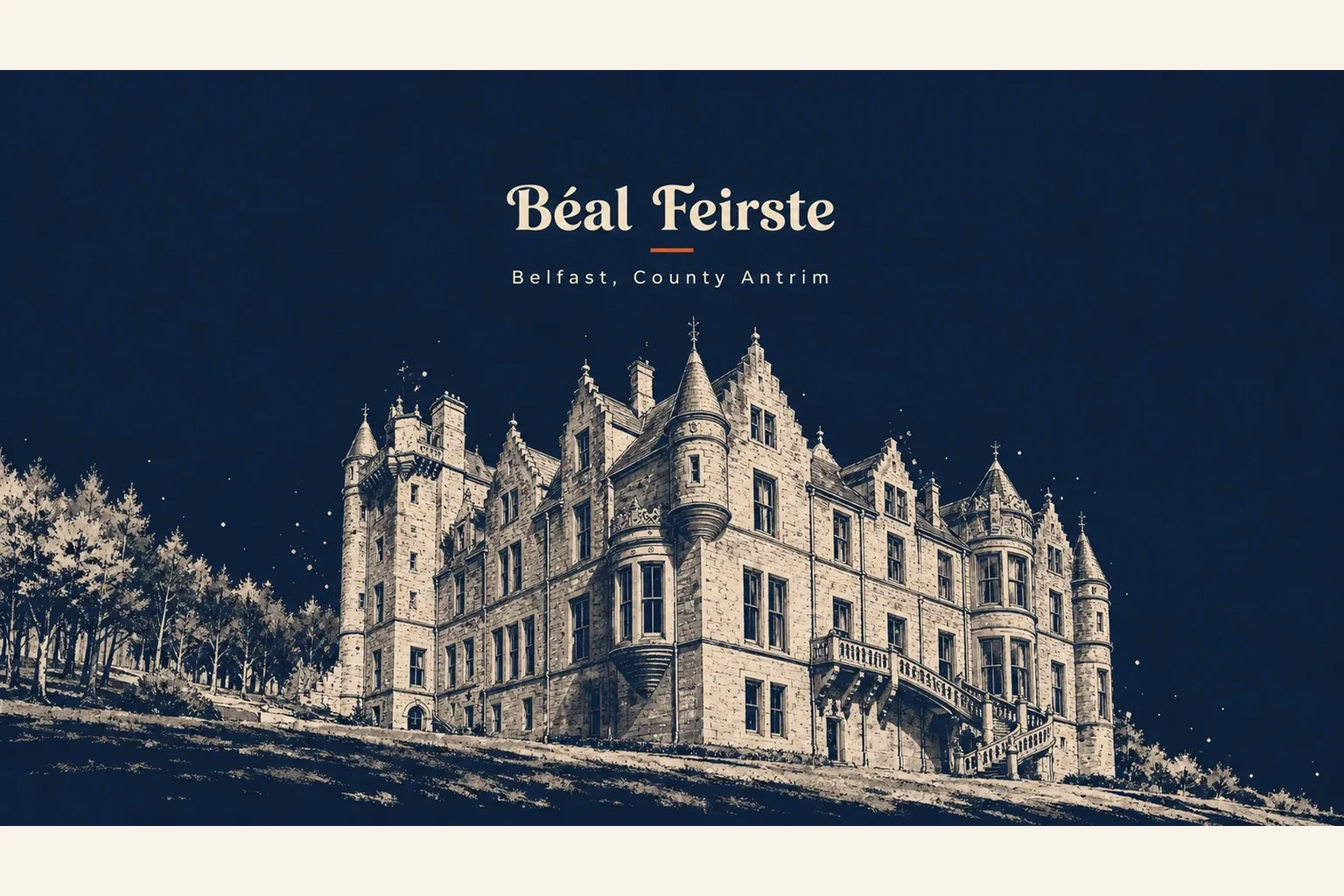
Béal Feirste

The Belfast
STOP 01 / 06
Béal Feirste · Co. Antrim

Linen, ships, the Troubles, the recovery. A city that never quite stops explaining itself.

Belfast is built on a sandbar at the mouth of the Lagan — Béal Feirste, the mouth of the sandbanks — where the river ran into Belfast Lough between two counties. It still sits on two counties: the city centre is County Antrim, the east of the river is County Down, and nobody who lives here pays the slightest attention to where the line falls. The line that mattered was always the one between the Falls and the Shankill, and that one is on every map.

The 19th century made the city. Linen first — by 1868 the place was being called Linenopolis, and by 1871 there were 78 mills running and 43,000 people in them. Then ships. Harland & Wolff opened on Queen's Island in 1861 and by the early 1900s were building the biggest ocean liners on earth. The Titanic was launched here on 31 May 1911. It still feels strange to write that sentence in the present tense, in a city that has not stopped processing what came after.

The 20th century broke the city and then patched it back together. The Troubles ran from 1969 to the Good Friday Agreement in 1998 — three decades, roughly 3,500 dead, the Europa Hotel bombed 33 times and never closed. The peace held. The city has changed faster in the twenty-five years since than in the hundred before. The Cathedral Quarter has bars in old bonded warehouses. The Titanic Quarter has a £97 million museum on the slipway. The peace walls are still there.

Don't come for a checklist. Come for a long weekend. Walk Cave Hill on a clear morning, drink in the Crown at Friday lunchtime, take a black taxi tour with a driver who lived through it, eat in the Cathedral Quarter, and leave a day for the coast — Carrickfergus is twenty minutes north, the Causeway an hour and a bit. The city explains itself slowly. Give it the time.
Population
~352,000 (city), ~672,000 (metro)
Walk score
City centre walkable end-to-end in 25 minutes
Founded
Charter 1613; castle 1611
Coords
54.5973° N, 5.9301° W
01 / 09

At a glance.

Three things every local will eventually mention. Read these and you've already understood more than most day-trippers do.

02 / 09

The pubs.

None of these are themed Irish pubs, because they don't need to be. A few that earn the trip:

The Crown Liquor Saloon

Tourists welcome, locals tolerate it
Victorian gin palace, Great Victoria Street

Owned by the National Trust since 1978, leased to a Nicholson's. The tilework, the snugs, the gas-lit feel — all real, all properly restored. Get a snug if you can. The pub is across the road from the Europa.

Kelly's Cellars

Vaulted, cluttered, trad sessions
Pub since 1720, Bank Street

Where Henry Joy McCracken and the United Irishmen plotted the 1798 rising. Low ceiling, old whitewash, a stout poured the way a stout should be poured. Trad sessions most weekends.

White's Tavern

Old alley, working pub
Tavern licence 1630, Winecellar Entry

First tavern licence in Belfast was for this address. Down a narrow entry off High Street. The garden out the back was added in 2020 and is the easiest place in town to find a seat at the weekend.

The Sunflower

Cage on the door, music inside
Pub & live music, Union Street

The security cage on the front door is from the Troubles — the building was sprayed with gunfire in 1988. The cage stays as a piece of the city's social history. Inside it is one of the friendliest rooms in Belfast.

The Duke of York

Cobbled alley, packed late
Pub, Commercial Court (Cathedral Quarter)

On a cobbled alley off Hill Street, mirrored whiskey bar, music Thursday to Sunday. Gerry Adams worked behind the bar here as a young man, which is the kind of thing the wall framing will tell you.

McHugh's

Tourists, three floors, food
Bar in one of the city's oldest buildings

Building dates to around 1711. Three storeys of bar, decent enough, and a useful place to know if the Cathedral Quarter is heaving and you want a corner.

03 / 09

Where to eat.

PlaceTypeLocal note
OX Restaurant, one Michelin star, Oxford Street £££ Stephen Toman's place, Michelin star since 2016, looking out at the Lagan. Three-course lunch around £55, tasting menu around £90. Belfast's headline-act dinner. Book weeks ahead.
The Muddlers Club Restaurant, one Michelin star, Cathedral Quarter £££ Gareth McCaughey's place, tucked between Waring Street and Exchange Place, Michelin-starred since 2020. Tasting menu only at dinner. Named for a 1790s United Irishmen drinking club that met on the same lane.
Mourne Seafood Bar Seafood, Bank Street ££ Their own oyster beds in Carlingford. Sit downstairs for chowder and oysters, upstairs for the proper menu. Right beside Kelly's Cellars, which is convenient.
St George's Market Covered market, May Street £ Fri 8–2, Sat 9–3, Sun 10–3. Built in the 1890s. The Saturday food market is the one to hit — coffee, sourdough, soda farls, a dozen places doing a breakfast bap. Live music on Sundays.
Taylor & Clay Wood-fired grill, Bullitt Hotel, Church Lane ££ The Bullitt's restaurant, open kitchen built around an Asador grill. Steak and a glass of red and you are sorted. Quicker to get into than OX.
04 / 09

Where to sleep.

PlaceTypeLocal note
The Merchant Hotel Five-star hotel, Cathedral Quarter, Waring Street The old Ulster Bank head office, built 1858–1860, opened as a hotel in 2006. Sandstone façade, dome over the Great Room dining room, the kind of bar that takes itself very seriously. Belfast's grand-hotel option.
Bullitt Hotel Boutique hotel, Church Lane 74 small, well-kitted rooms in an 1850s building in the Cathedral Quarter. No-nonsense brief, decent grill restaurant downstairs, rooftop bar upstairs. Walk-everywhere location.
Europa Hotel Hotel, Great Victoria Street Famous for being bombed 33 times during the Troubles and never closing. Opened 1971, still going. Across from the Crown. A piece of the story as much as a place to sleep.
Titanic Hotel Belfast Hotel, Titanic Quarter In the old Harland & Wolff drawing offices where the Titanic was actually designed. Original drawing tables in the public rooms. Fifteen-minute walk from the city centre, on the slipway side of the river.
Malmaison Belfast Hotel, Victoria Street Two old seed warehouses converted; theatrical interiors; useful mid-range price point in the centre. Fine for a weekend that is mostly spent out of the room.
05 / 09

Stories & lore.

The reason to come back. The things every local will eventually tell you about, usually after the second pint.

Built and launched here

The Titanic

Harland & Wolff opened the Queen's Island yard in 1861 and by the turn of the century were building the biggest ships on the planet for the White Star Line. The RMS Titanic was launched at 12:15pm on 31 May 1911 in front of a crowd of about 100,000. She sailed for Southampton the following spring, hit an iceberg on her maiden crossing, and the city has been arguing with that fact ever since. The Samson and Goliath cranes that still loom over the slipway are not the originals — they were put up in 1969 and 1974 — but the dry dock and the Drawing Offices are. The Titanic Hotel sleeps you in those Drawing Offices now.

1969 to 1998

The Troubles

Civil-rights marches in 1968 turned into civil unrest in 1969, the British Army was deployed in August of that year, and what followed was thirty years that killed roughly 3,500 people across Northern Ireland. The Falls Road and the Shankill Road run parallel half a mile apart in west Belfast. The first peace walls went up in 1969 as a temporary measure. There are still around a hundred of them, depending on what you count. The Good Friday Agreement was signed on 10 April 1998 and approved by referendum the following month. The peace held. The walls did not come down. The city is still working out what to do with that.

A world capital, briefly

Linenopolis

Belfast in 1808 had 25,000 people; by 1911 it had 385,000. Linen did most of that. James Kay's wet-spinning patent in 1825 made fine flax yarn possible, and within forty years half the linen produced in Ireland came out of Belfast mills. By 1871 there were 78 mills employing 43,000 workers, almost all of them women. The Linen Quarter south of the City Hall is named for the warehouses that sold the cloth on. The mills are mostly converted now, but the brick is everywhere if you start looking.

Westeros, with a Belfast accent

Game of Thrones

All eight seasons of HBO's Game of Thrones were shot out of Titanic Studios on the Lagan, between 2010 and 2019. The Throne Room, the Red Keep interiors and most of the indoor work happened on those soundstages. You can't visit the studio itself, but the Glass of Thrones trail is six stained-glass windows along the Titanic Quarter, free to walk, and the proper Studio Tour is at Linen Mill Studios in Banbridge — half an hour south, set against the original Winterfell Great Hall and Castle Black sets.

06 / 09

Things to do outside.

Wear waterproofs. Bring a sandwich. Tell someone where you're going if it's the mountain.

Cave Hill to McArt's Fort Park at Belfast Castle, climb the path, follow signs to McArt's Fort — the cliff known as Napoleon's Nose because it does in fact look like one. From the top: the whole city, the Lough, and on a clear day Scotland. Said to have inspired the giant in Gulliver's Travels. 218m of climb, mostly steady, occasionally steep.
5 km loopdistance
2 hourstime
Lagan Towpath Belfast city centre to Lisburn along the river and the old canal — about 11 miles. Flat, woodland, herons, the odd lock-keeper's cottage. Walk part of it and turn around, or do the lot and get the train back from Lisburn.
18 km one-waydistance
Half a daytime
Titanic Quarter waterfront From the Lagan Weir along the river past Titanic Belfast, the SS Nomadic, the Great Light and the Glass of Thrones windows. Loop back via the Maritime Mile signage. Easy, flat, paved, free.
3 kmdistance
1 hourtime
The Falls and Shankill Walk the Falls Road from the city centre, cut across at Lanark Way to the Shankill, walk back. You will see the murals, the peace walls, the gates that still close at night. Better with a black taxi driver who lived it. Doable on foot if you read the place properly.
5 kmdistance
2 hourstime
07 / 09

When to go.

There is no bad time. There are different times.

Spring
Mar–May

Gardens at Stormont open, Cave Hill green, the rain is intermittent rather than continuous. St Patrick's Day in the city is sober compared with Dublin, which suits some people.

◉ Go
Summer
Jun–Aug

The Twelfth of July is loud, partisan, and a real thing — book accommodation either side. Otherwise the city is at its best in long evenings; festivals run through August.

◐ Mind yourself
Autumn
Sep–Oct

The Belfast International Arts Festival runs late October to early November. Cave Hill in autumn light is one of the better sights in Northern Ireland.

◉ Go
Winter
Nov–Feb

Cathedral Quarter Christmas markets are good. Days are short — sunset can be before 4pm in December. The pubs become themselves again.

◐ Mind yourself
08 / 09

What to skip.

Honestly? Don't bother.

If a local was sitting beside you, this is the bit where they'd lean in.

×
The £25 black taxi tour with the driver who 'wasn't really there'

There are excellent ex-combatant guides on both sides who lived the Troubles. There are also guides who learned the script off YouTube. Read the reviews, ask who you are getting, and pay the local rate, not the bus-tour rate.

×
The Titanic Belfast ground-floor café for lunch

You paid £25 to get in. The café inside is a £14 sandwich. The Saturday food market at St George's is a five-minute walk and a quarter the price.

×
Doing the Cathedral Quarter as a stag-do crawl

It is a small grid of 200-year-old streets with 1,200-year-old paving. Three large groups in matching t-shirts kill it for everyone, including each other. Spread out.

×
The 'authentic Troubles experience' walking tour with replica balaclavas

It is a museum exhibit dressed as a city walk, run by people who weren't here. The Ulster Museum has a properly curated Troubles gallery for free, and the black taxi drivers do the rest.

+

Getting there.

By car

M1 from Dublin is just over 100 miles, 1h 50m at the speed limit, no border infrastructure. Belfast city centre is signposted from every motorway exit. Park at Victoria Square or one of the Q-Park sites — driving the centre is more trouble than it is worth.

By bus

Translink Goldliner from Dublin Airport / Dublin city, hourly, around 2h 15m. Local Translink Metro buses cover the city; the 1A and 2A run the main north and south arteries.

By train

Enterprise from Dublin Connolly to Belfast Grand Central — 2h 5m, hourly most of the day. Grand Central opened in 2024 on the site of the old Great Victoria Street station; ten minutes' walk to the City Hall.

By air

Belfast International (BFS) is 13 miles north, 30 minutes by Airport Express 300. George Best Belfast City (BHD) is 3 miles east, 15 minutes by Airport Express 600. Dublin Airport is 1h 40m by direct coach.