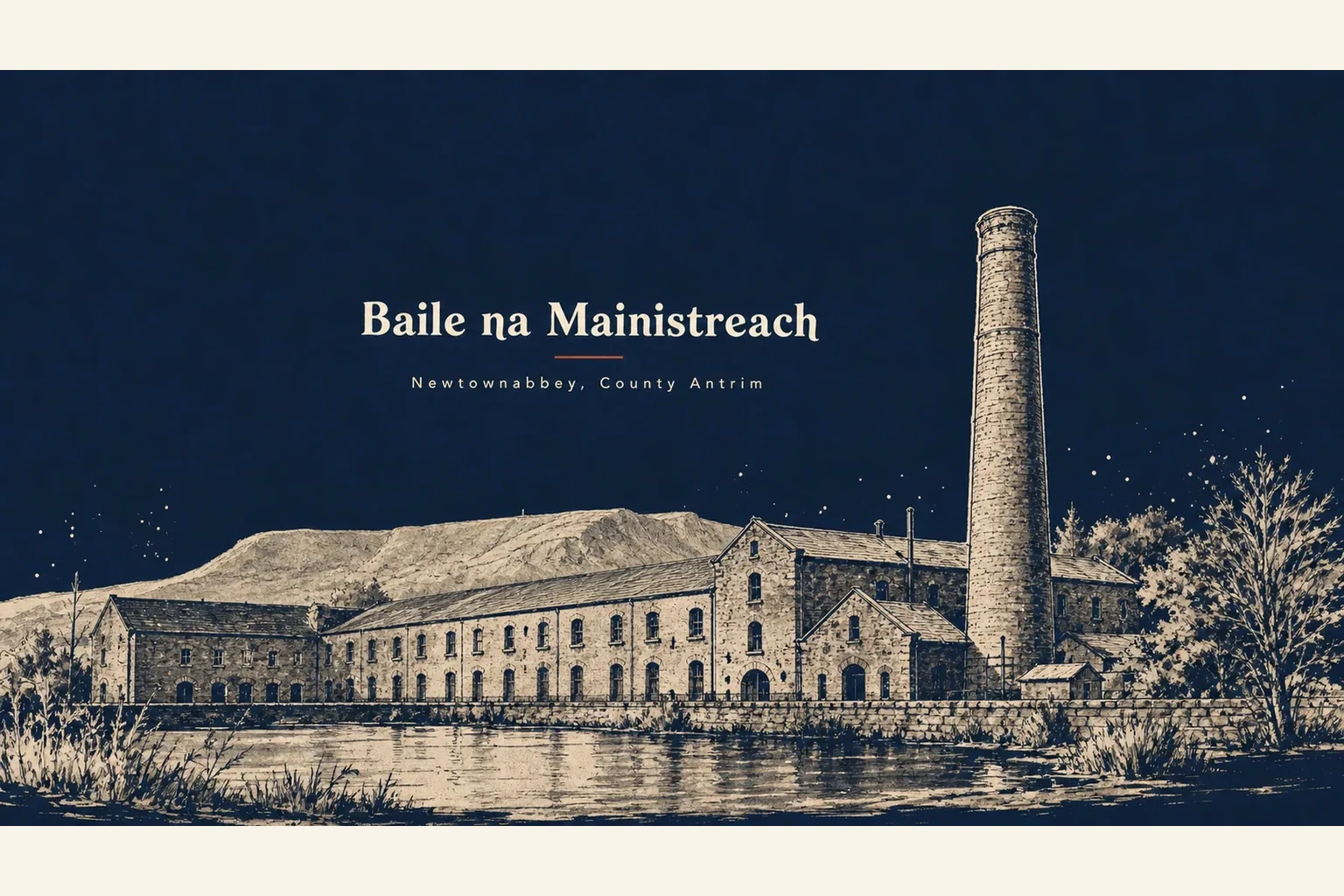
County Antrim Ireland · Co. Antrim · Newtownabbey Save · Share
POSTED FROM
NEWTOWNABBEY
CO. ANTRIM · IE

Newtownabbey

STOP 09 / 09
Newtownabbey · Co. Antrim

A 1958 stitch-together of seven villages on Belfast's northern edge. A place to live, not a place to visit.

Newtownabbey is the third-largest settlement in Northern Ireland and one most visitors have never heard of, which is a fair summary of what it is. It is a commuter belt — the dormitory ring on the north side of Belfast, with a population of around 67,600 spread across an urban sprawl that runs from the lough shore up over the foothills of Cave Hill.

It was assembled rather than founded. On 1 April 1958, under the Newtownabbey Urban District Act, seven separate villages were joined into a single council area: Whiteabbey, Whitehouse, Whitewell, Jordanstown, Glengormley, Carnmoney and Monkstown. That is why the place has no single high street, no town square, no obvious centre. Each old village kept its parish church, its older houses, its name on a road sign; the new town filled in the gaps with housing estates, retail parks, the Abbey Centre and the M2 motorway.

For a visitor, this isn't really a stop. There is no harbour, no castle, no medieval street, no must-walk headland. The pubs and restaurants are good enough but local rather than special. The honest advice is on the skip list below: drive through, or use it as a cheaper bed for a Belfast trip, but don't make it the destination itself. The two things genuinely worth a detour are the walk up the back of Cave Hill and the Three Mile Water river path from Mossley Mill.

Population
~67,600
Founded
1958
Coords
54.6797° N, 5.9100° W
01 / 09

At a glance.

Three things every local will eventually mention. Read these and you've already understood more than most day-trippers do.

02 / 09

The pubs.

None of these are themed Irish pubs, because they don't need to be. A few that earn the trip:

The Bellevue Arms

Loughside, dressy
Pub & restaurant

Out on the Antrim Road on the Glengormley side, with first-floor views over Belfast Lough. More of a dining pub than a drinking one. Locals dress up for it.

The Bureau

Whiteabbey regulars
Village local

On the Shore Road in Whiteabbey. A locals' bar that has outlasted everything around it. Karaoke and live cover bands at weekends.

Knags Bar and Grill

Bistro-style
Bar & grill

On the Antrim Road in Glengormley. A modern bar-restaurant rather than an old pub — cocktails, a long food menu, the kind of place locals book for a 50th.

03 / 09

Where to eat.

PlaceTypeLocal note
The Bellevue Arms Pub dining ££ The reliable Sunday-lunch option for the area. Carvery, fish, steak — done well rather than ambitiously.
Knags Bar and Grill Bistro & bar ££ Bistro plates and grill mains on the Antrim Road. Booking sensible at weekends.
Mill House Café Daytime café £ Inside Mossley Mill's civic centre. Tray-bake-and-soup territory, but the room is the restored mill interior and the riverside path starts at the door.
04 / 09

Where to sleep.

PlaceTypeLocal note
Premier Inn (Newtownabbey area) Budget chain hotel Cheaper than central Belfast and a 15-minute drive into the city on the M2. The reason most overnight visitors end up in Newtownabbey is the room rate.
Self-catering on the Shore Road Apartments & rentals Holiday lets along the lough shore at Whiteabbey and Jordanstown — handy for families wanting kitchens and parking without Belfast prices.
05 / 09

Stories & lore.

The reason to come back. The things every local will eventually tell you about, usually after the second pint.

Seven villages, one stroke of a pen, 1958

A town built by Act of Parliament

Most Irish towns grew out of a crossroads, a monastery or a port over centuries. Newtownabbey was created in a single act on 1 April 1958, when the Newtownabbey Urban District Act (Northern Ireland) 1957 merged the villages of Whiteabbey, Whitehouse, Whitewell, Jordanstown, Glengormley, Carnmoney and Monkstown into a new council area. The name was chosen for the medieval White Abbey at Whiteabbey, the only sliver of pre-19th-century history the area had in common. By the 1970s the population had passed 50,000 and the seven villages had been swallowed by housing estates, dual carriageways and the Abbey Centre shopping mall. The result is a town with no single centre — drive from Glengormley to Whiteabbey and you cross three or four old village edges without ever being told.

A flax mill that became a town hall

Mossley Mill

The mill at Mossley dates to the early 1800s — first a bleach works, then a flax-spinning factory under the Campbell and Barbour families. At its peak it was one of the larger linen mills in south Antrim, supplying yarn to the Belfast trade. It closed in 1995. The borough council bought it in 1996, restored the stone shells of the old buildings and reopened the site in 2000 as the civic centre — council offices in the main mill, the Museum at The Mill in the spinning block, and Theatre at The Mill, a 400-seat venue, in the converted weaving room. It is the rarer case of a Victorian industrial building still being used rather than mothballed.

The university that left

Jordanstown

From the early 1970s until 2022, Jordanstown was a campus town. The University of Ulster's largest site stood on the Shore Road, with around 13,000 students, the engineering and built-environment faculties, and the Sports Institute of Northern Ireland. Teaching moved out in stages and finished in September 2022, when the rebuilt Belfast campus on York Street opened. Most of the Jordanstown buildings are now closed; only the Sports Village — the running track, the swimming pool, the strength facility used by NI's Olympic athletes — is still in regular use. The town is still adjusting to losing the daily flow of 13,000 students.

06 / 09

Things to do outside.

Wear waterproofs. Bring a sandwich. Tell someone where you're going if it's the mountain.

Three Mile Water Park Circular Starts at the car park at Mossley Mill. A boardwalk drops down to the Three Mile Water and follows the river through a wooded valley to the conservation park and back. Easy, flat, dog-friendly. The best of what Newtownabbey has to offer on foot.
3.5 kmdistance
55 mintime
Newtownabbey Way A waymarked cycle-and-walking route from Corr's Corner down through Mossley Mill, along the Three Mile Water, out via Glenavna and onto the lough shore at Whiteabbey. Sustrans Cycle Route 93 signs cover most of it.
~10 kmdistance
2.5–3 hourstime
Cave Hill from the Newtownabbey side Routes up the back of Cave Hill from the Glengormley and Whiteabbey side are quieter than the standard Belfast Castle loop. McArt's Fort at the top — the prow that looks like a sleeping giant from Belfast — is the same destination. Bring a map; the paths are less marked from this approach.
6–8 kmdistance
2–3 hourstime
07 / 09

When to go.

There is no bad time. There are different times.

Spring
Mar–May

Three Mile Water and the Cave Hill paths are at their best — bluebells in the lower woods, dry-ish ground.

◉ Go
Summer
Jun–Aug

Long evenings on the lough shore. Theatre at The Mill runs its summer programme. As good as it gets here.

◉ Go
Autumn
Sep–Oct

Quieter trails, decent weather, colour on the river path. The town is more comfortable than it is in summer heat.

◉ Go
Winter
Nov–Feb

Not much reason to come unless you live here or you're cheap-bedding for Belfast. Cave Hill paths get slippery.

◐ Mind yourself
08 / 09

What to skip.

Honestly? Don't bother.

If a local was sitting beside you, this is the bit where they'd lean in.

×
Coming to Newtownabbey as a destination

It isn't one. It's a commuter town with no centre, no harbour, no castle and no headland. If you have one day in Antrim, spend it almost anywhere else on this coast.

×
Looking for the 'old town' or main square

There isn't one. Newtownabbey was built by amalgamating seven separate villages in 1958. Each old village has its own crossroads; the town itself has no centre.

×
Visiting the Ulster University Jordanstown campus

It closed for teaching in September 2022. The main buildings are largely unused. Only the Sports Village is still in operation.

×
Driving the Antrim Road for the scenery

It is the A6 commuter route into Belfast. The actual scenic coast road — the Antrim Coast Road — starts at Larne, twenty miles further north.

+

Getting there.

By car

On the M2 from Belfast — Glengormley and Whiteabbey are both about 15 minutes from the city centre off junctions 4 and 2. From Larne and the coast road, the A8 comes down through Ballyclare and Corr's Corner.

By bus

Translink Metro services run from Belfast city centre out the Shore Road and the Antrim Road into Whiteabbey, Jordanstown and Glengormley every few minutes through the day.

By train

NI Railways' Larne Line from Belfast Grand Central stops at Whiteabbey and Jordanstown. About 15 minutes from the city.

By air

Belfast International is 20 minutes by car on the M2. Belfast City Airport is around 20 minutes via the A2.