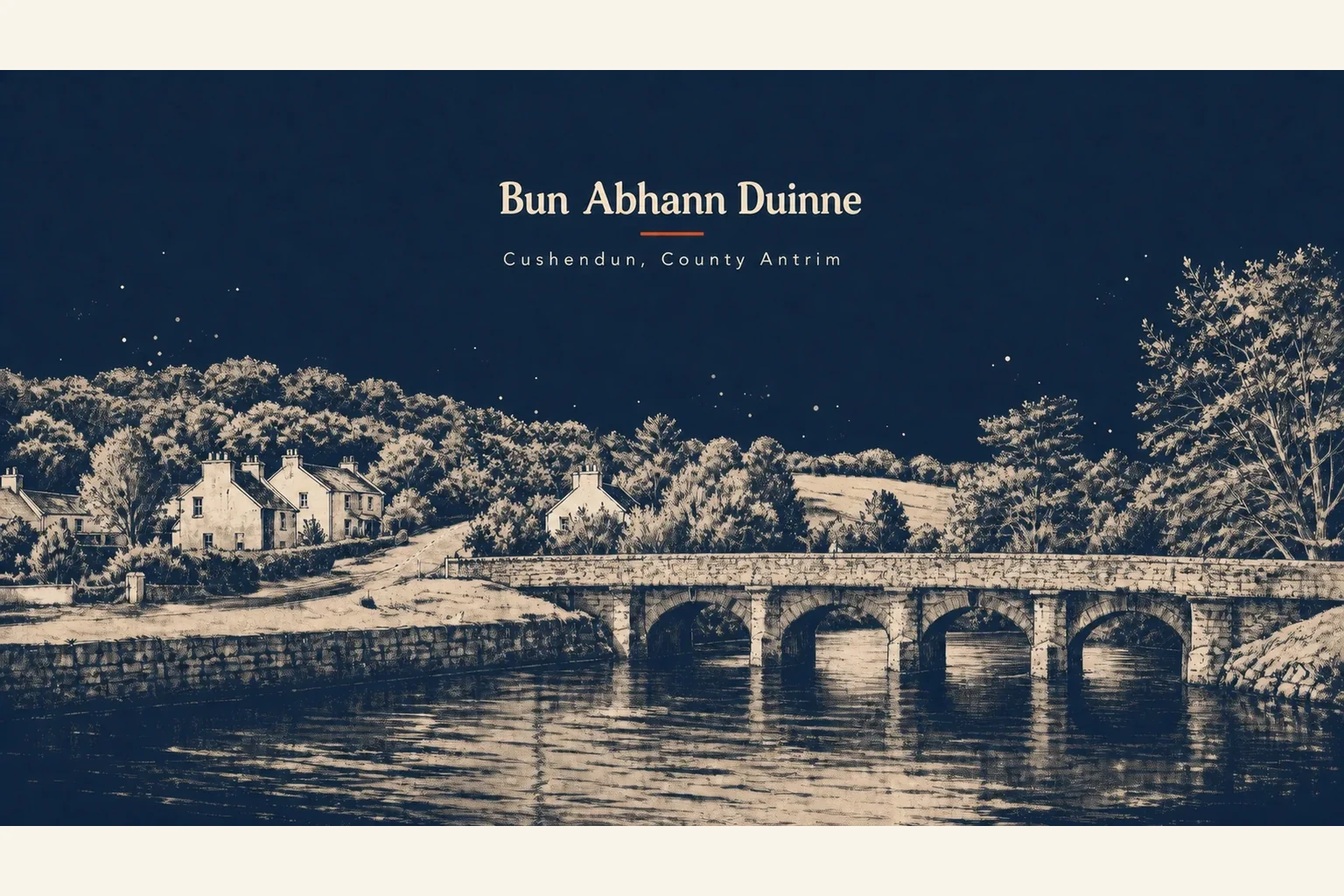
Bun Abhann Duinne · Co. Antrim
A Welshman built a Cornish village in an Irish glen for a Penzance wife.
Cushendun is a hundred and fifteen people in a village designed for a different country. In 1912 Ronald McNeill - later Lord Cushendun, the Conservative MP and Glenmona House owner - hired the Welsh architect Clough Williams-Ellis to lay out the place in the style of a Cornish fishing village. Williams-Ellis would later go on to build Portmeirion in north Wales, the small Italianate village where The Prisoner was filmed. Cushendun was an earlier and quieter rehearsal. The point of the Cornish look was a tribute to McNeill's wife Maud Bolitho, who came from Penzance and was homesick. The whitewashed terraces, the slate, the slightly-too-formal square - none of it is local. All of it has been here long enough now that it is.
The National Trust took on most of the village in 1954 and has had it since. That is the reason it still looks the way it looks: no shopfronts shouting, no extensions in the wrong materials, no holiday-let conversions with the wrong windows. Glenmona House sits behind it. The Maud Cottages, the five-house terrace built in 1926 after Maud's death, are at one end. There is a square. There is a bridge. There is a beach. There is a pub. That is most of the working list.
What people come for now, mostly, is the caves. Red sandstone sea caves at the south end of the beach, formed over four hundred million years, used in the second season of Game of Thrones for the scene where Melisandre gives birth to the shadow assassin. The caves came back in season eight for Jaime and Euron Greyjoy. The village has lived with it. The cave is still a cave. Walk to it before the coaches arrive - it is five minutes from the bridge - and it does what caves do.