Lacada Point, 26 October 1588
La Girona
The Girona was a galleass — a hybrid of galley and galleon — separated from the Spanish Armada off the west coast of Ireland and limping east along the Ulster shore. She had taken on survivors from two other wrecked Armada ships and was crammed with maybe thirteen hundred men, headed for Scotland. In a storm on the night of 26 October 1588 her rudder failed and she struck the rocks at Lacada Point, a couple of miles east of Portballintrae. Nine men reached the shore. The bodies and the cargo lay on the seabed for nearly four hundred years. In 1967 the Belgian diver Robert Sténuit — sometimes called the world's first aquanaut — located the wreck off Port-na-Spaniagh, the small bay east of the harbour. Over the 1967 and 1968 seasons his team raised gold rings, gem-set crosses, a salamander pendant, ducats, cannon. It is the largest hoard ever recovered from an Armada wreck. The whole collection is in the Ulster Museum in Belfast. It is worth the trip.
1883–1949, the world's first hydroelectric tramway
The Bushmills tram
From 1883 a narrow-gauge electric tram ran between Portrush and Bushmills, and from 1887 onward all the way to the Giant's Causeway. It was the first long electric tramway in the world and the first tram system anywhere powered by hydroelectricity — the engineer William Traill drove it off the River Bush at Walkmills. The line ran along the cliff above Portballintrae, with a stop called Port Hedge where a path led down into the village. The tram closed at the end of the 1949 season. The path it ran on through the dunes is now part of the Causeway Coast Way, and a replica narrow-gauge train runs the Bushmills end of the route in summer. The original cars are in the Ulster Transport Museum.
A landing for Dunluce
The harbour
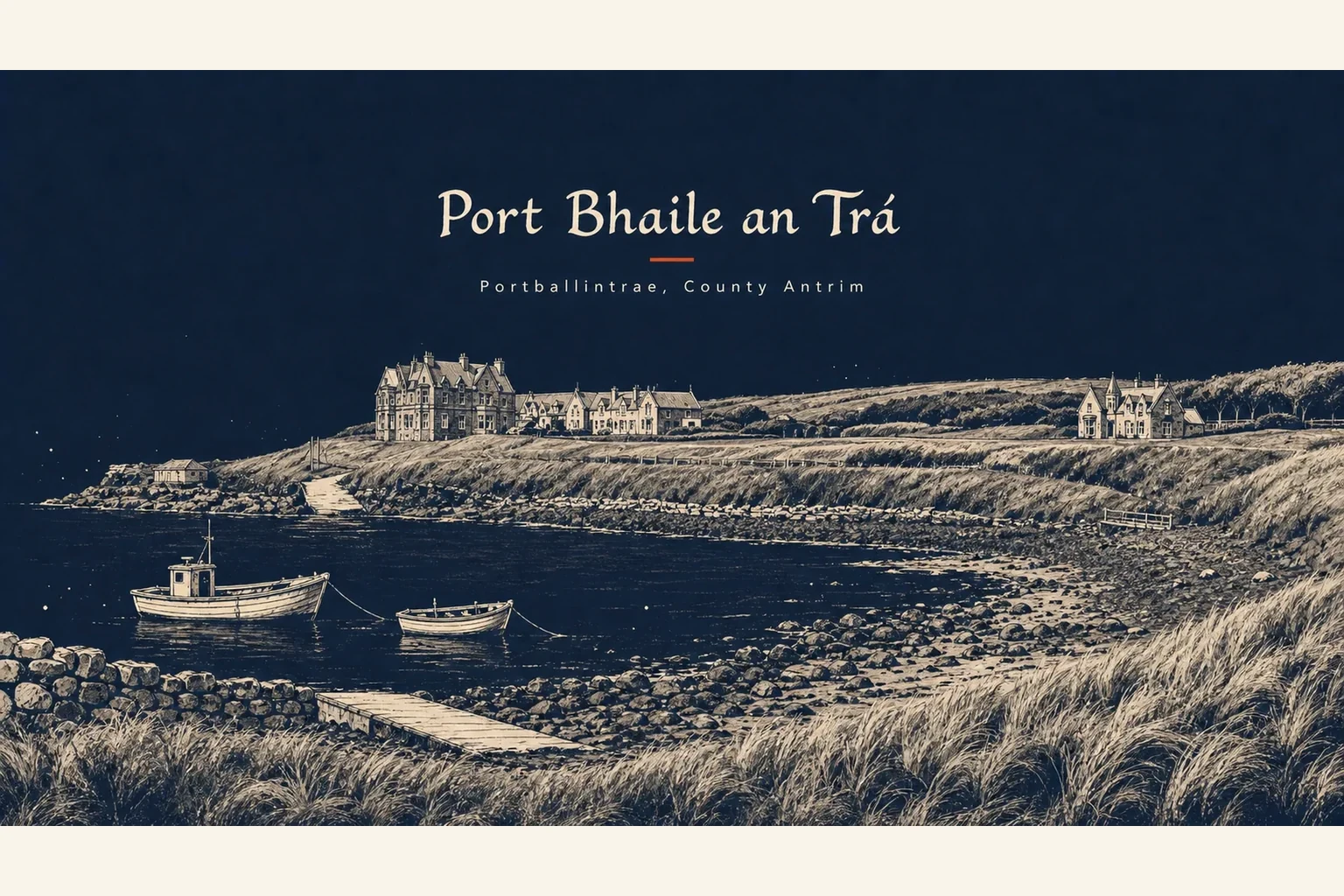
Portballintrae is older than it looks. In the 1600s it had its own customs house, serving the MacDonnell castle and town at Dunluce. The harbour was the closest landing place on this stretch of coast. When Dunluce was prospering as a market town, Scottish merchants came across from the Mull of Kintyre and settled here. The horseshoe bay is the same shape it was then. The coastguard station up on the hill went up in 1874. Seaport Lodge — known locally as Leslie's Castle — was built in the 1770s by the Leslie family as a sea-bathing lodge. Read the buildings round the bay and most of the village's history is there in the stone.