County Armagh Ireland · Co. Armagh · Maghery Save · Share
POSTED FROM
MAGHERY
CO. ARMAGH · IE

Maghery
An Machaire

The Ireland's Ancient East
STOP 06 / 06
An Machaire · Co. Armagh

Where the Blackwater meets Lough Neagh — and a wooded island a kilometre offshore holds eight thousand years of stories.

Maghery is a small village on the south-west corner of Lough Neagh, where the River Blackwater finishes its run and empties into the lake. A few hundred people live here. The Ordnance Survey Memoirs of 1835 describe sixteen one-storey thatched houses scattered along the shore and called it a fishing village. The houses have changed; the description hasn't really.

The lake in front of the village is the largest in Ireland and the largest in Britain — about 383 square kilometres of fresh water, shallow as a soup plate, and the source of more than forty per cent of Northern Ireland's drinking water. It also holds Europe's biggest commercial eel fishery. The fishermen's co-op is headquartered up at Toome on the Antrim shore, but the boats and the families work the whole lake, and Maghery is one of the historic shore villages the trade was built out of.

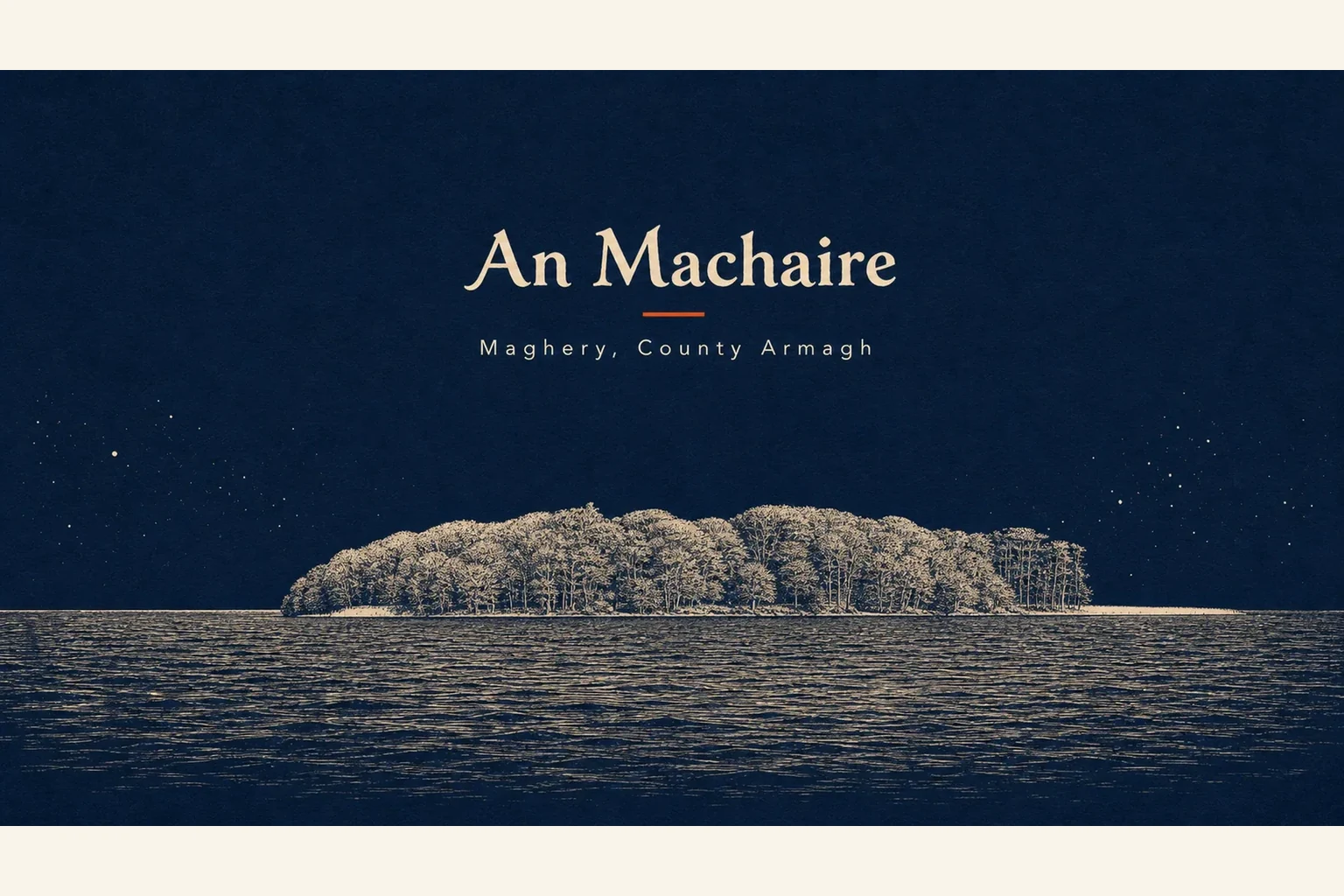
A kilometre offshore sits Coney Island — nine wooded acres with eight thousand years of human story under the trees. Mesolithic flints, a Norman motte, a 16th-century stone tower built by Shane O'Neill as a treasure store, a viscount's tomb. The National Trust owns it; the council manages it; a single caretaker lives on it. Boats run from the Country Park jetty at weekends from late spring to early autumn.

What you come for is the lake itself. The Country Park, the jetty, the canoe trail, the path along the Blackwater, the slow strange feeling of a horizon of water in the middle of Ulster. There's no hotel and no real restaurant. Bring a flask. Take your time.
Population
A few hundred
Walk score
Park gate to jetty in five minutes
Coords
54.4933° N, 6.5417° W
01 / 06

At a glance.

Three things every local will eventually mention. Read these and you've already understood more than most day-trippers do.

02 / 06

Stories & lore.

The reason to come back. The things every local will eventually tell you about, usually after the second pint.

8000 BC to now

Coney Island

The original Irish name is Inis Dabhaill — island of the Blackwater — because it sits opposite the river mouth. Excavations in 1962–63 found Mesolithic flints from around 8000 BC, a Neolithic settlement that ran into the Bronze Age, a 13th-century Anglo-Norman motte, and a 16th-century stone tower. The tower is the one Shane O'Neill built in the mid-1500s as a lookout and a place to stash treasure. The island fell to the English in 1567 when it was handed over to Lord Deputy Sir Henry Sydney — for a while it was even called Sydney's Island. In the 1890s the 7th Viscount Charlemont bought it, and when he died in 1913 he was entombed in O'Neill's tower. The National Trust owns it now.

The legend

St Patrick on the island

The story is that Patrick used to walk out to the island across a ford — later called St Patrick's Road — to think and pray. There's a stone on the island known as St Patrick's Stone, said to be where he sat. None of it is provable in the way an excavation is provable. But the island has been a quiet place to sit and think for a very long time, and that part is plain to anyone who goes there.

Europe's largest wild fishery

The eels

Commercial eel fishing on the Lough Neagh and Bann system is more than a hundred years old. Until the 1960s the rights were held by a London-based consortium of Dutch and English merchants, who fished the silver eels migrating down the Bann and largely shut local lake fishermen out. The Lough Neagh Fishermen's Co-operative Society was set up in 1965 to push back, and by 1972 the co-op had bought out Toome Eel Fishery (NI) Ltd outright. It is now the largest wild-caught eel producer in Europe — about 400 tonnes a year — and one of the few co-operatively owned fisheries on the continent. The HQ is at Toomebridge in County Antrim. Maghery is one of the shore villages the trade grew out of.

1322, then 1610

The grange

A papal letter of 1322 confirms the lands of Magnegraim — Maghery — to the Abbey of Saints Peter and Paul at Armagh. The village was a grange of the abbey, working the church land down on the lake shore. At the Plantation of Ulster in 1610 the church holdings were taken and granted by James I to Sir Toby Caulfeild, an English soldier who ended up holding most of the diocesan land in mid-Ulster. The same Caulfeilds got the fort at Charlemont a few miles upriver. Maghery's modern history runs out of those two grants — the medieval church one and the Jacobean Caulfeild one.

2023 — a lake in trouble

The algae

In summer 2023 the lake bloomed green with toxic cyanobacteria — visible from space, the worst in living memory. The cause is decades of phosphorus pollution from agriculture and wastewater, made vicious by warming water. Microcystin levels exceeded WHO recreational limits at every site. Dogs died. The 2024 bloom came back. The fishery and the drinking-water supply both depend on the lake recovering, and recovery is slow. If you come to Maghery in July or August, the water can look beautiful or it can look like green soup. Don't swim through a bloom, don't let dogs in, and don't pretend it isn't happening.

03 / 06

Things to do outside.

Wear waterproofs. Bring a sandwich. Tell someone where you're going if it's the mountain.

Maghery Country Park Thirty acres of woodland, picnic areas and lake shore wrapping around to the jetty. Birdwatching, fishing pegs, a slipway. Free, open all year. Dogs on leads.
5 km of trailsdistance
1–2 hourstime
Coney Island by boat Boats run from the Country Park jetty at weekends in season — the schedule moves, ring ahead. Once you're across, a path circles the nine wooded acres past the Norman motte, O'Neill's tower, and St Patrick's Stone. Bring lunch; there's nothing on the island to buy.
1 km crossingdistance
Half a day with the walk on the islandtime
The Blackwater bank From the village down along the river to where it widens into the lake. Quiet, flat, full of birds. Part of the Blackwater Canoe Trail if you've got a boat with you.
Up to youdistance
1–3 hourstime
Lough Neagh shore north Walk north out of the park along the lake edge towards Derrywarragh. Reedbeds, lapwings in spring, the lake out to your right going on for ever.
4–5 kmdistance
1.5 hourstime
04 / 06

When to go.

There is no bad time. There are different times.

Spring
Mar–May

Lapwings and waders in the reedbeds, the woodland green, the lake usually clear. The boats start running to Coney Island around Easter.

◉ Go
Summer
Jun–Aug

Long evenings on the water and the boats are running every weekend — but this is when the algae blooms. Check the DAERA warnings before you swim or paddle.

◐ Mind yourself
Autumn
Sep–Oct

Colour comes into the woodland, the eels are running for the sea, the visitor traffic thins out. The light on the lake is unreal.

◉ Go
Winter
Nov–Feb

Wild geese on the lake, big skies, hardly anyone about. Boats to the island stop. The Country Park stays open, but bring proper layers — there's no shelter on this shore.

◐ Mind yourself
05 / 06

What to skip.

Honestly? Don't bother.

If a local was sitting beside you, this is the bit where they'd lean in.

×
Looking for a pub or a restaurant in the village

There isn't one. There hasn't been a meaningful one in years. Bring a flask, or drive ten minutes to Charlemont/Moy or twenty minutes to Portadown for food and a pint.

×
Turning up to Coney Island and expecting a boat

The crossings are weekend only, seasonal, and weather-dependent. Ring the Country Park or check the council site before you drive.

×
Swimming during a blue-green algae warning

The 2023 and 2024 blooms produced microcystin levels that killed dogs and made people sick. If the water looks like green paint, it is green paint. Stay out and keep dogs out.

×
Confusing this Coney Island with the New York one

Different island. No rollercoaster. No hot dogs. Nine wooded acres, a Norman motte, an O'Neill tower, and a single caretaker. That's the whole package.

+

Getting there.

By car

Maghery is signposted off the M1 at junction 13 — about ten minutes north on minor roads through Annaghmore. Portadown is fifteen minutes south-east, Armagh city is twenty-five minutes south.

By bus

Translink Ulsterbus 75 runs Portadown–Maghery on weekdays, a few times a day. Sundays are thin. Check before you rely on it.

By train

Nearest station is Portadown on the Belfast–Newry/Dublin Enterprise line. From there it's a fifteen-minute taxi or the 75 bus.

By air

Belfast International (BFS) is forty minutes up the M1. Belfast City (BHD) is an hour. Dublin is an hour and forty south.