County Cavan Ireland · Co. Cavan · Ballyhaise Save · Share
POSTED FROM
BALLYHAISE
CO. CAVAN · IE

Ballyhaise
Béal Átha hÉis

The Ireland's Hidden Heartlands
STOP 06 / 06
Béal Átha hÉis · Co. Cavan

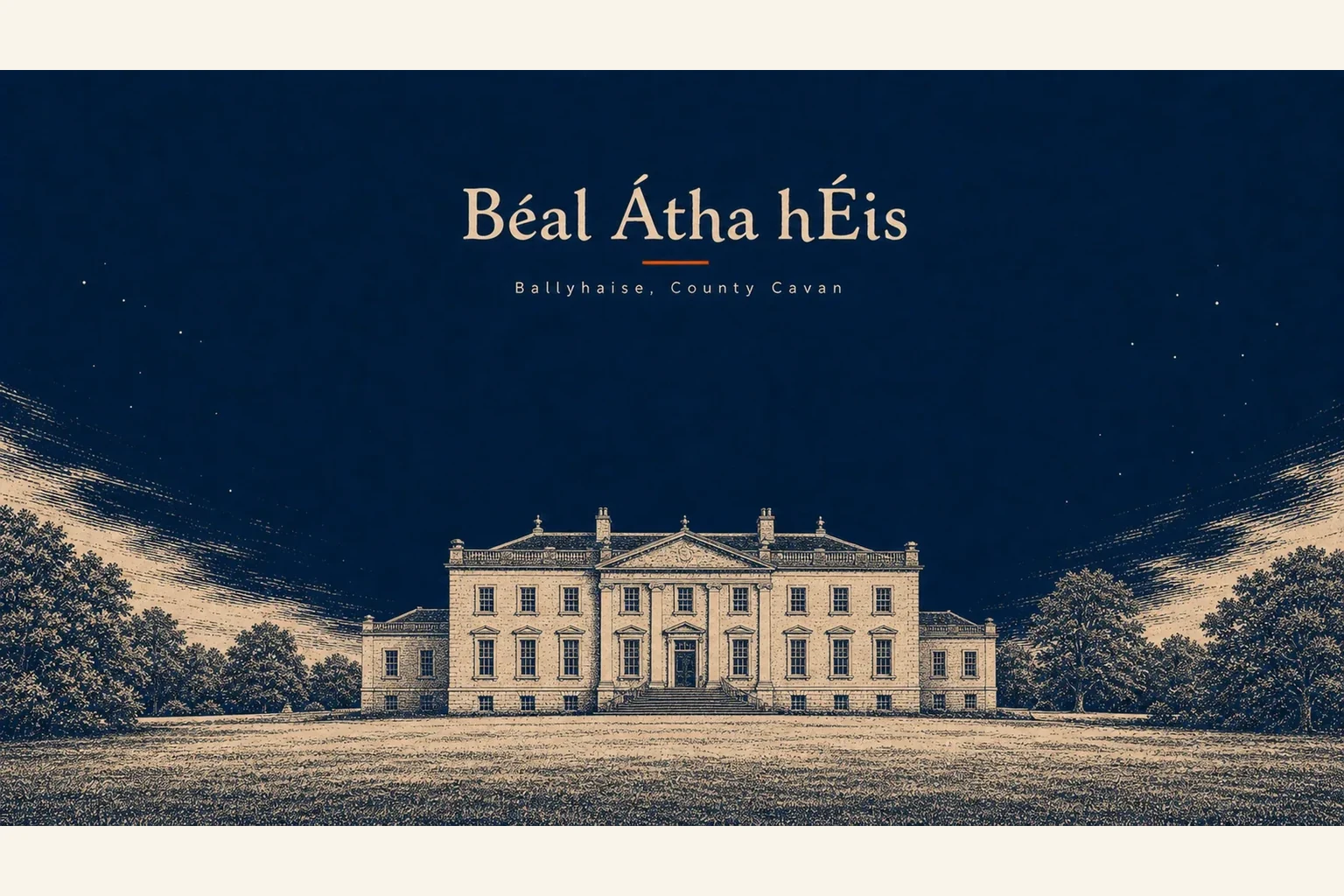
A Georgian mansion built by the man who designed Leinster House, now teaching farmers.

Ballyhaise is a small estate village in north Cavan, built to serve a big house. That is the whole explanation. The house came first — Palladian, Richard Cassels, circa 1733 — and the village arranged itself around it in the way villages did when one family owned everything in sight. Today the family is gone, the estate is a farm college, and the village has about 500 people, a church, and a main street that doesn't pretend to be anything other than what it is.

The house is the reason to come, and it is simultaneously the reason you cannot come in the way you might expect. Ballyhaise House is the campus of Ballyhaise Agricultural College, run by Teagasc. Students live and work in it. There are open days — check the college calendar — but it is not a heritage property you can wander through on a Tuesday afternoon. The building is Georgian Palladian: two storeys, symmetrical, the kind of composition that implies that the person who commissioned it had read enough Palladio to be dangerous. Cassels built Leinster House and Powerscourt. He also built this. Most people have never heard of this one.

The River Annalee passes along the lower edge of the village and carries on east toward Cootehill and eventually the Erne. It is a quiet, unhurried river in drumlin country — not the kind of thing that gets photographed much, but exactly the kind of water that holds bream and pike in numbers that serious coarse anglers already know about. If you come here without a rod, the river walk is still worth an hour. The light on the water in the late afternoon is worth more than that.

What Ballyhaise mostly is: a working north-Cavan village in the middle of dairy country, with an extraordinary building at its edge that most of Ireland has overlooked. That is not a criticism. It is a description. Not everywhere needs to be discovered. This one rewards the people who find it on their own.
Population
~500
Walk score
Village in five minutes; demesne adds another hour
Founded
Estate village, 18th century
Coords
54.0500° N, 7.3167° W
01 / 06

At a glance.

Three things every local will eventually mention. Read these and you've already understood more than most day-trippers do.

02 / 06

Stories & lore.

The reason to come back. The things every local will eventually tell you about, usually after the second pint.

The architect of Leinster House

Richard Cassels and the house he left behind

Richard Cassels — also known as Richard Castle — was a German-born architect who arrived in Ireland in the 1720s and never really left. He became the most significant country-house architect of the Georgian period: Leinster House, Powerscourt, Westport House, Russborough. Ballyhaise House dates to around 1733 and is considered one of the earliest Cassels buildings in Ireland in full Palladian style. It is a composed, two-storey block with a subtle classical authority — the kind of building that doesn't shout. It has been standing for nearly three hundred years and is in better condition than most country houses of comparable age precisely because someone has always been using it.

How a Georgian estate became a Teagasc campus

From demesne to dairy college

Ballyhaise House was for much of its life the seat of a landed estate. By the mid-20th century, like the majority of the great houses of the Protestant Ascendancy, it had passed out of private family ownership. The Irish state took it on and established an agricultural college on the grounds in 1947. Teagasc — the state's agriculture and food development authority — has run it since. The curriculum covers dairy farming, horticulture, equine management, and related land-based trades. Students work the same fields and look at the same Cassels facade that two centuries of gentry looked at before them. It is an unusual arrangement, and a better outcome than most comparable houses got.

North Cavan coarse fishing

The Annalee and the pike

The River Annalee drains a stretch of north Cavan drumlin country and feeds eventually into the upper Erne. It is not a fast or dramatic river. It meanders through flat fields and holds bream, roach, perch, and pike in the slow, dark water that those fish prefer. Coarse anglers have known the Annalee system for decades; it is part of a wider network of north-Cavan and Fermanagh waterways that draws visiting fishers who want the kind of water where you sit for an afternoon and think rather than scramble for a cast. Ballyhaise is one of the access points. The fishing is free on most of the local stretches but check the Inland Fisheries Ireland permit rules before you set up.

The village and the demesne

An estate village that outlasted the estate

Estate villages in Ireland have a particular shape. They were built to house the tradespeople, farm workers, and domestic servants that a large country house required — positioned close enough to serve, far enough to be out of sight from the main avenue. Ballyhaise is that kind of settlement. The demesne walls, the avenue, the lodge gates, the arrangement of streets relative to the house — all of it readable as a 19th-century landlord's plan. What makes Ballyhaise slightly different from the dozens of such villages that emptied out and fell into decay is the continuity provided by the college. There is still a reason for people to be here. The demesne still functions. The house still has a purpose. That is rarer than it should be.

03 / 06

Things to do outside.

Wear waterproofs. Bring a sandwich. Tell someone where you're going if it's the mountain.

Annalee river walk Down from the village to the river and along the bank. The path is informal — this is not a waymarked trail, it is a bankside walk on flat ground. Good for fishing access or for a quiet hour. The river is at its best in the evening light. Come back before dark; the path is unlit.
3–4 km out and backdistance
1 hourtime
Demesne and college grounds loop The college grounds are not a public park but on open days and during quiet periods the avenue and grounds around the house are accessible. Walk the avenue for the approach to the house, then around the perimeter of the lower fields toward the river. Respect that students and staff are working here.
~2 kmdistance
45 mintime
Village loop The village itself is compact. A short circuit takes in the church, the main street, and the lodge gates. On its own it is a fifteen-minute walk. Combined with the river or the demesne it fills a comfortable morning.
1.5 kmdistance
25 mintime
04 / 06

When to go.

There is no bad time. There are different times.

Spring
Mar–May

The college grounds are at their best before summer. The Annalee runs clear. Coarse fishing picks up from April.

◉ Go
Summer
Jun–Aug

Open days at the college are most likely in summer. Check the Teagasc calendar. Long evenings on the river.

◉ Go
Autumn
Sep–Oct

The drumlin country around Ballyhaise is as good as it gets in October. Pike fishing on the Annalee is proper autumn work.

◉ Go
Winter
Nov–Feb

North Cavan winter is grey and damp. The village has very limited services and nothing is set up for winter visitors. The house is still standing — it just won't feel like a discovery.

◐ Mind yourself
05 / 06

What to skip.

Honestly? Don't bother.

If a local was sitting beside you, this is the bit where they'd lean in.

×
Arriving without checking the college calendar

Ballyhaise House is a working campus. You cannot walk in off the road and tour it. Open days exist but are not year-round. Showing up unannounced means looking at the facade from the avenue and going home.

×
Expecting a heritage-trail village

There is no heritage centre, no interpretive boards, no gift shop. Ballyhaise is a real place that happens to have an extraordinary building in it. Bring your own curiosity.

×
Using Ballyhaise as a substitute for Cootehill

Cootehill — twenty minutes east — has Bellamont Forest (another great Palladian house, also inaccessible) and a fuller town with pubs, food, and a demesne walk. If you are in the area for the Georgian architecture, Ballyhaise is the bonus, not the main event.

+

Getting there.

By car

Cavan town to Ballyhaise is about 15 minutes north on the R212. Belturbet is 15 minutes further north. Cootehill is 20 minutes east on cross-country roads. Dublin is roughly 1h 45m via the M3.

By bus

Limited. Bus Éireann services between Cavan and Belturbet pass near the village but check current timetables — frequency is low and stops vary. A car is the practical option.

By train

No railway. Nearest stations are Cavan Junction (Drogheda/Dundalk line) or Clones direction. In practice, drive.

By air

Dublin Airport is 1h 40m by car. Belfast International is about 1h 30m.