County Cavan Ireland · Co. Cavan · Killeshandra Save · Share
POSTED FROM
KILLESHANDRA
CO. CAVAN · IE

Killeshandra
Cill na Seanrátha

The Ireland's Lakelands
STOP 06 / 06
Cill na Seanrátha · Co. Cavan

A small village beside a forest park beside a lough that hides a castle.

Killeshandra is a small plantation village in north-west Cavan, twenty kilometres west of Cavan town, dropped into the maze of small loughs that fan out from Lough Oughter. The name means church of the old ringfort, and there's been a settlement here longer than the Hamiltons who laid out the modern village in 1610. The 2022 census put it at 248 people. It feels smaller again on a wet Tuesday.

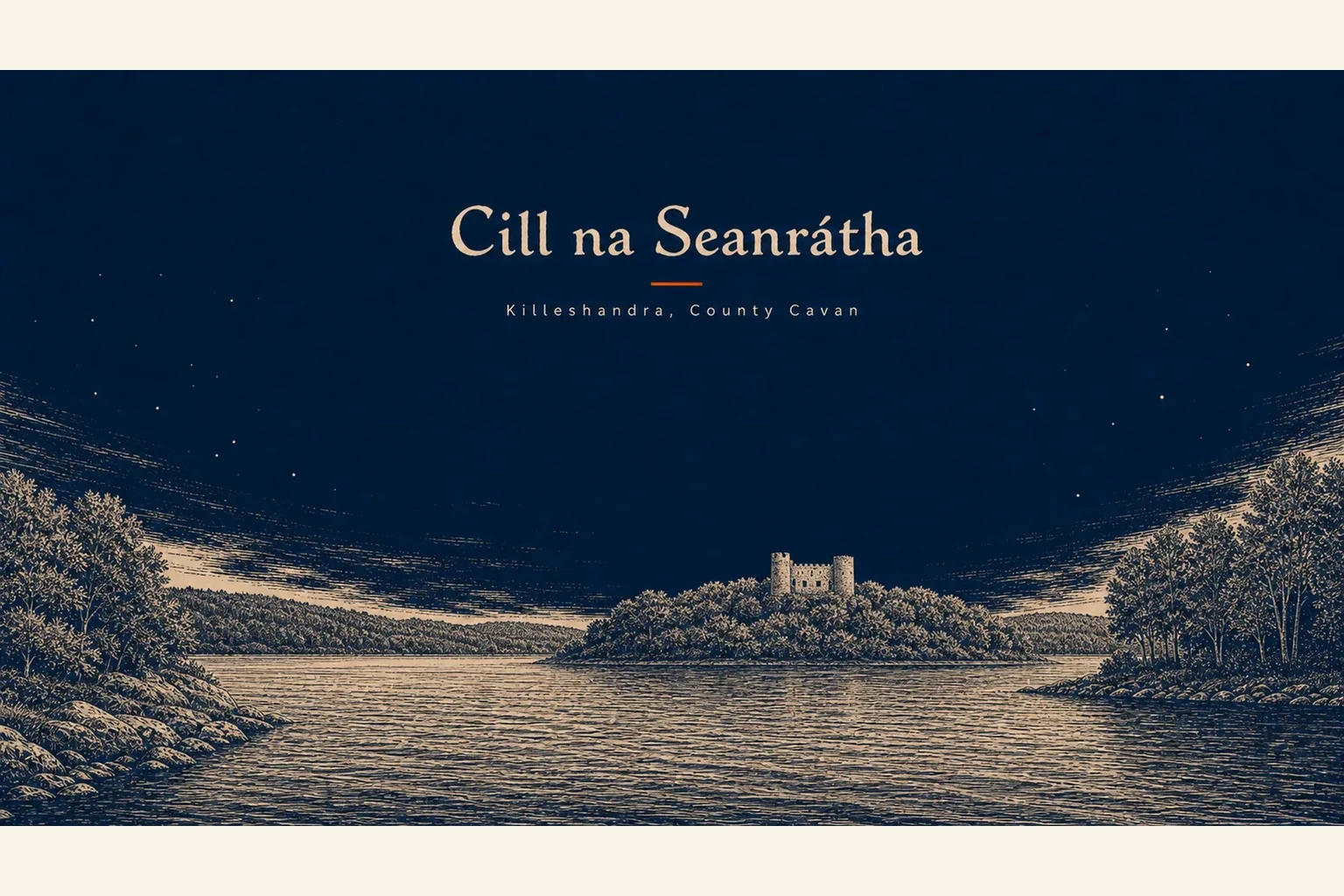
The reason to come is the water. Killykeen Forest Park, five minutes east, is one of Cavan's flagship outdoor places — six hundred acres of mixed woodland on the shore of Lough Oughter, with chalets, walking loops, anglers in the car park at six in the morning. Out in the middle of the lough, on a crannóg you could throw a stone across, sits Cloughoughter Castle: a circular Gaelic tower-house the O'Reillys built in the 13th century. It's where Owen Roe O'Neill — the Gaelic Irish general who beat the Scots at Benburb in 1646 — died of fever in 1649, with the Cromwellian war already lost around him.

The other thing that built the village was milk. The Killeshandra Co-operative Agricultural and Dairy Society was founded in 1896 and grew, slowly and stubbornly, into Lakeland Dairies — now the second-largest dairy co-op on the island. The HQ is still in the village. So is the headquarters of the Missionary Sisters of St Brigid, the order founded here in 1937 that sent Cavan nuns to Nigeria, Kenya and Brazil for most of the 20th century. For a place this size, that's a lot of weight in two unassuming buildings.

Don't come for a night out. Come for a long morning. Walk one of the Killykeen loops, drive out to the lakeshore for a sight of the castle, have lunch wherever's open in Cavan town, and go again.
Population
248
Walk score
Forest park trails on the doorstep
Founded
Plantation town, c. 1610
Coords
54.0152° N, 7.5289° W
01 / 06

At a glance.

Three things every local will eventually mention. Read these and you've already understood more than most day-trippers do.

02 / 06

Stories & lore.

The reason to come back. The things every local will eventually tell you about, usually after the second pint.

The general who died on the lough

Owen Roe at Cloughoughter

Owen Roe O'Neill — nephew of Hugh O'Neill, victor of the Battle of Benburb against the Scottish Covenanter army in June 1646 — spent the last months of his life moving around the Confederate-held parts of Ulster. By autumn 1649, with Cromwell already in Drogheda, he was sick and being carried from camp to camp. He was brought to the O'Reilly castle on Cloughoughter island in Lough Oughter, and died there on 6 November 1649. The castle was finally taken by Cromwellian artillery in 1653. The walls still stand on the crannóg, half-ruined, the last Gaelic stronghold to fall in the war.

How the village built Lakeland Dairies

The Co-op, 1896

The Killeshandra Co-operative Agricultural and Dairy Society was set up in 1896 — early, by Irish standards — under the influence of Horace Plunkett's co-operative movement. Local farmers brought milk to the creamery, the creamery sold butter, and the profit stayed in the parish. It survived the 20th century by absorbing smaller co-ops one at a time, and in 1990 merged with Lough Egish to form Lakeland Dairies. Today Lakeland is the second-largest dairy processor on the island and the registered office is still in Killeshandra. The original creamery building did the long, slow work of keeping the village alive when most rural Ireland was emptying out.

Cavan to Calabar

The Killeshandra Sisters

The Missionary Sisters of St Brigid were founded in Killeshandra in 1937 by Bishop Joseph Shanahan and Mother Mary Martin, specifically to send Irish nuns to Nigeria. The first six left for Calabar that same year. Over the next sixty years the order ran schools, hospitals and clinics in Nigeria, Kenya, Sierra Leone and Brazil. The mother house is still in the village. Most of the sisters today are not Irish — the order recruits in Africa now — but the headquarters of an entire missionary congregation still sits in a Cavan plantation village of two hundred and forty-eight people. That tells you something about 20th-century Ireland that is hard to explain otherwise.

A lake that's mostly islands

Lough Oughter

Lough Oughter isn't really one lake — it's a flooded drumlin landscape, a maze of small loughs, channels and islands wrapped around the upper Erne. There are over a hundred islands in it. It's a Special Area of Conservation and Special Protection Area, important for breeding waterfowl, otters and the white-clawed crayfish. In winter the whooper swans come in from Iceland. In summer the kingfishers work the shallows. The best way to see it is a canoe out of Killykeen; the second-best is patience on the shore at dawn.

03 / 06

Things to do outside.

Wear waterproofs. Bring a sandwich. Tell someone where you're going if it's the mountain.

Killykeen Forest Park — main lakeshore loop Out from the car park, along the shore of Lough Oughter, over the wooden footbridges between the wooded peninsulas, back through the conifers. Flat, well-marked, family-doable. Watch the water for grebes.
5 km loopdistance
1h 15mtime
Killykeen — Lakeshore short loop The shorter version for an hour before lunch. Stays on the south side of the park, takes in the pier and the chalet shore. Mostly tarmac.
2.5 kmdistance
40 mintime
Cloughoughter viewpoint Drive to the small lay-by at Inishconnell, walk down to the lakeshore, and the castle is sitting on its island a few hundred metres offshore. Bring binoculars. There is no public boat to the castle itself — kayak or canoe is the only way over.
1.5 km returndistance
25 mintime
Killykeen forest interior trail Inland from the lakeshore, through the older oak and beech stand. Quieter, fewer dogs, more birds. Wet underfoot in winter.
3 km loopdistance
1 hourtime
04 / 06

When to go.

There is no bad time. There are different times.

Spring
Mar–May

Bluebells in the Killykeen oakwood in April. Lambs everywhere on the road in. The lough still cold, the anglers already at it.

◉ Go
Summer
Jun–Aug

Chalets booked out, canoes on the water, long Cavan evenings. Bring midge repellent.

◉ Go
Autumn
Sep–Oct

The best season here. The forest goes copper, the lough goes still, the whooper swans arrive in October.

◉ Go
Winter
Nov–Feb

Half the chalets shut. The forest park stays open and is at its most itself in low light. Bring proper boots.

◐ Mind yourself
05 / 06

What to skip.

Honestly? Don't bother.

If a local was sitting beside you, this is the bit where they'd lean in.

×
Trying to land on Cloughoughter island

It's a fragile crannóg with unstable masonry and protected nesting birds. Look at it from the shore or from a kayak at a respectful distance. Don't be the person who collapses a 13th-century wall.

×
Hunting for nightlife in the village

There isn't any to find. Killeshandra is a 248-person village. The evening is for the forest, the chalet, or the road back to Cavan town.

×
Doing Killykeen as a quick stop on the way somewhere else

It's a half-day place, minimum. The loops are gentle but the point is the slowness. Treat it like the destination it is.

+

Getting there.

By car

Cavan town to Killeshandra is 25 minutes on the R201, west through Crossdoney. From Dublin, allow 2 hours via the M3 and N3.

By bus

Local Link Cavan runs limited services to Killeshandra from Cavan town and Belturbet. Bus Éireann coverage is thin — check the day before.

By train

No train. Nearest station is Dundalk or Longford, both an hour-plus by road.

By air

Dublin (DUB) is the nearest meaningful airport, 2 hours by car. Belfast International is 1h 45m.