County Cavan Ireland · Co. Cavan · Ballyconnell Save · Share
POSTED FROM
BALLYCONNELL
CO. CAVAN · IE

Ballyconnell
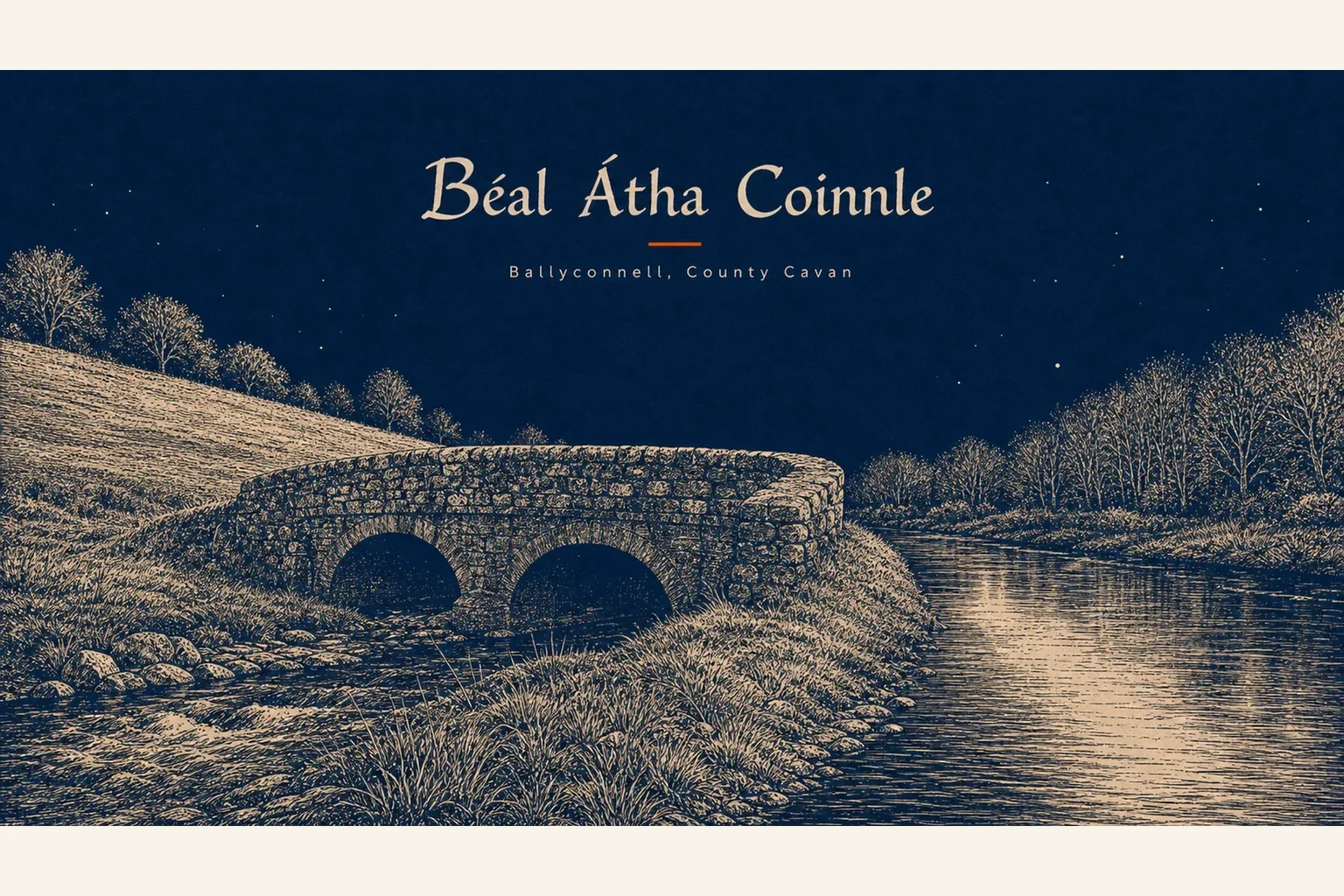
Béal Átha Coinnle

The Ireland's Hidden Heartlands
STOP 06 / 06
Béal Átha Coinnle · Co. Cavan

A waterway town that a billionaire built a resort beside, then lost everything.

Ballyconnell sits at the north-west corner of Cavan, five miles from the Fermanagh border, on the line of water that connects the Shannon to the Erne. The canal came through in the 1860s, immediately ran out of commercial traffic, and sat derelict for a hundred years before the EU and two governments put money into it and reopened it in 1994 as the Shannon-Erne Waterway. That decision changed the town. The hire-boats came, the quay got a new life, and Ballyconnell became a stop on a waterway corridor that stretches from Limerick to Enniskillen without a break in the water.

The Slieve Russell Hotel is the other thing the town is known for. Sean Quinn — born in Derrylin, just over the border in Fermanagh, but operating entirely out of this corner of Cavan — built a quarry empire, a glass business, an insurance company, and eventually one of the largest private fortunes in Ireland. The hotel came with the empire in 1992. It hosted the Irish Open in 2009, when Lee Westwood won. Then Quinn gambled on Anglo Irish Bank shares using contracts for difference, lost billions, and by 2011 the Quinn Group was in receivership. The hotel changed hands, reopened, changed again. It still runs. The cement works outside town still bears the Quinn name. The story of how one man from a border drumlin farm built and lost a multi-billion-euro empire in a single generation is not the kind of story that fits on a heritage panel.

The town itself is small — twelve hundred people, a tight commercial strip, a parish church, a 10th-century cross fragment that predates everything else. The border is close enough that the radio picks up BBC Radio Foyle. In the Troubles, that closeness mattered. The waterway was a corridor before it was a canal, and it has been a corridor of one kind or another ever since the monks moved through this landscape a thousand years ago.
Population
~1,200
Walk score
Town to towpath in five minutes
Coords
54.1072° N, 7.5889° W
01 / 06

At a glance.

Three things every local will eventually mention. Read these and you've already understood more than most day-trippers do.

02 / 06

Stories & lore.

The reason to come back. The things every local will eventually tell you about, usually after the second pint.

1994 — two governments, one canal

The waterway reopening

The Ballinamore-Ballyconnell Canal was cut in the 1860s to link the Shannon and Erne systems. It took twenty years to build and lasted about a decade of meaningful traffic before turf and goods found other routes. For a hundred years it sat closed, the locks rotting, the channel silting. In the 1990s a joint Irish-British initiative — part EU-funded, part cross-border goodwill in the run-up to the peace process — spent £30 million restoring 64 kilometres of waterway, 34 lakes, and 16 locks. It reopened in 1994 as the Shannon-Erne Waterway. Ballyconnell was the central stop. The hire-boat industry followed. What had been a derelict cut through bog became one of the longest unbroken inland waterways in Europe.

The rise and fall of the border billionaire

Sean Quinn

Sean Quinn grew up on a farm in Derrylin, County Fermanagh, a few miles from Ballyconnell. He started quarrying gravel in 1973 with a borrowed £100. By the 2000s the Quinn Group employed 8,000 people across cement, glass, insurance, and property. Forbes listed him as Ireland's richest man. The cement quarries outside Ballyconnell — the dusty workings visible from the road — were the physical heart of it. Quinn put several billion euros into contracts for difference on Anglo Irish Bank shares and lost almost all of it when the bank collapsed in 2008. The Quinn Group went into receivership in 2011. Quinn himself was jailed briefly in 2012 for contempt of court during a dispute with the receivers. The quarries are still operating under different ownership. The Slieve Russell Hotel is still open. The area around it still carries the Quinn name on gateways and buildings. The locals have a complicated relationship with all of it.

10th century, still standing

The Town Cross

A fragment of a high cross in Ballyconnell dates to around the 10th century, the period when Irish monasticism was at its most architecturally productive. High crosses of this type were theological statements as much as monuments — figurative carvings, biblical scenes, the intersection of the human and the divine rendered in stone. The Ballyconnell fragment is what survived a millennium of weather, plantation disruption, and the general indifference of one era to the next. It is not dramatic. It is just old in a way that most things in Irish market towns are not.

A line on water that never quite held

The waterway as border corridor

The Shannon-Erne system runs parallel to the Irish border through some of the most contested geography on the island. In the Troubles, the lakes and rivers were not just landscape — they were routes. Bridges were blown, roads cratered, army checkpoints ran on every main road. The waterway moved through it differently. It had no checkpoints. It crossed the border and back in the space of a lake. The 1994 reopening of the canal was a deliberate act of cross-border cooperation in the years when such acts were symbolic as much as practical. The water predated the border and outlasted the worst of it.

03 / 06

Things to do outside.

Wear waterproofs. Bring a sandwich. Tell someone where you're going if it's the mountain.

Shannon-Erne Waterway towpath The towpath runs alongside the canal from the town quay. Flat, well-surfaced in places, rough in others. Lock gates, reedy margins, the occasional cruiser passing at walking pace. Head south toward Lough Scur for the best of the lake scenery.
Variable — from 2 km to as long as you havedistance
45 min minimum, half day for a decent stretchtime
Town loop Church, town cross, the river bridge, quay and back. Covers the main points in under an hour. The cross is easy to walk past — look for it near the church grounds.
2 kmdistance
30–40 mintime
04 / 06

When to go.

There is no bad time. There are different times.

Spring
Mar–May

The waterway season starts. Cruisers back on the water from April, the towpath quiet. Good walking weather most years.

◉ Go
Summer
Jun–Aug

Peak hire-boat traffic. The quay has life. The Slieve Russell fills with golfers and conference delegates. Book ahead if staying.

◉ Go
Autumn
Sep–Oct

The cruisers thin out. Light on the lakes. The border country takes on a particular quality in October that is hard to describe and easy to remember.

◉ Go
Winter
Nov–Feb

Quiet to the point of still. The canal empties out. The hotel stays open but the town does not ask much of you, which can be a virtue or a problem depending on what you came for.

◐ Mind yourself
05 / 06

What to skip.

Honestly? Don't bother.

If a local was sitting beside you, this is the bit where they'd lean in.

×
Treating the Slieve Russell as the only reason to come

The hotel is fine — large, well-run, golfer-heavy. But it exists apart from the town. Staying there and not walking to the waterway is like going to a coastal hotel and not seeing the sea.

×
The Quinn industrial tourism impulse

There is no visitor centre, no official trail, no guided story of the Quinn years. The cement works is an active quarry, not a heritage site. The story is worth knowing; the site is not worth driving past slowly while pointing.

×
Expecting the town cross to be signposted and lit

It is not a major attraction in the tourist-infrastructure sense. Find it, look at it, think about what a thousand years means. Then move on. That is the correct amount of ceremony.

+

Getting there.

By car

Dublin to Ballyconnell is about 1h 50m via the M3 and N3 through Cavan town, then the R200 north-west. Enniskillen is 40 minutes north on the A509. Belturbet is 15 minutes east.

By bus

Limited direct service. Bus Éireann serves Cavan town with connections to Dublin; local services from Cavan town north toward Ballyconnell are infrequent. Check timetables. A car is the practical way in.

By train

No railway. Nearest mainline stations are Dundalk (1h 20m) or Mullingar (1h 10m), both by road.

By air

Dublin Airport is 1h 50m by car. Belfast International is 1h 15m. Ireland West (Knock) is 1h 45m.