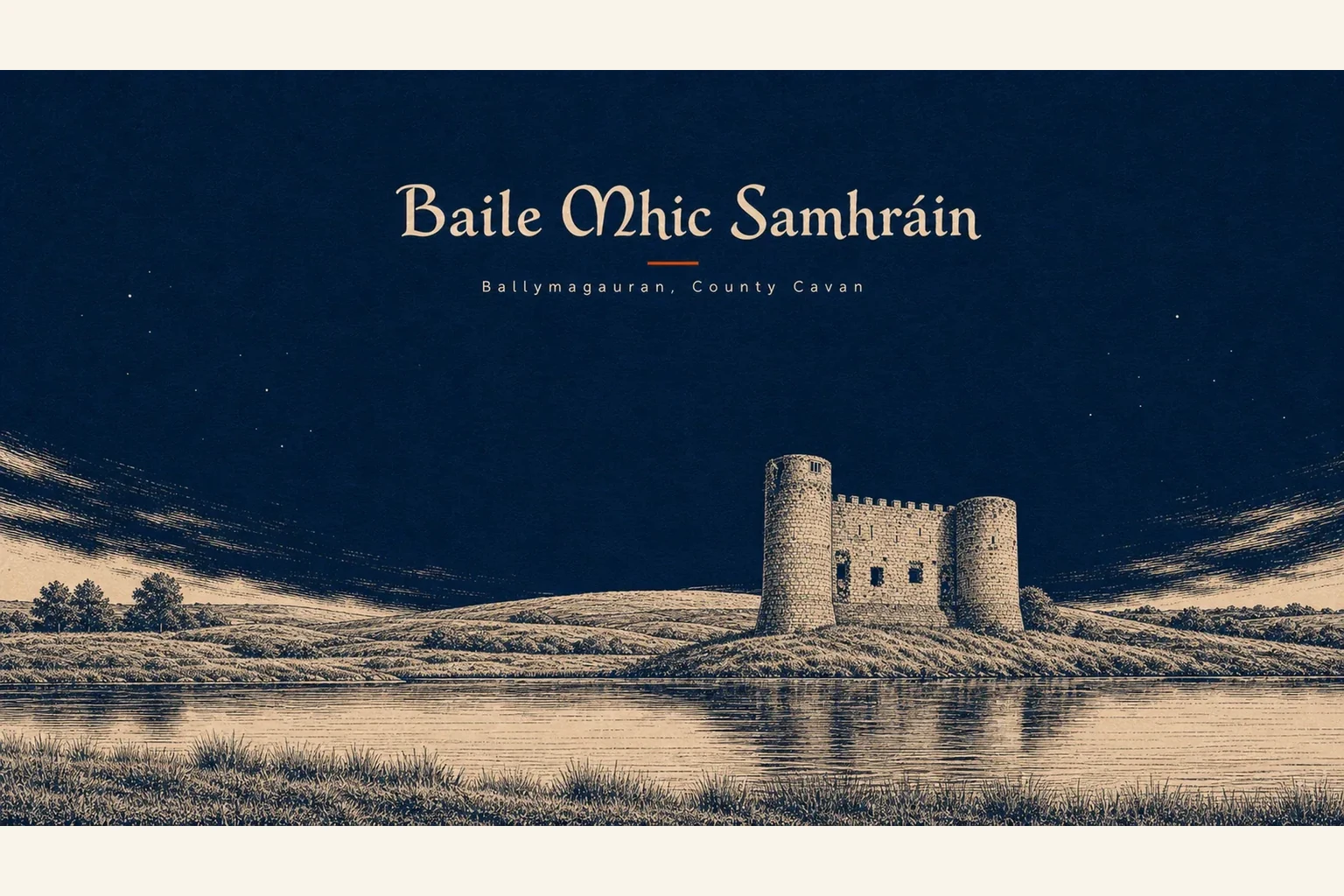
Baile Mhic Samhráin · Co. Cavan
A crossroads that was once the seat of lords and the plain of idols.
Ballymagauran is a crossroads village on the Cavan-Leitrim border, population well under two hundred. The road from Ballinamore meets the road from Ballyconnell and that is more or less the village. There is not much to see if you drive through at speed, which most people do.
Stop and look at the map. The plain around the village was called Mag Slécht - the Plain of Prostrations - where, according to every early Christian source that mentions the place, pagan Ireland kept its chief idol: Crom Cruach, a gold-and-silver pillar surrounded by twelve lesser stones, the whole assembly buried to their chins in the earth and worshipped with sacrifices at Samhain. Saint Patrick, the Tripartite Life says, came here specifically and knocked them all over. The field is flat and green and unremarkable now. It was, at some point, the most charged piece of ground in Ireland.
After 1400, the McGoverns - the Mac Shamhráin, the lords of Tullyhaw - moved their chief seat here from elsewhere in the barony. The Annals of the Four Masters mention the place first in 1431, the same year it was burned. It was burned again in 1455, 1459, 1485, 1498, and 1512. Six burnings in eighty years is not coincidence; it is what happened to contested ground in medieval Ulster. A fortified stone house replaced whatever came before it, built in 1611 after the McGovern lord recovered his estate from the post-Flight confiscations. Cromwell's forces destroyed that too, in 1649. The ruins remain on the townland. The McGoverns also left behind a manuscript: the Book of Magauran, a 14th-century vellum duanaire, the oldest surviving family poembook in Ireland. It is in the National Library now.