County Clare Ireland · Co. Clare · Ballyvaughan Save · Share
POSTED FROM
BALLYVAUGHAN
CO. CLARE · IE

Ballyvaughan
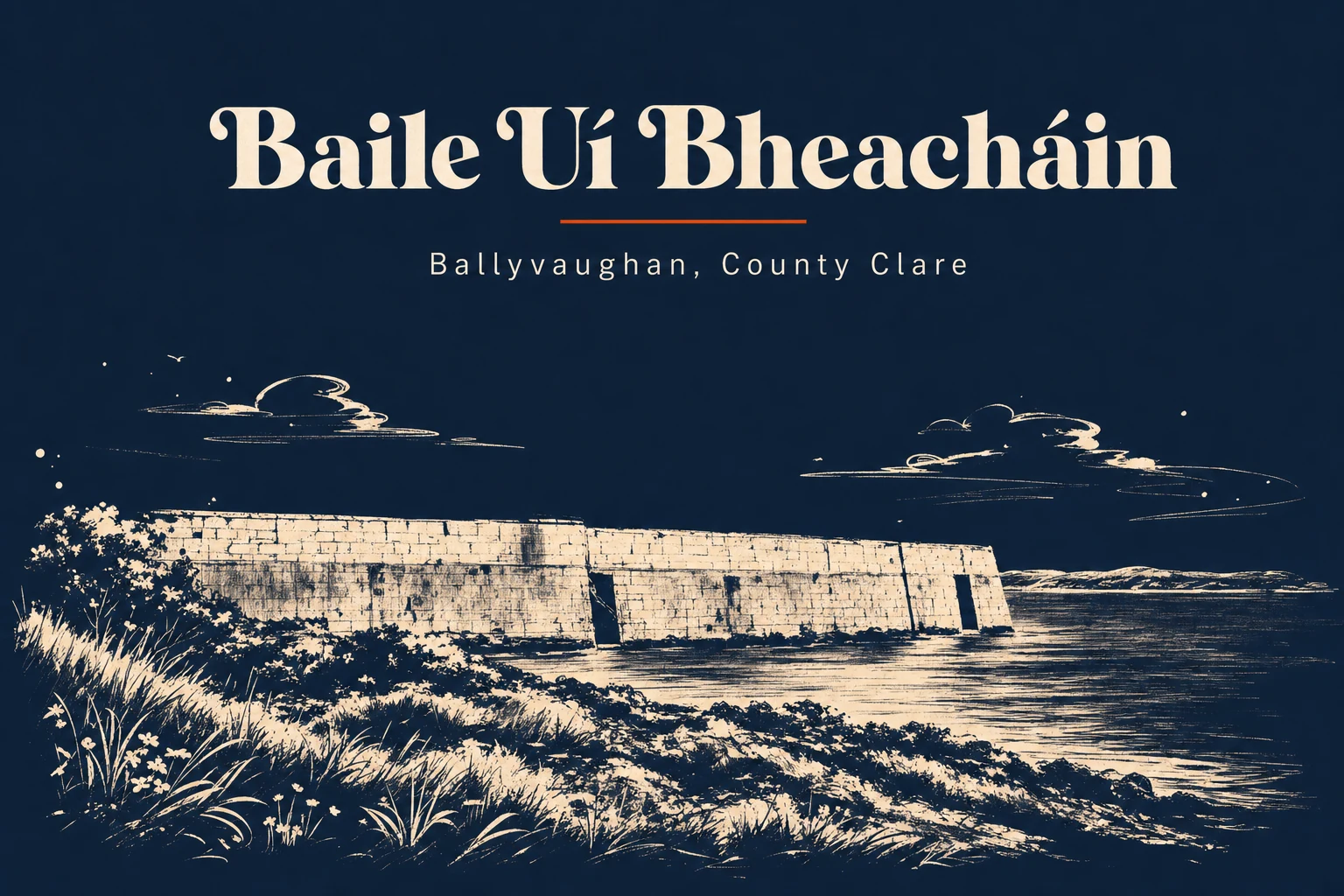
Baile Uí Bheacháin

The Wild Atlantic Way
STOP 03 / 06
Baile Uí Bheacháin · Co. Clare

Where the Burren meets the bay, and the road turns into limestone.

Ballyvaughan is the front door of the Burren. The village itself is tiny — a crossroads, a pier, a square, and the bay rolling out toward Galway. Stand at the harbour wall and look south and you see nothing but limestone climbing into cloud. Stand at the same wall and look north and you see the whole arc of Galway Bay, with Connemara on the far side and the Aran Islands sitting low between.

It earned its keep as a port. Turf went out across the bay to the islands, fish came in, and a pier was built in 1829 to make the trade easier. The village laid itself out around that pier, in cottages that are still there. The Burren behind it was thought of for centuries as wasteland — Cromwell's surveyor said it had not enough wood to hang a man, water to drown him, or earth to bury him. He had not looked properly. The limestone holds more rare flowers per square metre than almost anywhere in Europe, and the village has spent the last forty years quietly becoming the place people stay while they walk it.

The current shape of Ballyvaughan is two hotels, three pubs, a handful of cafés, and the Burren College of Art up the road in Newtown Castle. Gregans Castle Hotel, four kilometres up Corkscrew Hill, has had a Michelin star for years and is the kind of dinner you book a year out. Hyland's Burren Hotel sits on the square and has done since 1796. Between them, the village handles the visitor traffic without losing the run of itself.

Two nights here is the right amount. One day for the Burren — the loop walks, Aillwee Cave, the perfumery — and one day for the coast road north toward Black Head, where the limestone falls into the sea and the road goes nowhere fast. Eat at one of the hotels, drink at one of the pubs, sleep with the windows open. The bay does the rest.
Population
~250
Pubs
3and counting
Walk score
Harbour to crossroads in eight minutes
Founded
Pier built 1829; village laid out around it
Coords
53.1167° N, 9.1500° W
01 / 10

At a glance.

Three things every local will eventually mention. Read these and you've already understood more than most day-trippers do.

02 / 10

The pubs.

None of these are themed Irish pubs, because they don't need to be. A few that earn the trip:

Monk's Pub & Restaurant

Tourists and locals, side by side
Pub & seafood, harbour-side

Right at the pier. Built into a stone warehouse from the old port days. Famous for seafood chowder and a window seat looking out at the bay. Busy in summer; book a table for dinner if you want one.

Greene's Pub

Quiet, talkative
Village local

On the square in the middle of the village. The local end of things. Trad sessions on summer weekends, occasional big nights in winter. The pint is the pint.

O'Loclainn's Whiskey Bar

Hushed, wood, old labels
Tiny whiskey bar, opens when it opens

One of the oldest pubs in the country, run by the Loclainn family for seven generations. A back-room of a shop with a stove and a wall of whiskey — bottles you cannot find anywhere else, including a few from distilleries that closed in the 1970s. Hours are vague. If the door is open, go in. If not, try tomorrow.

03 / 10

Where to eat.

PlaceTypeLocal note
Gregans Castle Hotel Country-house restaurant, Michelin-starred €€€€ Up Corkscrew Hill, four kilometres south. The McEvaddy family run it, and David Hurley has held the Michelin star in the kitchen for years. Tasting menu only at dinner. The dining room looks out across the Burren toward the bay. Book months ahead, dress like you mean it.
Monk's Pub & Restaurant Seafood, pub setting €€ The chowder is the chowder you came to Clare for — heavy with mussels and salmon, served with brown bread. Order it for lunch with a half-pint and watch the boats.
An Fear Gorta (The Tea & Garden Rooms) Daytime tearooms, harbour cottage A whitewashed cottage with a walled garden by the pier. Open day-only, March to October. Cakes, scones, sandwiches, and a pot of tea poured properly. Closed if it rains too hard.
Hyland's Burren Hotel Hotel restaurant & bar food €€ On the square. Full dinner menu in the dining room, simpler bar food in the lounge. Reliable, not flashy. The kind of dinner you have on the second night when you cannot face another tasting menu.
Burren Smokehouse outpost Smoked-salmon shop, ten minutes south The Smokehouse is up in Lisdoonvarna but they sell pre-packed Burren oak-smoked salmon in shops around Ballyvaughan. Pick up a fillet, a brown loaf, and a lemon — best lunch on the Wild Atlantic Way for under fifteen euro.
04 / 10

Where to sleep.

PlaceTypeLocal note
Gregans Castle Hotel Country house hotel Eighteenth-century house on the side of Corkscrew Hill, run by the McEvaddy family since 1976. Twenty-one rooms, a Michelin-starred restaurant, gardens, and a view across the Burren that is the reason most people come. Not cheap. Worth it once.
Hyland's Burren Hotel Village hotel On the square in Ballyvaughan. The Hyland family have had an inn on this spot since 1796. Thirty rooms, turf fire in the lobby, walking distance to all three pubs. The honest, comfortable, in-the-village option.
Drumcreehy House B&B Yellow Bavarian-style house on the bay, twelve rooms, run by Bernadette and Armin. Big breakfasts, sea views, a five-minute walk from the village. Booked solid in summer.
Cappabhaile House B&B On the road south toward Lisdoonvarna, just outside the village. Eight rooms, large garden, peat fire in the sitting room. Quieter than the village itself, a five-minute walk in.
A cottage out at Bishopsquarter Self-catering Ten minutes east of Ballyvaughan, on the bay. A cluster of cottages and farmhouses to rent through the usual sites. Halve the price of a hotel, double the silence, and the strand at Bishopsquarter is at the bottom of the lane.
05 / 10

Stories & lore.

The reason to come back. The things every local will eventually tell you about, usually after the second pint.

A famine road, still in use

Corkscrew Hill

The N67 climbing south out of Ballyvaughan was built in the 1840s as relief work during An Gorta Mór, the Great Hunger. Local men were paid a few pennies a day to break stone and stack the road up the limestone face in a sequence of hairpins so tight it earned the name. Most famine roads led nowhere on purpose — the point was the labour, not the destination. This one led to Lisdoonvarna and survived because the route was needed. Drive it slowly. The walls on either side were laid by hand by people who were starving.

Cromwell's surveyor was wrong

The Burren

When General Edmund Ludlow surveyed Clare for the Cromwellian settlement in the 1650s, he wrote that the Burren had not enough wood to hang a man, water to drown him, or earth to bury him. He missed the point. The limestone pavement holds more than seventy percent of Ireland's native flowering plants — Arctic, Alpine and Mediterranean species growing side by side because the rock holds heat in winter and damp in summer. The gentians come up blue in May. The orchids follow in June. Whole botany careers are built on twenty square metres of this stone.

A tower-house with students in it

Newtown Castle and the College of Art

Two kilometres south of the village, Newtown Castle is a sixteenth-century tower house — round on a square base, an unusual design — built by the O'Briens and later held by the O'Loghlens, the kings of the Burren. Mary O'Loghlen took it over in the late twentieth century and founded the Burren College of Art at its foot in 1993. International postgraduates now come for residencies and MFA programmes in a converted farmyard with the tower at its back. The castle is open to visitors when the college is not using it.

A peninsula, a pier, a vanished trade

Aughnish and the bay

North of the village, the Aughnish peninsula sticks out into Galway Bay — a low limestone finger ending in a Martello-style watchtower from the Napoleonic Wars. Boats from Ballyvaughan ran turf, livestock and people across the bay to Galway and the Aran Islands for centuries; the pier was built in 1829 to formalise the trade. Steam packets called weekly until the railway killed the route in the 1860s. The pier still works, but for pleasure boats now, not turf.

06 / 10

Things to do outside.

Wear waterproofs. Bring a sandwich. Tell someone where you're going if it's the mountain.

Black Head Loop The coast road north out of Ballyvaughan toward Fanore. The road hugs the bay, then the limestone falls into the sea at Black Head, where there is a small lighthouse and nothing else. Walk a stretch of it from any lay-by; the whole loop is a fine day on a bike.
26 km loop by car / longer on footdistance
Half daytime
The Burren Way (Ballyvaughan section) The waymarked Burren Way passes through the village. The northern stretch climbs out of Ballyvaughan over the limestone toward Fanore — proper rock-walking, not a path. Wear boots with grip. Do not do it in low cloud.
12 km one waydistance
4 hourstime
Aillwee Cave & hill loop Up the road from the cave entrance, a short loop climbs onto the hill behind it — limestone pavement, hazel scrub, a view back across the bay. Combine it with the cave tour and the Burren Birds of Prey display next door.
4 km loopdistance
1.5 hourstime
The Pier and Aughnish Out the pier, along the shore road, up onto the Aughnish peninsula and back. Flat. Suitable for a half-pint pause at Monk's on the way home. Best at evening when the light goes copper across the bay.
5 km returndistance
1.5 hourstime
Burren Perfumery loop Drive ten minutes inland to Carron, park at the perfumery, walk the herb garden and a short loop on the limestone behind. The perfumery itself is the only one of its kind in Ireland — small-batch scents made from Burren plants. The tearoom does a good lunch.
3 kmdistance
1 hourtime
07 / 10

Tours, if you want one.

The ones below are bookable through our partners — pick one that suits, or skip the lot and just turn up.

We earn a small commission when you book through our tour pages. It costs you nothing extra and keeps the village hubs free. All Co. Clare tours →

08 / 10

When to go.

There is no bad time. There are different times.

Spring
Mar–May

May is the Burren's month. Gentians out, orchids starting, the limestone warm to the touch and the village still quiet. The light is unreal.

◉ Go
Summer
Jun–Aug

Coach traffic on the N67 is real and Aillwee Cave queues out the door. Stay in the village, walk early, eat late. The long evenings are worth the trade-off.

◐ Mind yourself
Autumn
Sep–Oct

The Burren in October is grey and gold and entirely yours. Storms come in across the bay. The pubs settle back into themselves. The hotels drop their rates.

◉ Go
Winter
Nov–Feb

Half the village shuts. Gregans Castle closes from late October to February. Hyland's stays open. If you do not mind a quiet pint and a long walk in horizontal rain, it is the most honest the place ever is.

◐ Mind yourself
09 / 10

What to skip.

Honestly? Don't bother.

If a local was sitting beside you, this is the bit where they'd lean in.

×
The Cliffs of Moher day-trip via Ballyvaughan

The cliffs are an hour south. Worth a day, but not from here. Stay in Doolin if the cliffs are the point. Stay in Ballyvaughan if the Burren is.

×
Driving the Burren in a big rental car

The interior roads are one limestone lane wide with stone walls on both sides. Hire something small. The hedge does not negotiate and the wall negotiates less.

×
The Aillwee Cave gift-shop circuit only

The cave itself is fine. The Birds of Prey display next door is genuinely good. The car-park-and-fudge experience without either is a waste of a morning.

×
A single night

One night is a meal and a sleep. The Burren is the reason to come, and you cannot walk it in the half-day either side of a hotel breakfast. Stay two.

+

Getting there.

By car

Galway to Ballyvaughan is 50 minutes on the N67 around the south of the bay — a lovely drive past Kinvara. Doolin is 45 minutes south via Lisdoonvarna and Corkscrew Hill. Shannon is 1h 20m.

By bus

Bus Éireann 350 runs Galway–Ennis via Ballyvaughan, Doolin and the Cliffs of Moher. Several services daily in summer, fewer in winter. Slow but it does the job.

By train

No train. Nearest stations are Galway (50 minutes by road) and Ennis (1 hour). Both connect to bus services into the village.

By air

Shannon (SNN) is the nearest airport at 1h 20m by car. Ireland West (Knock) is 1h 40m. Dublin is 3 hours.