County Clare Ireland · Co. Clare · Fanore Save · Share
POSTED FROM
FANORE
CO. CLARE · IE

Fanore
Fán Óir

The Wild Atlantic Way
STOP 07 / 07
Fán Óir · Co. Clare

One pub, one beach, and a wave that scares professionals.

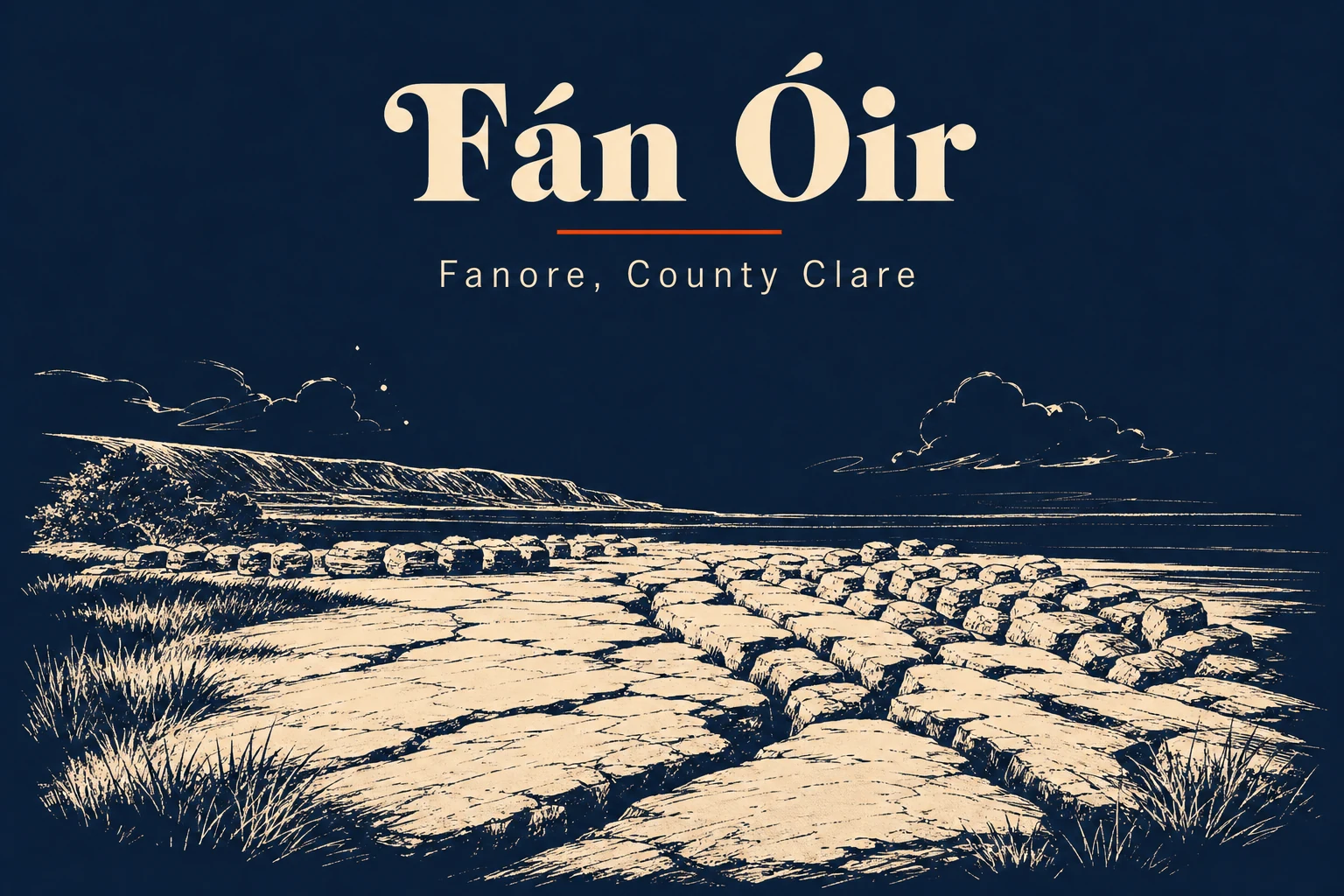
Fanore is the kind of place that doesn't try to explain itself. A beach, a pub, a scatter of houses, the road running north to Galway and south toward Doolin. The Burren comes down to the shore here and stops, and the result is limestone pavement running to a sandy beach, which is a geological accident that looks deliberate.

It is quiet. The population is under two hundred and in winter it drops further. What holds people is the landscape — the bare grey shelves above the road, the gentian flowering in the cracks in May, the surf breaking offshore in January on a swell that has crossed the full width of the Atlantic. The wave at Aillemore, sometimes called Aill na Searrach, is one of the heavier big-wave breaks on this coast. On the right winter day it draws serious surfers. On every other day the sea simply does what it wants.

The Burren Way passes through. The coastal path runs north and south. You don't come here for infrastructure — you come because the West of Ireland gets genuinely wild at this end of the Burren, and Fanore is the version of that wildness with a sandy beach and a pint at the end of the day.
Population
<200
Walk score
Beach to road in two minutes; limestone plateau in twenty
Coords
53.1333° N, 9.2833° W
01 / 07

At a glance.

Three things every local will eventually mention. Read these and you've already understood more than most day-trippers do.

02 / 07

The pubs.

None of these are themed Irish pubs, because they don't need to be. A few that earn the trip:

O'Donoghue's Bar

Remote, genuine, no agenda
Pub, isolated Burren valley location

One pub for a village of under two hundred people. It's the social infrastructure. Walkers come in off the Burren Way. Surfers come in after a session at Aillemore. Farmers come in because it's Tuesday. No live music schedule — just the conversation.

03 / 07

Stories & lore.

The reason to come back. The things every local will eventually tell you about, usually after the second pint.

The big wave

Aill na Searrach

The offshore break at Aillemore — the Foals' Cliff in Irish — only shows its full size when a large winter groundswell runs in from the northwest and the tide is right. On those days it produces a heavy, ledging wave that the Irish big-wave community rates among the better spots on the coast. It isn't Mullaghmore and it doesn't get the same attention, which is partly why the people who surf it prefer it. You can watch from the headland. Bring binoculars in January.

The beach that shouldn't exist

Sand in the wrong place

The Burren is limestone. Limestone doesn't make beaches — it dissolves, it cracks, it produces pavement and dolmens and turloughs, but not sand. Fanore beach is an anomaly: a long strand tucked between the karst and the sea, built up from shell and Atlantic sediment over thousands of years. It's a good swimming beach in summer. Walk the tide line and the geology of the place — stone immediately west, sand underfoot, limestone above — sits slightly wrong in a way that you keep noticing.

Where the stone runs out

The Burren edge

The Burren plateau covers roughly 250 square kilometres of north Clare. Fanore is one of the few places where you can stand and see the limestone terminate — it comes off the hills to the east, runs across the coastal flat, and stops at the beach. The karst pavement above the village holds arctic-alpine plants that survived here since the last Ice Age, sheltered in the limestone grikes. The gentian flowers in May. Orchids appear in April. The Burren's reputation as a botanical oddity is most accessible here, fifteen minutes' walk from a pub.

04 / 07

Things to do outside.

Wear waterproofs. Bring a sandwich. Tell someone where you're going if it's the mountain.

Fanore Beach & Coastal Path The beach itself is the starting point. Walk the strand north, pick up the coastal path toward the Galway border, and return inland. Low-level, no navigation required. The limestone terraces to the east are visible the whole way.
3–5 kmdistance
1–2 hourstime
Burren Way (Fanore section) The long-distance Burren Way passes through Fanore. The section south to Ballyvaughan traverses open karst pavement — flat, exposed, strange. Underfoot is firm limestone. Navigation is straightforward in clear weather; the plateau feels very empty in mist.
10 km one way to Ballyvaughandistance
3–4 hourstime
Limestone karst above the village Walk east from the road and you're on the pavement in minutes. No formal path — that's the point. The rock is broken into grikes (cracks) that hold soil and rare plants. Bring an ID guide in May. Don't twist an ankle in the fissures.
Open accessdistance
As long as you wanttime
Aillemore headland Short walk to the headland above the big-wave break. In winter swell the view offshore is the point. In summer it's a quieter vantage over the bay and the Aran Islands on the horizon.
2 km returndistance
30–40 minutestime
05 / 07

When to go.

There is no bad time. There are different times.

Spring
Mar–May

May is when the Burren botanicals peak — gentian, orchids, spring sandwort in the grikes. The beach is empty and the light on the limestone is long and flat.

◉ Go
Summer
Jun–Aug

The beach works for swimming. Fanore is quiet by Clare coast standards — no surf school circus, no chipper queue. Warm enough most years.

◉ Go
Autumn
Sep–Oct

First Atlantic swells arrive. The surfers start watching the forecasts. The limestone in low autumn light is worth the drive alone.

◉ Go
Winter
Nov–Feb

The pub is open and the big-wave season runs Nov–Feb, but the village is very quiet. Come if you want the coast at its most honest and don't need anything to be open.

◐ Mind yourself
06 / 07

What to skip.

Honestly? Don't bother.

If a local was sitting beside you, this is the bit where they'd lean in.

×
Expecting a café or restaurant

There isn't one, or not one that's reliably open. Bring food, or drive to Ballyvaughan (10 minutes south) before you arrive.

×
Paddling out at Aillemore without local knowledge

It's a serious big-wave spot. The wave breaks over a limestone reef. If you're asking whether you should surf it, you shouldn't.

×
The Burren Way in low cloud without a map

The plateau is flat and featureless in mist. There are no trees to orient by. Download the OS map before you start.

+

Getting there.

By car

Ballyvaughan to Fanore is 10 minutes north on the R477 along the coast. Doolin is 20 minutes south on the same road. From Galway city, allow 1h 15m via Kinvara and Ballyvaughan.

By bus

Bus Éireann 350 (Galway–Doolin–Lisdoonvarna) stops at Fanore in summer. Check the timetable — services are limited and the stop is a request halt.