Georgian to boarding school to question mark
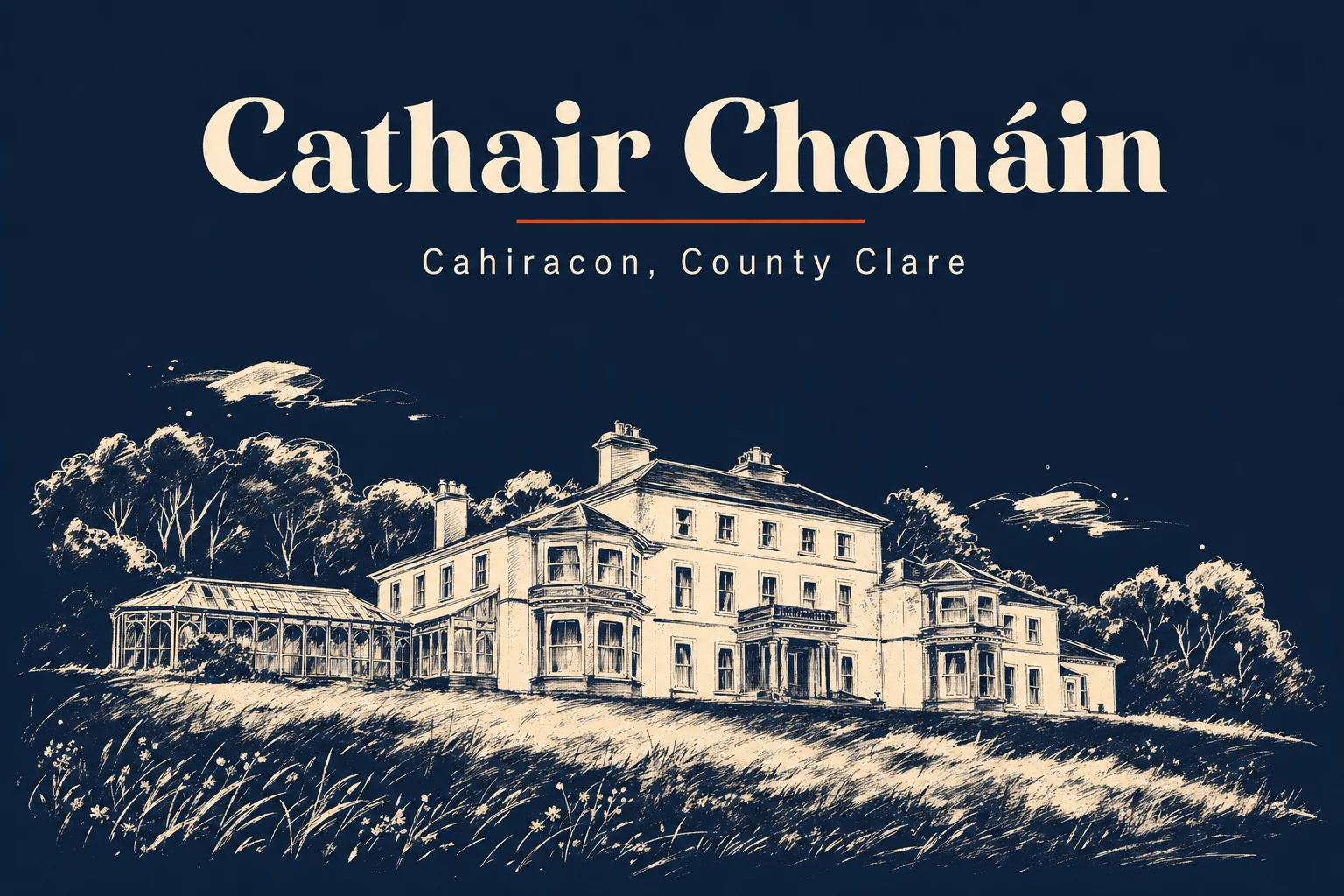
Cahercon House
The house was built around 1790 — five bays, three storeys over a basement, a limestone Ionic porch dropped onto the centre. Two-storey wings with full-height canted bay windows were added in 1873, along with a lean-to conservatory. The Scott family held it from 1712. By the mid-1870s the Hon. Charles William White, son of Baron Annally, was living there. The Vandeleurs took it in 1889 and stayed until 1920. The Maynooth Mission to China bought it that year for £14,000. The Salesian Sisters of Don Bosco bought it from them in 1962. After the boarding school closed in 2002 the buildings entered the long Irish limbo of plans and feasibility studies — Clare County Council commissioned one in 2019. Most recent reports have a private buyer planning a hotel conversion. Treat any of that as live information; check before you drive out.
A missionary order founded a parish over
The Maynooth Mission to China
The Missionary Society of St Columban — the Maynooth Mission to China — was founded in Ireland in 1918 to send priests to China. The associated women's order, the Missionary Sisters of St Columban, was formed in 1922, and Cahiracon is one of the places named in their early history. The Columban Fathers held Cahercon House for forty-two years before selling it to the Salesians. There's a thread that runs from this stretch of the Shannon estuary out to the mission stations of Hubei and Jiangxi in the 1920s, and back again through Communist expulsion in the 1950s. Most of the people in the parish in 1920 had never been further than Limerick.
Steamers, tolls, and a useful rock
The pier
The Shannon Commissioners built the pier in the 1840s — a causeway out to a projecting rock, the rock cut down, a pier set on top, the whole job costed at £1,986. Kildysart and Cahiracon were one of the lower-Shannon stops the Commissioners worked on after the proprietors signed up in 1840. By 1893 the steamers from Limerick and Kilrush called at Cahercon Pier daily in summer and on alternate days in winter; a Second Class Collector had been stationed to collect the tolls. The steamers are gone. The pier remains. Foynes is the lit-up bit on the far side at night.