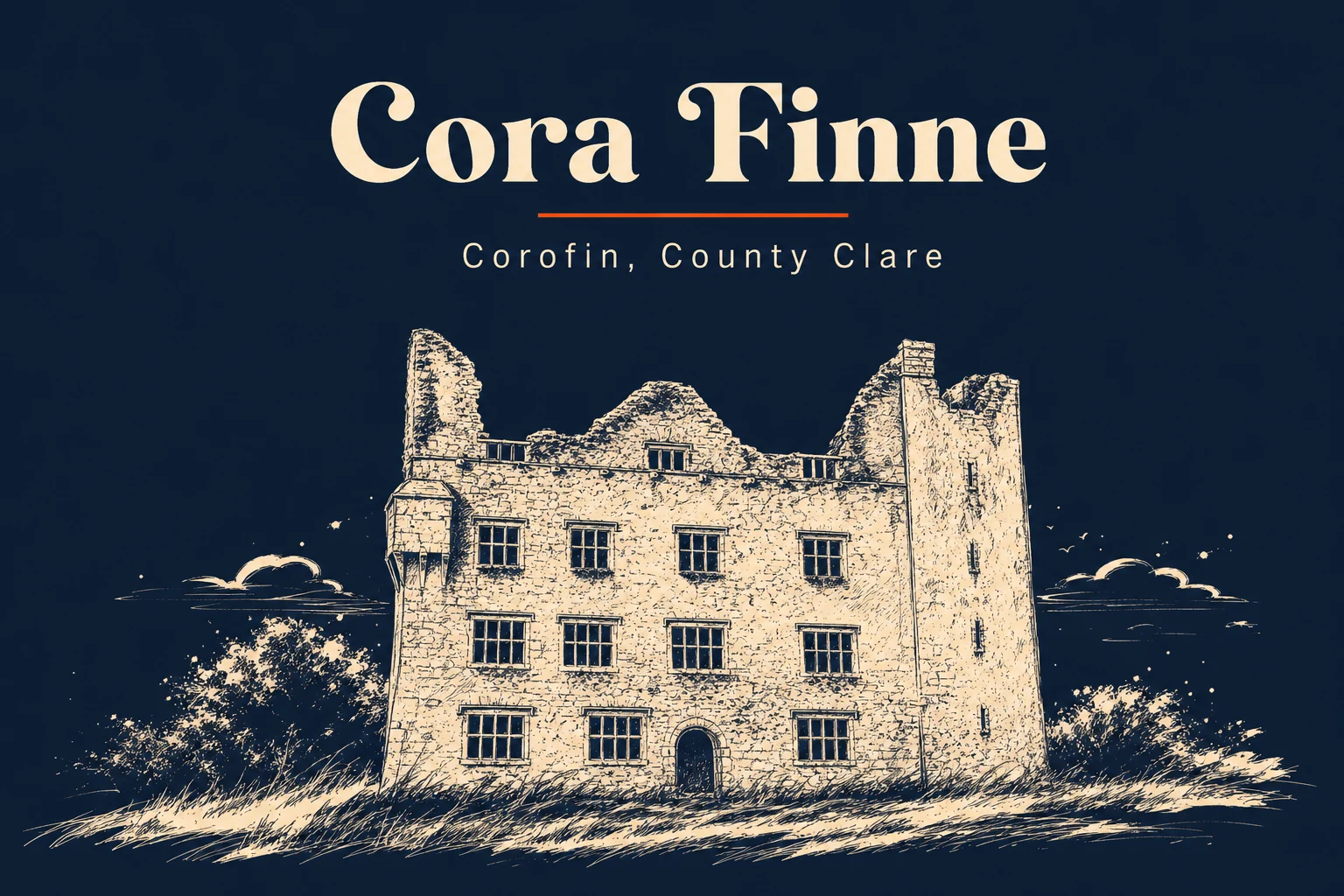
Cora Finne · Co. Clare
Where the Burren runs out of rock and hits a lake.
Corofin sits where the limestone runs out. The Burren proper - the grey pavements, the Arctic-alpine flowers, the karst - starts a kilometre or two north. South is ordinary Clare farmland: green fields, hedgerows, cattle. The village is at the join. It has a lake, a river, a church that is now a genealogy archive, and a castle ruin visible from the road into Kilfenora.
People come here for two reasons. Some are walking the Burren and want somewhere quieter and cheaper than Doolin or Lisdoonvarna to sleep. Others are Irish-American or Irish-Australian or Irish-something, and they've flown a long way to stand in front of a database and find out which townland their great-grandmother left in 1848. The Heritage Centre handles those people with the particular gentleness that discovery requires.
The rest of Corofin's history doesn't ask you to work very hard. The O'Dea clan fought the Normans four kilometres away in 1318 and won, decisively and permanently. Máire Rua O'Brien - red-haired, twice-widowed, the subject of various colourful stories - lived in the castle on the Kilfenora road in the 1600s. St Tola founded his monastery at Dysert in the eighth century and a round tower and high cross are still there to prove it. You can stand at all of these places in a single morning and still be back for lunch.
The village itself is small. One main street. A pub with music. A lake walk you can do in an hour. It earns its place as a stop, not a destination - and that's not a criticism. The Burren needs a town like this at its southern edge: modest, useful, with enough story to justify arriving.