County Clare Ireland · Co. Clare · Ruan Save · Share
POSTED FROM
RUAN
CO. CLARE · IE

Ruan
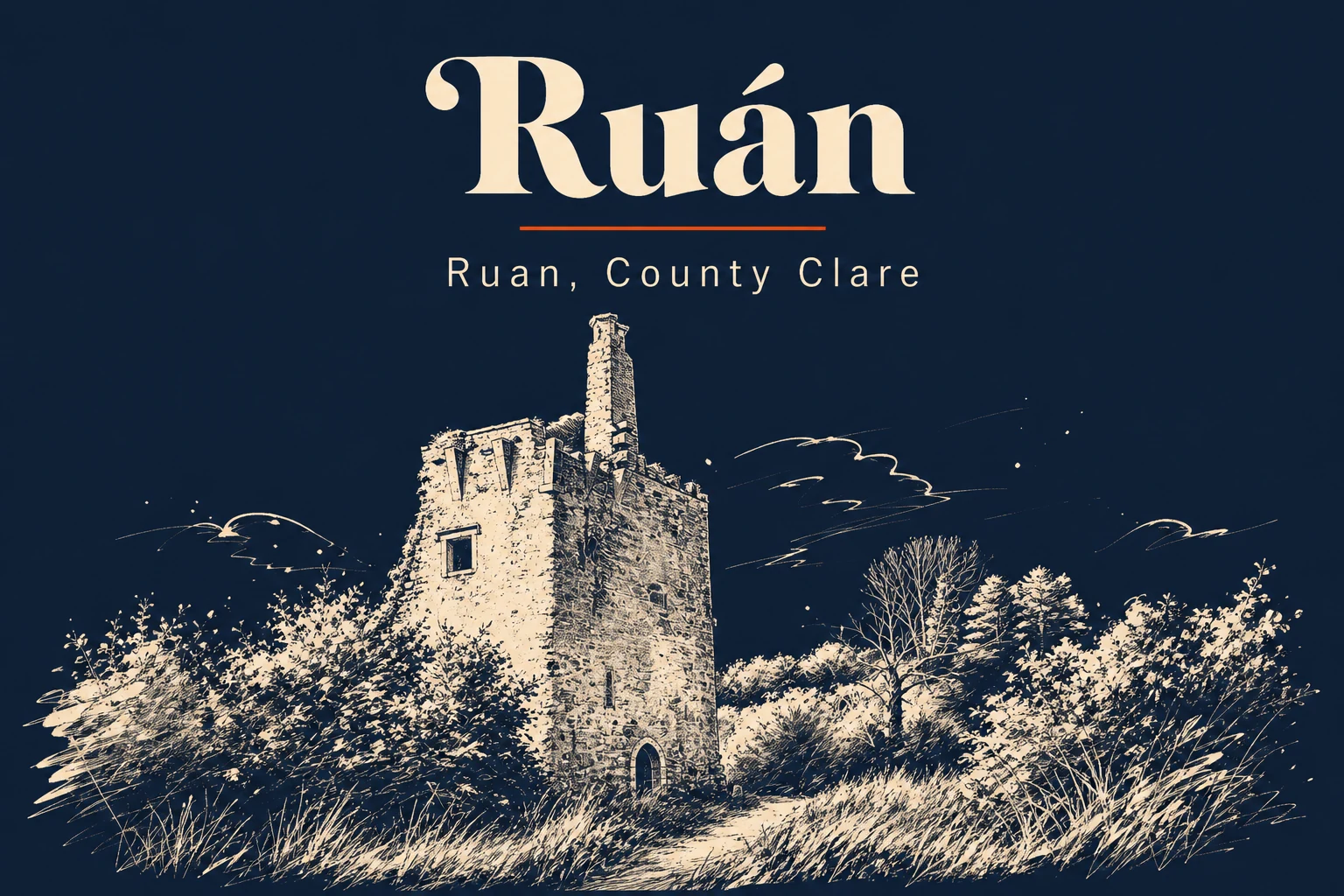
Ruán, Co. Clare

The Ireland's Ancient East
STOP 06 / 06
Ruán · Co. Clare

A crossroads village on the south-eastern edge of the Burren - ringforts in the fields, a 700-hectare wood next door, and the place that produced Sharon Shannon.

Ruan is a small village in the parish of Dysart and Ruan, about ten kilometres northwest of Ennis on the Corofin road, where the limestone of the Burren runs out into ordinary green farmland. It is a crossroads with a church, a school, a GAA pitch and a handful of houses. The countryside around it is full of ringforts - the Liss names pile up in the townlands, Lisnabulloge, Lisbeg, Lisduff, Lisheen - which tells you this was settled early and settled densely by early-medieval standards.

The parish was once called Dysert O'Dea, after the sept who held this corner of north Clare. The big event in its history happened two kilometres west on 10 May 1318, when Richard de Clare, the Norman lord of Thomond, marched on the O'Deas and was overwhelmingly beaten and killed at the Battle of Dysert O'Dea. The O'Briens reasserted control of Clare and the Normans never again seriously threatened them in the county. Ruan kept making smaller history afterwards: a sheep fair on 26 September that was one of the most important in the county by the 1830s, a station on the West Clare railway from 1888 to 1921, and a barracks attacked by the IRA Mid-Clare Brigade in October 1920.

What you actually come here for now is the land. Dromore Wood, the 700-acre nature reserve on the village's doorstep, is the real draw - turloughs and limestone pavement and a ruined O'Brien castle on the lake. The village itself is also Sharon Shannon's home place; the accordion player who outsold every other traditional record in Ireland with her 1991 debut was born and raised here.

Reports put three pubs in the village, and that is genuinely all the centre offers in the way of services - no hotel, no notable restaurant that research can confirm. Ennis, ten kilometres south, has everything Ruan does not, and Corofin five kilometres northwest has the Clare Heritage Centre and a lake. Use Ruan for the wood and the ringforts, then eat and sleep in Ennis.
Population
~250 (village)
Walk score
Village in three minutes; Dromore Wood in ten
Founded
Parish village, Dysart and Ruan; fair town by the 1830s
Coords
52.9583° N, 9.0833° W
01 / 06

At a glance.

Three things every local will eventually mention. Read these and you've already understood more than most day-trippers do.

02 / 06

Stories & lore.

The reason to come back. The things every local will eventually tell you about, usually after the second pint.

The day Norman Thomond was finished

The Battle of Dysert O'Dea, 1318

On 10 May 1318, Richard de Clare, the Norman lord of Thomond, marched on Conor O'Dea in this part of north Clare. The O'Deas, reinforced by the O'Briens and other Gaelic septs, met him near Dysert O'Dea two kilometres west of Ruan. De Clare was killed and his force overwhelmingly defeated. It was decisive: the O'Briens of Thomond reasserted control of Clare and the Anglo-Normans never again held the county. The parish around Ruan carried the name Dysert O'Dea for centuries afterwards. The battle is commemorated at the Dysert O'Dea castle and archaeology centre, which is the place to actually stand on the ground.

Liss names in every townland

The ringfort country

The townlands around Ruan are studded with Liss names - Lisnabulloge, Lisbeg, Lisduff, Lisheen - the Irish lios meaning a ringfort or enclosed homestead. The Burren and its fringes hold one of the densest concentrations of ringforts in Ireland. These were the farmsteads of the early-medieval period: circular banked enclosures, each typically home to one farming family. Most survive now only as low circular earthworks in the fields, but the sheer density of them tells you this was a well-worked, well-defended landscape long before the Normans ever rode through it.

400 hectares, a state reserve since 1985

Dromore Wood

On the village's doorstep, Dromore Wood is a National Parks and Wildlife Service nature reserve of roughly 400 hectares, established in 1985 for the diversity of its habitats. River, lakes, turloughs that fill and empty with the limestone water table, callows, reed beds, fen peat, bare limestone pavement and broadleaf woodland all sit in one stretch of ground. The ruined 17th-century O'Brien castle stands on the lakeshore, and the reserve also holds the sites of Cahermacrea Castle, Kilakee Church, two ringforts and a lime kiln. There is a visitor centre and two self-guiding nature trails.

The accordion that outsold everything

Sharon Shannon's home ground

Sharon Shannon, the button-accordion and fiddle player, was born and raised at Ruan in 1968. She started out as a child with the local band Disirt Tola, touring the United States at fourteen. Her self-titled 1991 debut became the best-selling album of traditional Irish music ever released in Ireland, and she has played with everyone from the Waterboys to Steve Earle since. The village does not make a fuss of it, which is in character, but the music came out of this parish.

03 / 06

Things to do outside.

Wear waterproofs. Bring a sandwich. Tell someone where you're going if it's the mountain.

Dromore Wood Loop The main walk in the area and the reason to come. The loop links the two self-guiding nature trails through woodland, along the lakeshore past the ruined O'Brien castle, and across limestone and turlough ground. National Parks and Wildlife reserve, free, with a visitor centre on site. Boots after rain - the turloughs are exactly where the ground floods.
6 km loopdistance
1.5 to 2 hourstime
Dromore nature trails If the full loop is too much, either of the two waymarked self-guiding nature trails through the reserve does the job in about an hour. Good for the woodland, the lake and the castle ruin without committing to the whole circuit.
Two short trailsdistance
1 hour eachtime
Mid-Clare Way (Dromore trailhead) Dromore is one of the trailheads for the Mid-Clare Way, a 148 km waymarked loop. Nobody is asking you to walk all of it; the point is that you can pick up a serious long-distance trail from the door here and walk a stage of it through the quiet country between Ruan and the wider Burren.
148 km full routedistance
Six days end to endtime
04 / 06

When to go.

There is no bad time. There are different times.

Spring
Mar-May

Dromore Wood at its best as the broadleaf comes into leaf and the turloughs are still full. Good light on the limestone and quiet trails.

◉ Go
Summer
Jun-Aug

Works as part of a Burren day - Dromore in the morning, Corofin or Dysert O'Dea after. Long evenings for the loop walk.

◉ Go
Autumn
Sep-Oct

Colour in Dromore Wood and empty roads. The ringfort fields are best walked with nobody else around.

◉ Go
Winter
Nov-Feb

The turloughs are full and the wood can be heavy underfoot. Fine for a passing stop; services are in Ennis and Corofin.

◐ Mind yourself
05 / 06

What to skip.

Honestly? Don't bother.

If a local was sitting beside you, this is the bit where they'd lean in.

×
Expecting a destination village

Ruan is a church, a school, a pitch and a few houses at a crossroads. Reports put three pubs here but no notable restaurant or hotel that can be confirmed. The wood and the ringforts are the reason to come; eat and sleep in Ennis or Corofin.

×
Looking for St Mary's spire

The spire of St Mary's church caught fire after a lightning strike in December 2024 and collapsed. Set your expectations accordingly if the church is on your list.

×
The battle as a Ruan attraction

The Battle of Dysert O'Dea is the parish's big story, but the ground and the visitor centre are at Dysert O'Dea two kilometres west, not in Ruan village itself. Go to the castle to stand where it happened.

+

Getting there.

By car

About ten kilometres northwest of Ennis on the Corofin road (R476 area). Corofin is five kilometres northwest, Dysert O'Dea two kilometres west, Crusheen to the east. Dromore Wood is signposted from the village.

By bus

No frequent scheduled service through the village. Local Link Clare covers parts of this rural area on limited timetables; check current routes. Ennis is the nearest real transport hub.

By train

No station - the West Clare railway line that served Ruan closed in 1921. The nearest railway station is Ennis, on the Limerick-Galway line, about ten kilometres south.