County Clare Ireland · Co. Clare · Kilmurry Save · Share
POSTED FROM
KILMURRY
CO. CLARE · IE

Kilmurry
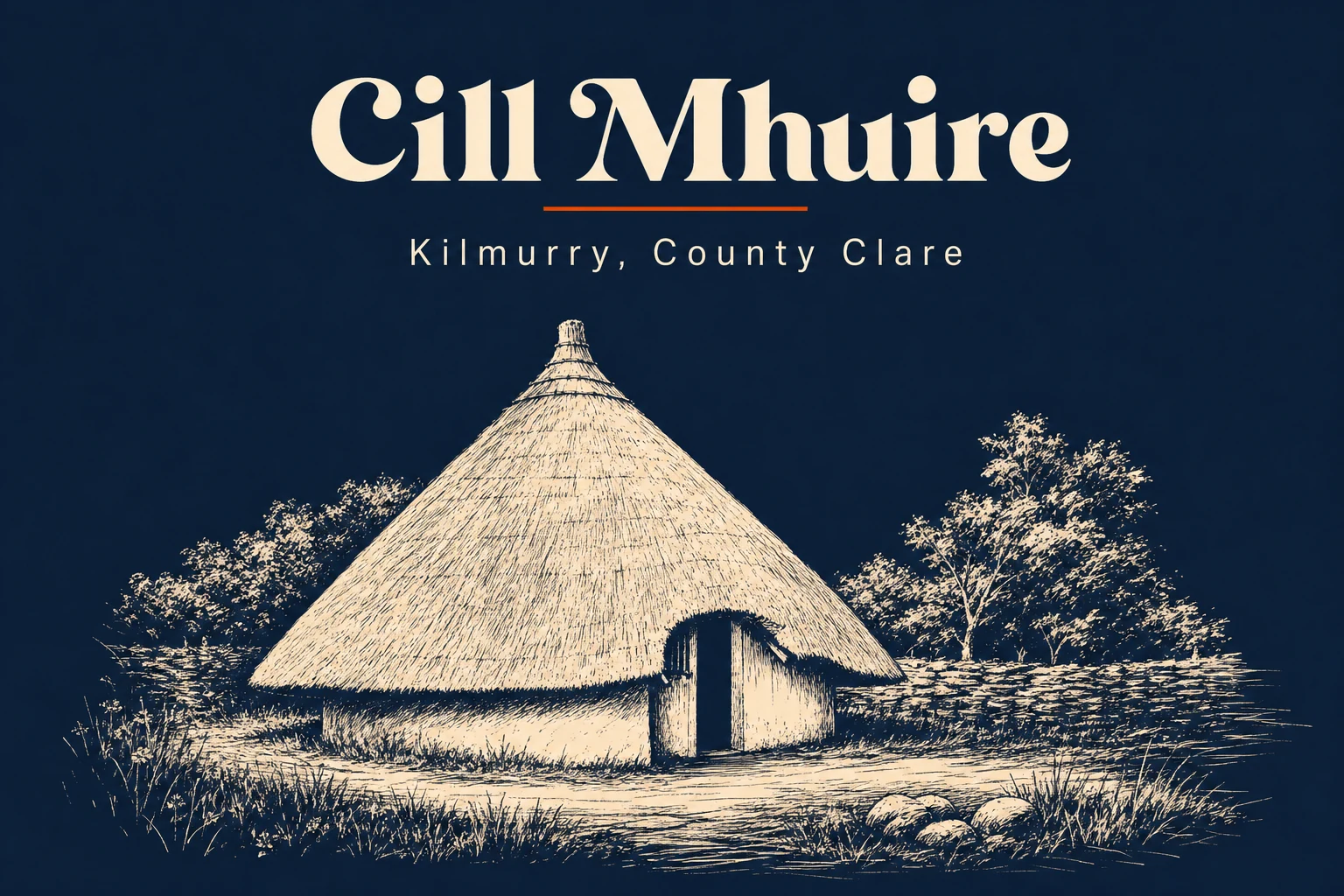
Cill Mhuire, Co. Clare

The Wild Atlantic Way
STOP 07 / 07
Cill Mhuire · Co. Clare

A five-road crossroads north of Sixmilebridge in the heart of MacNamara country - one pub, an old church ruin, and Craggaunowen up the road.

Kilmurry is a small East Clare village, not the Kilmurry on the Loop Head coast and not the one near Milltown Malbay - this is the one in the rolling drumlin country north of Sixmilebridge, on the R462 between Sixmilebridge and Kilkishen, about 4 km up the road to Quin. The centre of the village is a meeting of five roads, which is most of what makes it a village rather than a townland.

The civil parish is Kilmurry-Negaul. At its heart is the old parish church, now a roofless ruin in a graveyard that is still in use - by 1897 the last of the church walls were going, but people kept burying their dead around it, and they still do. There is a holy well nearby, Tobar Faoile. The parish ran nearly a thousand people in 1821; the Famine and emigration hollowed that out, as everywhere in west Munster, and it has stayed small since.

What brings visitors is not the village itself but what surrounds it. This is MacNamara country. Craggaunowen, 5 km north, is a 16th-century MacNamara tower house turned open-air archaeology park - the crannog, the ringfort, the ogham stone, and the leather-hulled boat Tim Severin sailed to Newfoundland in 1977 to prove St Brendan could have reached America first. Knappogue Castle, the older MacNamara seat, is 5 km west. And the 12 O'Clock Hills walking trails are a short drive east near Kilkishen.

Day to day the village has the Pumphouse Bar and not a great deal else, and it would not pretend otherwise. It is a place to pass through on the way to a castle or a hill walk, with one good pub stop in the middle of it. Sixmilebridge has the shops and the train within ten minutes; Ennis and Shannon Airport are both close.
Population
~200 (parish; village smaller)
Pubs
1and counting
Founded
Medieval parish (Kilmurry-Negaul); MacNamara castles 15th-16th c.
Coords
52.7833° N, 8.7833° W
01 / 07

At a glance.

Three things every local will eventually mention. Read these and you've already understood more than most day-trippers do.

02 / 07

The pubs.

None of these are themed Irish pubs, because they don't need to be. A few that earn the trip:

The Pumphouse Bar

Old-school bar, community hub
Village pub, Kilmurry crossroads

The pub at the crossroads and the social centre of the parish. It closed for a spell and reopened under new management, which the village treated as the news it was - the manager described it openly as a community centre as much as a bar. Old-school room, younger crowd at the weekend. If you want one stop in Kilmurry, this is it, because it is more or less the only one.

03 / 07

Stories & lore.

The reason to come back. The things every local will eventually tell you about, usually after the second pint.

Cill Mhuire, Kilmurry-Negaul

The church of Mary, and a well

The village takes its name from its medieval parish church - Cill Mhuire, the church of the Virgin Mary - though local tradition holds the original dedication may have been to an Irish saint, the kind of substitution that happened across Ireland as Roman dedications layered over older ones. By 1837 the church was already a ruin; by 1897 the last of its walls had gone. What remains is the graveyard, sub-rectangular, wrapped around the footprint of the lost church, and still an active burial ground. A holy well nearby, Tobar Faoile, kept the older devotion going after the building itself was gone. It is the quiet centre of the place and worth a few minutes if you are passing.

MacNamara tower house, c. 1550

Craggaunowen and the Brendan Boat

Five kilometres north, Craggaunowen Castle was built around 1550 by John MacSioda MacNamara, a descendant of the Sioda MacNamara who raised Knappogue in 1467. In the 20th century the John Hunt collection turned the castle and its grounds into an open-air museum of ancient Ireland: a reconstructed crannog (a lake dwelling on stilts, ringed by a spiked palisade), a ringfort, a fulacht fiadh cooking site, a dolmen and an ogham stone. The star exhibit is the Brendan - the ox-hide and oak currach that Tim Severin sailed from Ireland to Newfoundland in 1976-77, recreating the voyage of St Brendan the Navigator and showing the medieval legend of an Irish monk reaching America was at least seaworthy. The boat sits indoors now, salt-stained and improbable.

MacNamara, 1467

Knappogue, the older seat

Knappogue Castle, 5 km west of Kilmurry, is the senior MacNamara tower house - built in 1467 by Sioda Cam MacNamara, whose family held some forty-two castles across the Clare baronies of Bunratty and Tulla at their height. Knappogue survived where most did not: it was spared in the Cromwellian period because its occupant had supported Parliament, was later restored with a 19th-century castellated range, and now runs medieval banquets in the manner of Bunratty down the road. The two MacNamara castles, Knappogue and Craggaunowen, bracket the village and tell the same family's story a century apart.

04 / 07

Things to do outside.

Wear waterproofs. Bring a sandwich. Tell someone where you're going if it's the mountain.

12 O'Clock Hills looped walks The local hill-walking, a short drive east towards Kilkishen. Trailhead and car park at Belvoir, with two public toilets. Three waymarked loops - red, blue and purple - through woodland, bog and lakeshore, passing the 15th-century Ballycullen Castle. The tops give panoramic views over West Clare, the Burren and the Shannon Estuary. The long-distance East Clare Way (180 km circular) links through here.
5 km, 8.5 km or 13 km loopsdistance
1.5 to 4 hourstime
Craggaunowen grounds The archaeology park itself is walkable - paths loop around the tower house, the crannog out on its island, the ringfort and the woodland. Admission charged; seasonal opening, so check before you drive out. Good for an hour or two and genuinely interesting for children.
Short trails around the castle and lakedistance
1 to 2 hourstime
Rosroe and Fenloe lakes Two small lakes near the village, popular with birdwatchers - willow warblers, herons, kestrels and terns among them. Not a formal trail so much as a quiet place to stand with binoculars. The castle of Rossroe, a MacNamara holding well preserved into the 1890s, stood near here.
Lakeside, casualdistance
30 to 60 minutestime
05 / 07

When to go.

There is no bad time. There are different times.

Spring
Mar-May

Craggaunowen opens for the season and the 12 O'Clock Hills are at their greenest. Quiet, with the castles and trails to yourself on a weekday.

◉ Go
Summer
Jun-Aug

Full season for Craggaunowen and Knappogue banquets, long evenings for the hill walks, and the Pumphouse busy at weekends. The best window for the area.

◉ Go
Autumn
Sep-Oct

Good colour on the 12 O'Clock Hills and clear estuary views on a settled day. Craggaunowen winds down its season, so check opening before driving out.

◉ Go
Winter
Nov-Feb

Castles and the archaeology park are mostly closed or seasonal. The hill trails get muddy. The pub keeps going. Come for the walk and the fire, not the visitor attractions.

◐ Mind yourself
06 / 07

What to skip.

Honestly? Don't bother.

If a local was sitting beside you, this is the bit where they'd lean in.

×
Expecting a tourist village

Kilmurry is a working crossroads parish with one pub and a church ruin. The interest is what surrounds it - Craggaunowen, Knappogue, the 12 O'Clock Hills. Treat the village as a base or a pause, not a destination in itself.

×
Confusing it with the other Kilmurrys

There are several Kilmurrys in Clare - one near Loop Head (Kilmurry McMahon), one near Milltown Malbay (Kilmurry-Ibrickane). This is the East Clare one north of Sixmilebridge. Set your sat-nav to the village near Quin, or you will end up an hour and a half away on the coast.

×
Driving to Craggaunowen off-season without checking

The archaeology park runs seasonal hours and shuts for the winter. It is a real drive down side roads to find a locked gate. Check the opening times before you set out.

+

Getting there.

By car

On the R462 between Sixmilebridge and Kilkishen, about 4 km north of Sixmilebridge on the road to Quin. From the M18 (Limerick to Ennis) take the Sixmilebridge exit; Shannon Airport is roughly 20 minutes south, Ennis 20 minutes northwest.

By bus

No direct service to Kilmurry itself. Sixmilebridge, 4 km south, has bus connections, and Local Link covers parts of East Clare. A car is effectively essential for the village and the surrounding castles and trails.

By train

The nearest station is Sixmilebridge on the Limerick to Galway line, about 4 km south, with services to Limerick and Ennis. No public transport from the station to the village.

By air

Shannon Airport (SNN) is about 20 minutes south by car - the closest airport in the country to the village, which makes this an easy first or last stop on a Clare trip.