County Cork Ireland · Co. Cork · Aghabullogue Save · Share
POSTED FROM
AGHABULLOGUE
CO. CORK · IE

Aghabullogue
Achadh Bolg, Co. Cork

The Lee Valley
STOP 07 / 07
Achadh Bolg · Co. Cork

A one-pub farming village with 1,400 years of Christianity in its graveyard and Cork's first All-Ireland in its trophy cabinet.

Aghabullogue is a parish village in the upper Lee country, thirty kilometres west of Cork city and tucked under the southern edge of the Boggeragh Mountains in the old barony of Muskerry East. The parish takes in Coachford and Rylane as well; the village itself is the small bit - a pub, a shop, a national school, a community hall, and St John's Catholic church. Census figures count the parish rather than the village, so the village is best read as a few hundred people and the farms that surround them.

What the place has, and most villages this size do not, is depth. The graveyard at Coolineagh has been a place of Christian burial for something like fourteen hundred years, founded on the cell of St Olan - confessor to St Finbarr of Cork and the patron everyone here still names. The oval boundary of the early monastic enclosure is still half-visible, bisected now by a public road.

Then there is the hurling. In 1890 a team from this parish went to Dublin in bare feet and came home with Cork's first All-Ireland title. That is not a brochure line - it is fact, and it is the kind of fact a small place keeps polished. Come for the saint and the stone and the story. Do not come expecting a tourist town. There is one pub. That is the right number.

Population
~300 (village)
Pubs
1and counting
Founded
Early Christian ecclesiastical site, c. 6th century (St Olan)
Coords
51.9450° N, 8.8081° W
01 / 07

At a glance.

Three things every local will eventually mention. Read these and you've already understood more than most day-trippers do.

02 / 07

The pubs.

None of these are themed Irish pubs, because they don't need to be. A few that earn the trip:

The village pub

The one pub, and the GAA pub
Local bar, village centre

Aghabullogue has a single public house in the village, alongside the shop. It is a local in the truest sense - the parish drinks here, the GAA talk happens here, and on a championship Sunday it is the centre of the world. There is no second option and no need for one. If you want choice, Coachford is five kilometres east.

03 / 07

Stories & lore.

The reason to come back. The things every local will eventually tell you about, usually after the second pint.

Olan / Eolang, patron of the parish

St Olan and the three stations

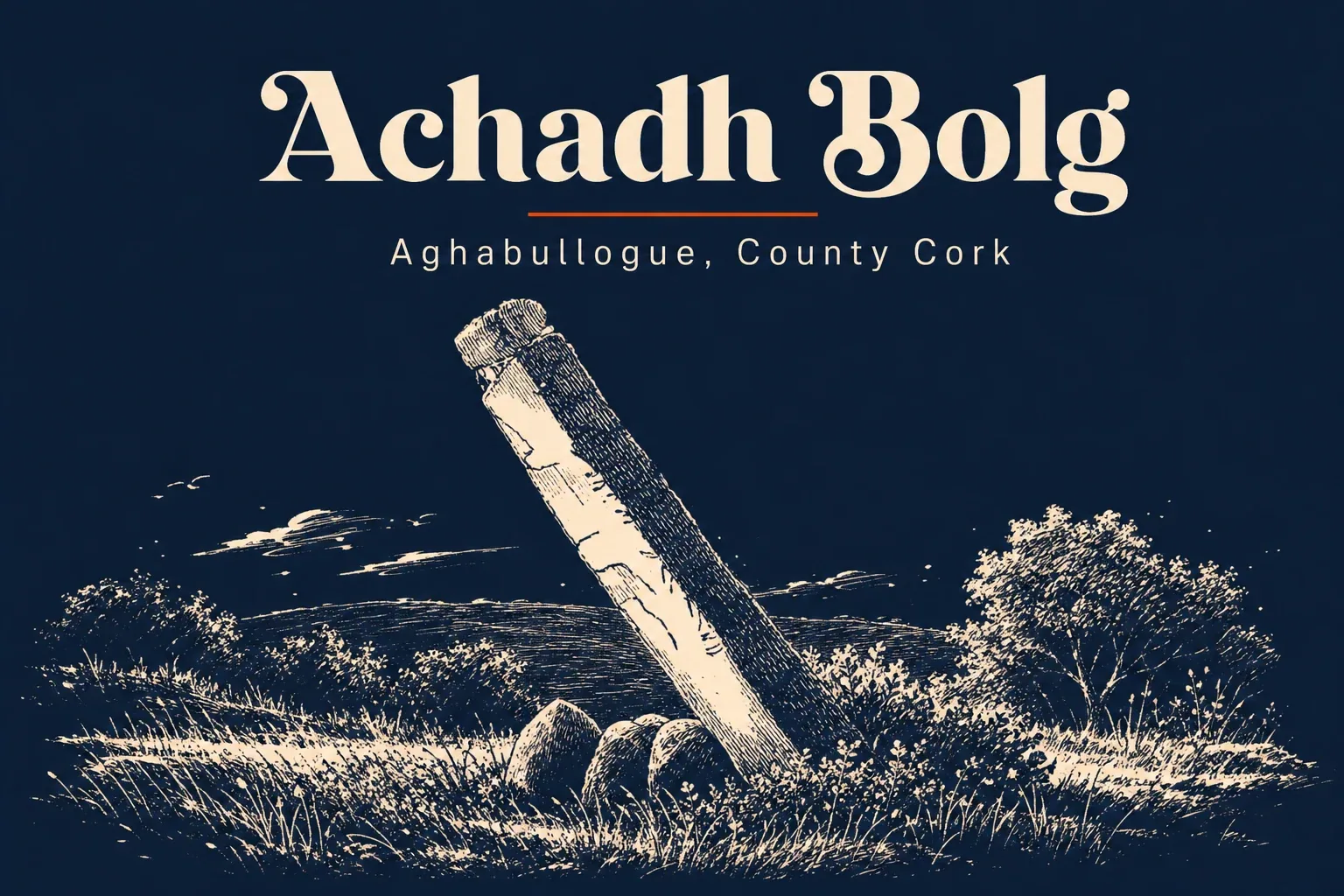
Olan, also written Eolang, was an early saint remembered as confessor to St Finbarr of Cork, and his cell is the seed the parish grew from. His cult survives as three pilgrim stations. St Olan's Well sits by the Rylane road, a little stone beehive structure inside a chain-looped fence, once visited for cures of eye trouble, toothache and warts. In the old churchyard at Coolineagh stand the other two: St Olan's Stone, and St Olan's Cap - a quartzite boulder that sits on top of a tall ogham-inscribed pillar stone. The cap was carried three times around the medieval church on the head to cure a headache, and was credited with helping women in childbirth. Rounds were paid with five Our Fathers, Hail Marys and Glorias at each station and a full Rosary. The pattern day is 5 September.

Found in the demolition, 1838

The Coolineagh ogham stone

In 1838 workmen under the architect William Hill were taking down the old church in Aghabullogue graveyard when they turned up an ogham stone, its edges notched with the old alphabet. It went on to University College Cork and is part of the collection there as the Coolineagh ogham stone. The parish therefore has two ogham connections within a field of each other: the stone that travelled to UCC, and the pillar that still stands under St Olan's quartz cap. For a place this small, that is a remarkable density of very old writing.

Cork's first All-Ireland

Barefoot champions, 1890

Aghabullogue won the Cork county hurling championship of 1890, and under the rules of the day the county champions represented Cork at the All-Ireland. The final was played at Clonturk Park in Dublin on 16 November 1890 against Wexford, represented by the Castlebridge club. The Aghabullogue men wore green and white and white breeches, and famously played in bare feet. With Wexford leading, the Cork team left the field over rough play; the referee awarded the game to Cork and the Central Council ratified it a week later. It stands as Cork's first All-Ireland hurling title, and Aghabullogue GAA has carried it as the club's founding story ever since. Dan Drew (1863-1923), one of that team, is the parish's best-remembered hurler.

04 / 07

Things to do outside.

Wear waterproofs. Bring a sandwich. Tell someone where you're going if it's the mountain.

Village to St Olan's Well and Coolineagh churchyard The well sits by the Rylane road inside a railed enclosure; from there the old churchyard at Coolineagh, with St Olan's Stone and the ogham pillar under its quartz cap, is a short way on. Lanes, not trails. Bring boots and the patience to read worn stone. This is the parish's whole story laid out within a couple of fields.
Short - a few km of quiet lanesdistance
1 to 2 hours with stopstime
Lee Valley roads toward Coachford The road east drops out of the Boggeragh foothills toward Coachford and the Inniscarra reservoir. Open farming country, big sky, narrow roads. Better on a bike or on foot in good weather than gawped at through a windscreen.
5 km to Coachforddistance
Drive, or a long cycletime
05 / 07

When to go.

There is no bad time. There are different times.

Spring
Mar-May

The foothills green up and the lanes dry out. Quiet, long-lit, good for walking the stations without company.

◉ Go
Summer
Jun-Aug

Best light on the Boggeraghs and the GAA season in full flow. Still no crowds - this is not that kind of place.

◉ Go
Autumn
Sep-Oct

St Olan's pattern day falls on 5 September, the old pilgrim date. Clear light, the championship reaching its end, the village at its most itself.

◉ Go
Winter
Nov-Feb

Short days and weather coming off the hills. The pub and the church keep going; little else does. The churchyard is atmospheric in mist if you do not mind mud.

◐ Mind yourself
06 / 07

What to skip.

Honestly? Don't bother.

If a local was sitting beside you, this is the bit where they'd lean in.

×
Expecting a visitor centre

There is none. No tearoom at the well, no interpretive panel at the ogham stone, no gift shop. The interest here is real and unmediated, which is the appeal - but you must come knowing what you are looking at, because nothing will explain it to you on site.

×
Treating it as more than a half-day

The well, the churchyard, the stone, a pint and the lie of the land are a morning or an afternoon, not a stay. Base yourself in Macroom or Coachford and take Aghabullogue as a focused detour into the parish's history.

+

Getting there.

By car

About 30 km west of Cork city. Easiest via the N22 to the Lee Valley and up the local roads through Coachford (5 km east) and Dripsey, or in from Macroom to the west. Signposting is rural - a map helps.

By bus

No direct mainline service to the village. The nearest regular buses run through Coachford and Macroom on the Cork-Macroom corridor; check Local Link for the rural runs around Muskerry. A car is the realistic way in.

By train

No railway. Nearest stations are in Cork city (Kent Station), 30 km east. From there it is road the rest of the way.