County Cork Ireland · Co. Cork · Carrigadrohid Save · Share
POSTED FROM
CARRIGADROHID
CO. CORK · IE

Carrigadrohid
Carraig an Droichid, Co. Cork

The Lee Valley
STOP 08 / 08
Carraig an Droichid · Co. Cork

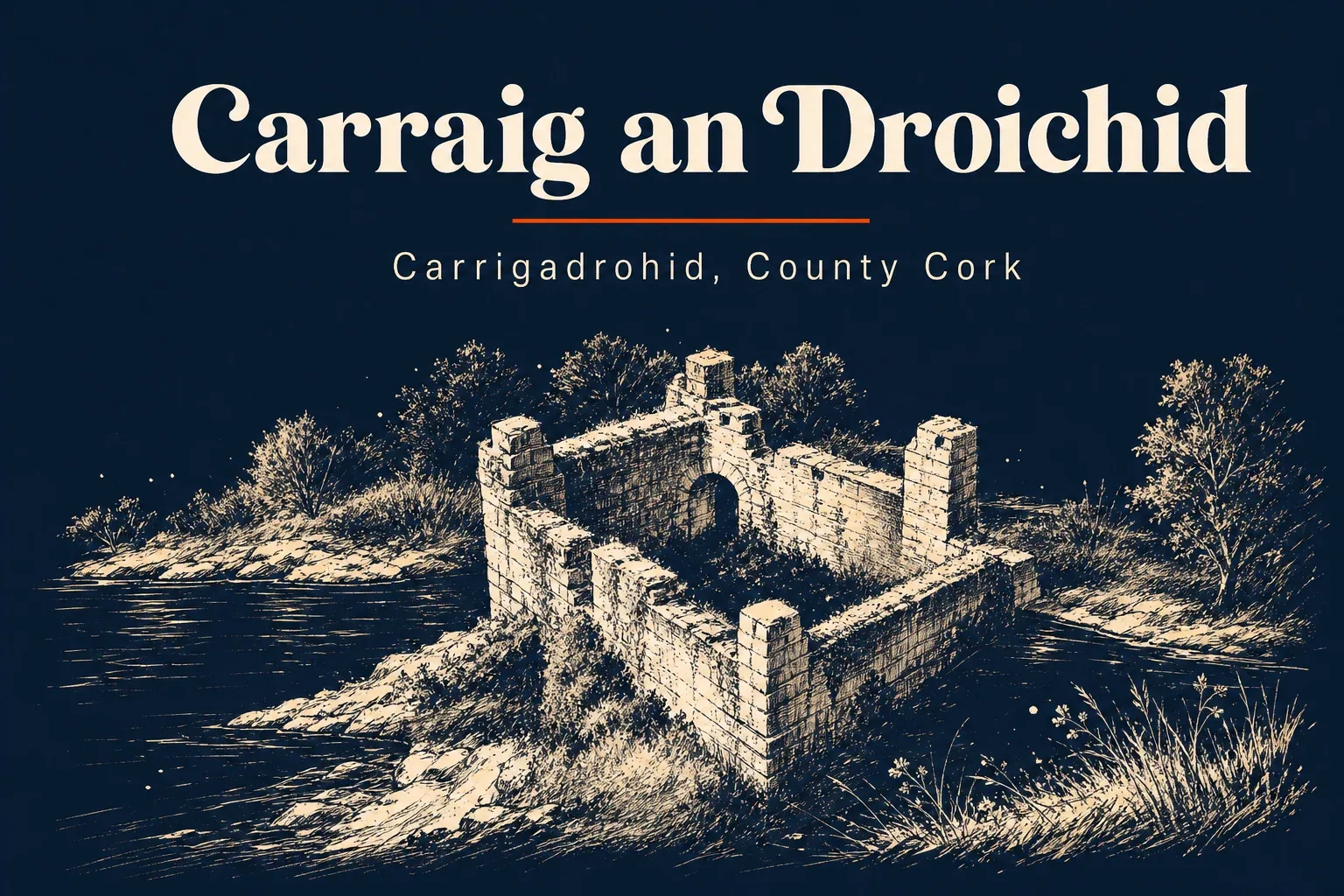
A MacCarthy tower house marooned on a rock in the Lee, a Cromwell-built bridge beside it, and a drowned valley behind. The name means rock of the bridge.

Carrigadrohid is a townland and small village in the parish of Aghinagh, on the north bank of the River Lee about eight kilometres east of Macroom. The name is the whole story in three words: Carraig an Droichid, the rock of the bridge. The rock carries a castle. The bridge crosses beside it. Both have been there longer than anything else you will see.

Cormac Laidir MacCarthy and his kin, the MacCarthys of Muskerry, put the tower house up in 1455 on a low rock in the middle of the river, a toll post to control everything moving along the Lee. In 1650, after the Battle of Macroom went against the Irish, Parliamentary forces besieged it. The story they tell here is of Boetius MacEgan, Bishop of Ross, brought to the castle a prisoner and ordered to call on the garrison to surrender. He told them to hold out instead, and was hanged outside the walls with the reins of his own horse. The castle was last lived in around 1750 and was a ruin by 1770. The Office of Public Works put money into stabilising it in 2006. It still stands on its rock, which is more than most.

The other thing that shaped the place arrived in the 1950s. The ESB dammed the Lee here as part of the Lee Hydroelectric Scheme, built between 1952 and 1957, and the reservoir backed up over the valley floor. Carrigadrohid station turns out around eight megawatts. The water is calm and wide and good for coarse and trout angling, and it makes the castle look like it is floating, which it more or less is.

Do not come expecting a town. This is a bridge, a castle, a handful of houses, a church and graveyard across the water at Killinardrish, and the GAA pitch of Canovee club near the power station. The reasons to stop are the castle, the still water, and the drowned forest of the Gearagh a short drive upstream. If you are driving the Lee between Cork and Macroom, the southern shore road is quiet and the view of the tower on its rock is the picture.
Population
~200
Founded
Tower house built 1455 by the MacCarthys of Muskerry
Coords
51.9017° N, 8.8528° W
01 / 08

At a glance.

Three things every local will eventually mention. Read these and you've already understood more than most day-trippers do.

02 / 08

The pubs.

None of these are themed Irish pubs, because they don't need to be. A few that earn the trip:

The Carrig Inn

The local, and the only one
Village bar

The bar in the village itself, by the bridge and the castle. A small country pub of the kind that doubles as the social centre of a place this size. Do not expect a music programme or a gastropub menu. Expect a pint, the local crowd, and a view of the most photographed castle in the Lee Valley out the door. For a fuller choice you are looking at Coachford or Macroom.

03 / 08

Where to sleep.

PlaceTypeLocal note
O'Callaghan's Bar & Guest Rooms Bar with guest rooms, Coachford (8 km) Not in Carrigadrohid itself but in Coachford on the far side of the reservoir, the nearest bed worth naming. A traditional bar on Main Street with en-suite guest rooms and a cooked breakfast, long popular with anglers fishing the Lee reservoirs. The honest base for a night on the water.
04 / 08

Stories & lore.

The reason to come back. The things every local will eventually tell you about, usually after the second pint.

Boetius MacEgan, 1650

The bishop and the bridge

After the Battle of Macroom in 1650, Cromwellian forces under Lord Broghill took Boetius MacEgan, the Catholic Bishop of Ross, prisoner and brought him to Carrigadrohid Castle. The garrison inside was holding out. MacEgan was marched to the walls and told to order them to surrender in exchange for his life. He did the opposite, calling on the men to hold the castle, and was hanged on the spot with the reins of his own horse. The castle fell soon after and the MacCarthys lost everything. The bridge beside it is traditionally said to have been built on Cromwell's order, which is why the river crossing and the tower have stood side by side ever since.

A toll tower in a man-made lake

The castle on the rock

The MacCarthys of Muskerry built the tower house in 1455 on a rock in the middle of the Lee, a rare medieval castle set on an island in a river rather than on a bank. Extensions were added east and an annex north over the following centuries. It controlled the movement of goods and people along the valley. Granted to the Bowen family after the Cromwellian dispossession, it was abandoned by the mid-1700s. Four hundred years and several wars later, the ESB raised a reservoir around its feet in the 1950s and left it standing. Engineers worked around the rock. The tower is still there in the water.

The Gearagh, an Gaorthadh

The drowned forest

Two kilometres upstream toward Macroom is the Gearagh, the last fragment of primeval post-glacial alluvial forest in western Europe, a maze of braided river channels and oak-wooded islands that had stood since the end of the last Ice Age. In 1954 the ESB clear-felled roughly half of it ahead of flooding the valley behind the Carrigadrohid dam, and around sixty percent of the old oak woodland was lost. What survived was declared a statutory nature reserve in 1987 and is now a Ramsar wetland of international importance. At low water the drowned stumps stand out of the reservoir. It is one of the strangest landscapes in Munster and almost nobody is there.

05 / 08

Things to do outside.

Wear waterproofs. Bring a sandwich. Tell someone where you're going if it's the mountain.

The castle and bridge Park near the bridge and walk it. The tower house sits on its rock in the river right beside the crossing, best seen from the bridge itself or the southern bank. The castle is a stabilised ruin and not open to enter, so this is a look-and-photograph stop rather than a clamber. The water is usually mirror-still. Across the bridge is the old church and graveyard at Killinardrish.
Short, roadsidedistance
20 minutestime
The Gearagh nature reserve Drive two kilometres upstream toward Macroom to the Gearagh. Marked paths run along causeways out into the reservoir among the drowned oak woodland. A Ramsar site and one of the best birdwatching spots in Cork, with wildfowl in winter. Wear boots, the ground is wet, and the light at dawn over the dead trees is the reason to come early.
Several marked trailsdistance
1 to 2 hourstime
The southern shore drive Not a walk so much as the quiet alternative to the main R618. The minor road along the south side of the reservoir runs through Canovee and gives the long views back across the water to the castle. A good slow link if you are crossing between Cork city and Macroom and have ten minutes to spare.
Drive, several kmdistance
30 minutestime
06 / 08

When to go.

There is no bad time. There are different times.

Spring
Mar-May

The valley greens up, the water is high and still, and the Gearagh comes alive with birdsong. Good light on the castle and few people about.

◉ Go
Summer
Jun-Aug

Long evenings on the reservoir, the best months for coarse and trout angling, and the southern shore drive at its quietest. Bring midge repellent for the Gearagh at dusk.

◉ Go
Autumn
Sep-Oct

Low autumn water can expose the drowned stumps in the Gearagh, and the oak colour is worth the trip. Crisp light on the tower house.

◉ Go
Winter
Nov-Feb

Short days and a lot of rain off the valley, but winter is the season for wildfowl on the reservoir and the Gearagh. Roads can flood near the water. A clear cold day here is exceptional and a wet one is grim.

◐ Mind yourself
07 / 08

What to skip.

Honestly? Don't bother.

If a local was sitting beside you, this is the bit where they'd lean in.

×
Trying to get inside the castle

It is a stabilised medieval ruin on a rock in the river, not a visitor attraction with a turnstile. There is no access into the tower and no causeway to walk out to it. Photograph it from the bridge and the bank. That is the whole experience, and it is a good one.

×
Expecting a village with services

Carrigadrohid is a bridge, a castle, a church across the water and a single bar. There is no shop strip, no cafe row, no hotel in the village. Stock up in Macroom or Coachford. Come for the castle and the water, not for a day's worth of amenities.

+

Getting there.

By car

On the R618 between Macroom and Coachford, about 8 km east of Macroom on the north bank of the Lee. The castle is visible from the road and the bridge. Cork city is roughly 30 km east via the N22 and Lee Valley roads.

By bus

No direct village service of note. Bus Eireann and Local Link routes serve Macroom on the N22 corridor; from there it is a short drive or taxi. Coachford has limited Local Link links toward Cork city.

By train

No railway. The nearest stations are in Cork city (Kent Station), about 30 km east, on the lines to Dublin, Mallow and Cobh.

By air

Cork Airport (ORK) is about 35 km southeast, around 45 minutes by car. It is the natural arrival point for the Lee Valley.