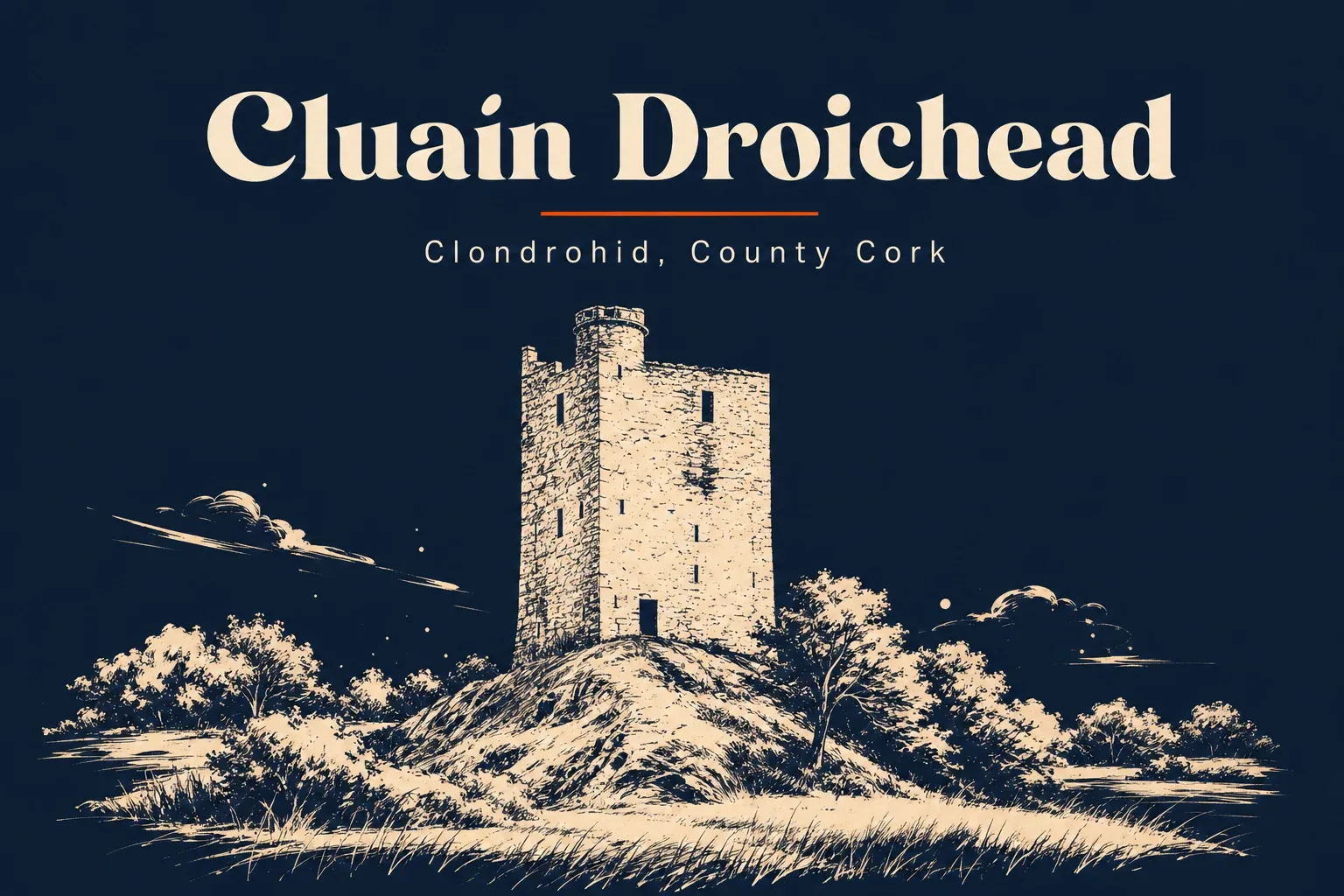
MacCarthy tower house, early 15th century
Carrigaphooca - the rock of the puca
Caislean Charraig a' Phuca, the castle on the rock of the puca, is a five-storey rectangular tower of sandstone and limestone set on a steep crag above the River Sullane. The MacCarthys of Muscrai built it as a defensive tower in the early 15th century. Its history is dramatic: Cormac Teige McCarthy, Lord of Blarney, sheltered here after siding with the Irish at the Siege of Kinsale in 1601, and stayed until Elizabeth I forgave him for a written apology. In 1602 the tower was attacked and taken by Donal Cam O Sullivan Beare's forces, who broke the outer wall and burned the timber door. The castle is owned by the state and maintained by the Office of Public Works, but it stands on private land and is not open to the public. You look at it from the road - which, given the setting, is no hardship.
Roughly 3,000 years old
The stone circle by the river
In a field near the castle stands the Carrigaphooca stone circle, a Bronze Age monument reckoned to be around three thousand years old. Five standing stones in the open valley, older than the tower beside them by some two and a half millennia. The pairing - prehistoric circle and medieval keep within sight of each other above the Sullane - is the kind of layered antiquity that Irish farmland throws up without ceremony.
A barn-style church on the rise
St Abina's church, 1877
The Catholic church in the village, St Abina's, was built in 1877 - a tall, plain, barn-style church of seven bays with rendered walls, a cut-limestone bellcote and a slate roof. Inside there is a carved timber Queen-post truss roof with arch braces, a marble altar and a timber gallery on columns. It replaced an earlier cruciform church shown on the first Ordnance Survey maps of the 1840s, and it remains the social focus of the village.
1839-1920, born in the parish
Peadar O Laoghaire
An tAthair Peadar O Laoghaire - Father Peter O'Leary - was born in the parish of Clondrohid in 1839. A Catholic priest and one of the central figures of the Gaelic Revival, he wrote Seadna, often cited as the first major work of modern literary Irish, alongside a stream of stories, translations and his autobiography Mo Sceal Fein. His insistence on writing the living spoken Irish of Muscrai, rather than a bookish revival dialect, shaped the language as it is written today. A considerable figure to come out of so small a place.
Clondrohid GAA
County champions, 1891 and 1892
Clondrohid GAA, the village's Gaelic football club, was one of the earliest Muscrai clubs to win the Cork county championship, taking the title in 1891 and defending it in 1892, beating Kilmurry in the final both years. It is a footballing club to this day, the pitch and clubhouse on the edge of the village. For a parish this size to hold back-to-back county crowns in the GAA's first decade is a fact the locals have not forgotten.