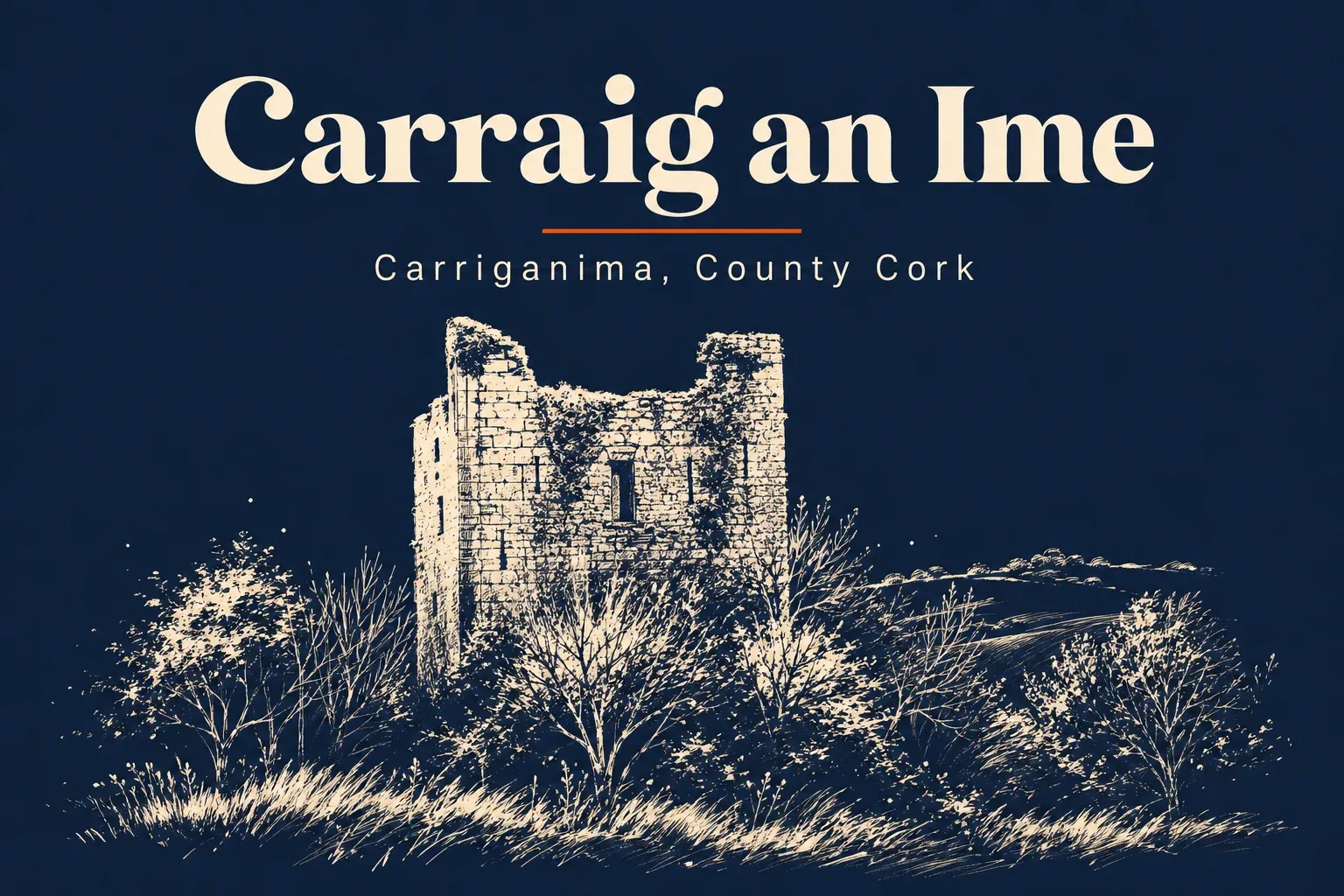
County Cork Ireland · Co. Cork · Carriganima Save · Share
POSTED FROM
CARRIGANIMA
CO. CORK · IE

Carriganima
Carraig an Ime, Co. Cork

The Mid Cork
STOP 07 / 07
Carraig an Ime · Co. Cork

A small upland village on the R582 between Macroom and Millstreet, in the old Muskerry barony. It is where Art O'Leary was shot dead in 1773, the killing behind the greatest love poem in the Irish language.

Carriganima is a small village on the eastern flank of the Derrynasaggart Mountains, in the upper Muskerry country of mid Cork. It sits in a valley between the Boggeragh and Derrynasaggart ranges, on the R582 roughly halfway between Macroom and Millstreet, close enough to the Kerry line that the landscape has already started to change - open hill, small farms, the Foherish stream running down past the old creamery toward the Sullane.

The name is Carraig an Ime, the rock of the butter. There is a church, a national school, a GAA presence, one pub, and not a great deal else by way of amenities. Millstreet is the nearest town with a full set of services, about 10km north; Macroom is the larger gateway town, around 11km southeast. This is working farming country, not tourist country, and it does not pretend otherwise.

What it has, out of all proportion to its size, is a place in Irish literature. On 4 May 1773 Art O'Leary was shot dead here, and the lament his wife composed for him is taught in classrooms across the country to this day. Half a century later the village raised a man who would help save the language that lament was written in. For a crossroads of three hundred people, that is a heavy weight of story to carry, and most of the cars heading over to Killarney never slow down enough to feel it.

Population
~300
Pubs
1and counting
Walk score
A roadside village - the walking is in the hills around it
Founded
Gaelic Muskerry settlement; medieval ringfort country
Coords
51.9667° N, 9.0333° W
01 / 07

At a glance.

Three things every local will eventually mention. Read these and you've already understood more than most day-trippers do.

02 / 07

The pubs.

None of these are themed Irish pubs, because they don't need to be. A few that earn the trip:

The Pub

The one local, and the heart of the place
Village pub, Carriganima

Carriganima has one pub and it is called, plainly, The Pub. It is the community's gathering point - music and dance nights with local and visiting bands, fundraisers, the muster point for the St Patrick's Day parade and the charity tractor runs. Do not arrive expecting a gastropub. Arrive expecting a rural Cork local where everyone knows everyone, and you will not be disappointed.

03 / 07

Stories & lore.

The reason to come back. The things every local will eventually tell you about, usually after the second pint.

4 May 1773

The death of Art O'Leary

Art O'Leary - Art Ui Laoghaire - was a Catholic gentleman who had served as an officer in the Hungarian army of the Empress Maria Theresa and come home to Macroom with a famous brown mare. Under the Penal Laws a Catholic could not legally own a horse worth more than five pounds, and when his mare beat the High Sheriff Abraham Morris's horse in a race, Morris demanded he sell it for that sum. Art refused. Outlawed and hunted, he was shot dead by Morris's soldiers at Carriganima on 4 May 1773. His wife, Eibhlin Dubh Ni Chonaill - aunt of Daniel O'Connell - came to the spot, drank a handful of his blood, and poured out her grief in the keen known ever since as Caoineadh Airt Ui Laoghaire, the Lament for Art O'Leary. It survived orally for decades before being written down, and is widely held to be the greatest poem composed in Ireland or Britain in the eighteenth century. Art is buried in Kilcrea Friary, west of Cork city; the killing happened here.

Born Liscarrigane, 1839

Peadar O Laoghaire and the rescue of the language

Peadar Ua Laoghaire was born in 1839 in the townland of Liscarrigane just outside Carriganima, and went to the local national school. He became a Catholic priest and one of the founding writers of the Gaelic revival. His novel Seadna, written in the living Irish of his own Muskerry district rather than a bookish literary dialect, is reckoned the first major prose work of the modern movement. Three townlands in the parish - Glendav, Liscarrigane and Labbadermody - are still officially inside the Muskerry Gaeltacht, the same Irish-speaking world he drew his stories from.

Con Walsh, born 1881

The Olympian from the crossroads

Cornelius E. Walsh, known as Con, was born in Carriganima on 24 April 1881. He emigrated and competed for Canada in the hammer throw at the 1908 London Olympics, where he took the bronze medal. A plaque was unveiled in his honour in the village in 2008, a hundred years on. Not bad for an upland parish that never had more than a few hundred souls.

04 / 07

Things to do outside.

Wear waterproofs. Bring a sandwich. Tell someone where you're going if it's the mountain.

The Derrynasaggart hills The high ground rises west of the village toward the Cork-Kerry border. This is unmarked, open hill country rather than a waymarked trail - rough, boggy underfoot, big views back over the Sullane valley on a clear day. Boots, a map, and respect for the weather. Not a casual stroll.
Variesdistance
Half daytime
Foherish valley lanes Quiet farm roads run down from the village past the old creamery along the Foherish stream. Low-key rural walking - hedgerows, cattle, the odd ringfort hump in a field. The kind of leg-stretch you do because you are already here, not because it is on a list.
Shortdistance
30-60 minutestime
05 / 07

When to go.

There is no bad time. There are different times.

Spring
Mar-May

The hills green up and the light over the Derrynasaggart is at its best. Early May is the anniversary of Art O'Leary's death - the date the lament hangs on. The village does its St Patrick's parade in March.

◉ Go
Summer
Jun-Aug

Long evenings and the easiest hill walking of the year. A handy quiet stop on the back road between Macroom and Killarney when the main routes are clogged with tour traffic.

◉ Go
Autumn
Sep-Oct

Clear, cool days for the high ground and fewer cars on the R582. Good light, fading colour on the bog.

◉ Go
Winter
Nov-Feb

Upland weather - wet, windy, the hills often in cloud. The pub keeps going but the walking is grim. Drive over the pass to Kerry only if you are confident in the conditions.

◐ Mind yourself
06 / 07

What to skip.

Honestly? Don't bother.

If a local was sitting beside you, this is the bit where they'd lean in.

×
Expecting a visitor centre for the lament

There is no museum, no interpretive centre, no gift shop for Caoineadh Airt Ui Laoghaire. This is a working village, not a heritage attraction. The story is in the place and the poem, not in a building you can pay into. Come knowing the poem and the landscape does the rest.

×
Treating it as a destination in its own right

Carriganima is a stop, not a stay - three hundred people, one pub, no accommodation in the village itself. Pair it with Millstreet, Macroom or a run over to Killarney. It rewards a slow half-hour, not a weekend.

+

Getting there.

By car

On the R582 between Macroom and Millstreet, signposted from the N72. About 11km northwest of Macroom and 10km south of Millstreet. Roughly 50 minutes from Cork city; the road continues over the hills toward Killarney.

By bus

Bus Eireann route 257 (Macroom - Millstreet - Killarney) runs the corridor through this part of mid Cork seven days a week. TFI Local Link Cork also covers the rural Macroom and Millstreet area; check current timetables before relying on it.

By train

No station in the village. The nearest railway station is Millstreet, about 10km north, on the Cork - Mallow - Killarney - Tralee line.