County Cork Ireland · Co. Cork · Dripsey Save · Share
POSTED FROM
DRIPSEY
CO. CORK · IE

Dripsey
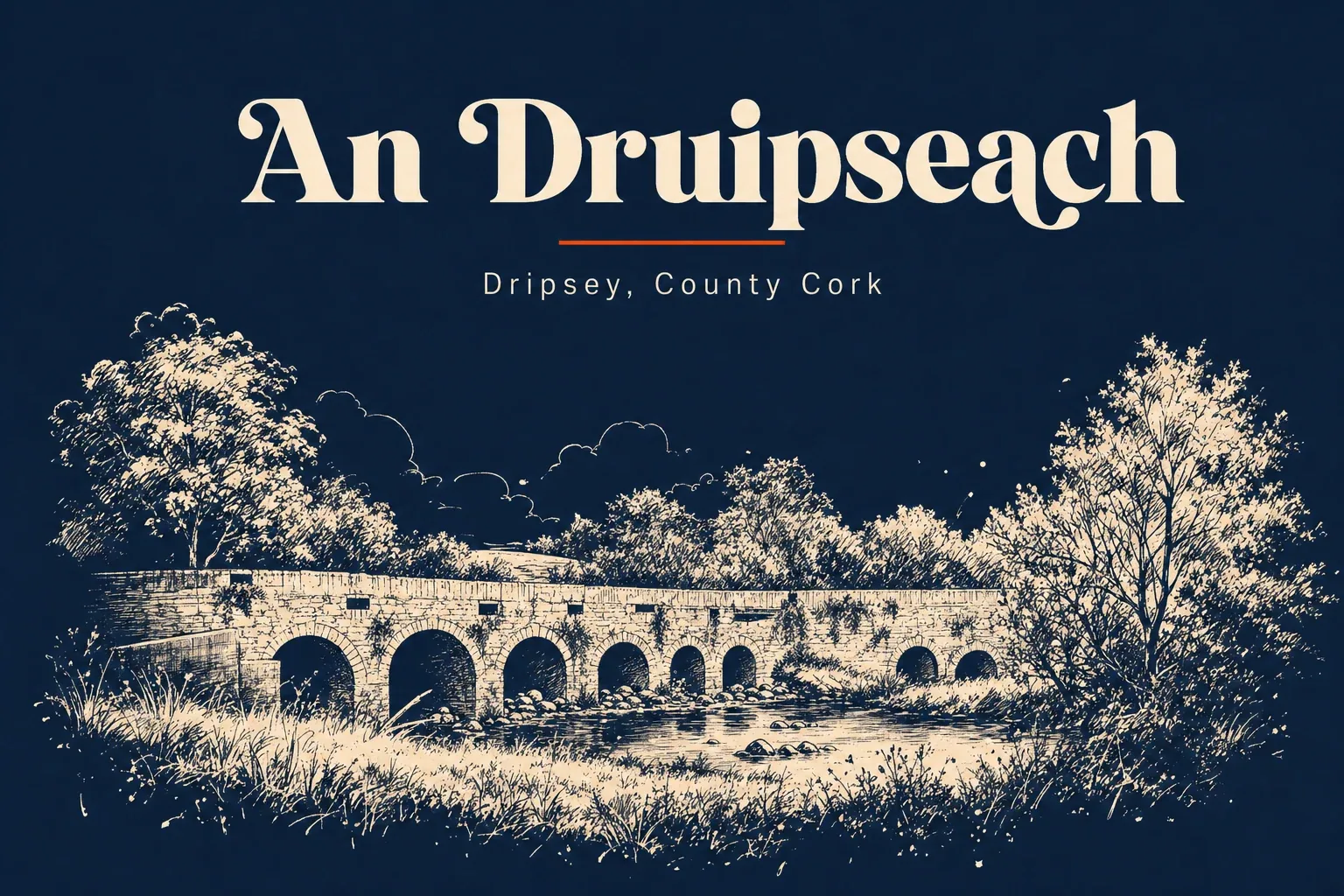
An Druipseach, Co. Cork

The Lee Valley
STOP 07 / 07
An Druipseach · Co. Cork

A mill village strung along the R618 where the Dripsey River runs to the Lee - a tower house, two dead mills, and the ambush nobody here has forgotten.

Dripsey is a small mill village on the R618, about twenty kilometres west of Cork city, strung along the valley of its own river where it falls towards the Lee. The folder will tell you it is on the N22 - it is not. The N22 runs the high road to Macroom. Dripsey is down on the river road through Coachford, the slower way, the one that follows the water.

It is barely three hundred people and it comes in three pieces - Lower Dripsey, Dripsey Cross, and the Model Village that grew up around the woollen mill. For a place this size it has carried a surprising amount of history. There was a paper mill here from 1784 that printed banknotes for the Bank of England and employed four hundred souls at its height; there was a woollen mill from 1840 that wove blankets and tweed and shipped them to Canada and New Zealand and closed in the late 1970s. Above all of it, on a rock over the river, stands Carrignamuck, a fifteenth-century MacCarthy tower house, and a Georgian house grafted onto its estate.

And then there is the ambush. On a January day in 1921 the local IRA set a trap on the Coachford road and were betrayed before a shot was fired. The men who were caught were tried and five of them were executed. The village has not let it go, and it should not. Seamus Murphy carved the memorial. You drive past it on the way in.

There is one pub now, the Weigh Inn at the Cross, run by the same family since 1969 - no food, no music most nights, a fire in winter and the pint. The other pub closed in 2007, which ended Dripsey's brief moment of fame: the world's shortest St Patrick's Day parade, twenty-three metres from one pub door to the other. Come for the history and the river. Do not come expecting a day's worth of things to do. That is not what Dripsey is.
Population
323 (2022)
Pubs
1and counting
Founded
Mill village; paper mill from 1784, tower house c. 1450
Coords
51.9147° N, 8.7422° W
01 / 07

At a glance.

Three things every local will eventually mention. Read these and you've already understood more than most day-trippers do.

02 / 07

The pubs.

None of these are themed Irish pubs, because they don't need to be. A few that earn the trip:

The Weigh Inn

Old-school, locals first
Village pub, Dripsey Cross

The one pub left in Dripsey, at the Cross, run by the Feeney family since they came from Bishopstown in 1969. No food menu, no music most nights, a working fire in winter and a properly poured pint. A community local in the truest sense - it was one of the two pubs that marked out the world's shortest St Patrick's Day parade. If you want the village, this is where it is.

03 / 07

Stories & lore.

The reason to come back. The things every local will eventually tell you about, usually after the second pint.

MacCarthy of Muskerry, c. 1450

Carrignamuck tower house

On a rock above the Dripsey River stands a five-storey tower house built around 1450 by the MacCarthys of Muskerry - the same dynasty that raised Blarney and Carrigadrohid - as one of a ring of strongholds guarding the Lee valley. Cromwellian forces under Lord Broghill took it in 1650. The estate passed eventually to the Colthurst family of Blarney, who built a Georgian house alongside the old tower in the eighteenth century. The tower still stands, blunt and grey, and the whole estate has changed private hands more than once in recent decades. It is not a public visitor attraction - admire it from the road and the river.

Paper from 1784, wool from 1840

The mills that built the village

Dripsey's two mills are the reason there is a village here at all. Batt Sullivan opened a paper mill on the river in 1784; it printed Treasury bills and Bank of England banknotes and employed around four hundred people by 1812 before it closed in 1864. A woollen mill went up in 1840, ran for a spell as a flour mill, then was bought in 1903 by Andrew O'Shaughnessy, who turned it back to wool. The Dripsey Woollen Mills wove cellular blankets, bedspreads and tweed and exported to Britain, Canada, New Zealand and the United States. The cluster of workers' houses around it was named the Model Village. The mill closed in the late 1970s. The Model Village is still there; the looms are not.

Betrayed at Godfrey's Cross

The Dripsey Ambush, 1921

On 28 January 1921 men of the 6th Battalion, Cork No. 1 Brigade lay in wait on the road between Dripsey and Coachford for a British convoy running from Macroom to Cork. They had been informed on - by a local loyalist, Mrs Mary Lindsay, who had spotted them and warned the military. The convoy came on prepared, outflanked the position, and in the failing light most of the IRA men escaped, but eight were captured along with two local men. Five of them were tried and executed. Lindsay and her chauffeur were later taken and shot by the IRA in reprisal, their bodies never found. A wooden cross went up in 1924, unveiled by Annie MacSwiney; in 1938 the Cork sculptor Seamus Murphy carved a slender limestone obelisk that stands at the ambush site today.

23.4 metres, door to door

The shortest parade in the world

From 1999 to 2007 Dripsey held what the record books recognised as the shortest St Patrick's Day parade in the world - a procession of twenty-three and a bit metres, the distance between the front doors of the village's two pubs, the Weigh Inn and the Lee Valley Inn. When the Lee Valley Inn closed in 2007 there was nowhere left to march to, and the parade ended. It is the kind of thing a very small place does very well, and it is genuinely the most famous thing Dripsey has done since the ambush.

04 / 07

Things to do outside.

Wear waterproofs. Bring a sandwich. Tell someone where you're going if it's the mountain.

Riverside and the mill village There is no waymarked trail in Dripsey itself - this is a quiet-roads wander. Walk down through Lower Dripsey and the Model Village along the river, looking up at Carrignamuck on its rock, and out past the ambush memorial on the Coachford road. Lanes and verges, not a hiking route. Boots after rain; the name means muddy river for a reason.
About 2 kmdistance
45 minutestime
Lee Valley towards Coachford Dripsey sits in the Lee Valley between the Inniscarra and Carrigadrohid reservoirs. The riverside and lakeshore walking is better a few kilometres west around Coachford and the dam, where there are proper marked paths. Use Dripsey as the starting point and drive the few minutes up the R618.
Variesdistance
Half a daytime
05 / 07

When to go.

There is no bad time. There are different times.

Spring
Mar-May

The river runs clear and the valley greens up. Late March brings the anniversary mood around the ambush memorial.

◉ Go
Summer
Jun-Aug

Long evenings and dry-ish lanes make the riverside wander pleasant. The Lee Valley walking around Coachford is at its best.

◉ Go
Autumn
Sep-Oct

Good light on the tower and the valley colours turning. Quiet, which is the point.

◉ Go
Winter
Nov-Feb

Wet, muddy and short on daylight. A fire in the Weigh Inn is the best of it.

◐ Mind yourself
06 / 07

What to skip.

Honestly? Don't bother.

If a local was sitting beside you, this is the bit where they'd lean in.

×
Expecting a tourist village

Dripsey is three hundred people, one pub, a tower you look at from the road and a memorial you stop at. There are no cafes to fill an afternoon, no visitor centre, no attraction with an entrance. It is a place to pass through slowly, not to spend a day in. Scale your expectations to the place.

×
The N22 turnoff

Old listings and the stub for this village will tell you Dripsey is on the N22. It is not. Stay on the river road, the R618 through Coachford. The N22 will take you straight past on the high road to Macroom and you will never see the place.

×
Trying to visit the castle

Carrignamuck and the Dripsey Castle estate are private property and have been sold privately in recent years. There is no public access and no tour. The view from the river road is the visit.

+

Getting there.

By car

Cork city to Dripsey is about 20 km west, roughly half an hour, out the R618 river road through Inniscarra and Coachford. Coming from the west, drop off the N22 at Macroom and follow the valley down. Blarney is about fifteen minutes north.

By bus

Local Link Cork serves the Lee Valley villages along the R618 corridor between Cork city, Coachford and Macroom, but services are infrequent - check the timetable before relying on it. A car is the realistic way to get here.