County Cork Ireland · Co. Cork · Ballinascarthy Save · Share
POSTED FROM
BALLINASCARTHY
CO. CORK · IE

Ballinascarthy
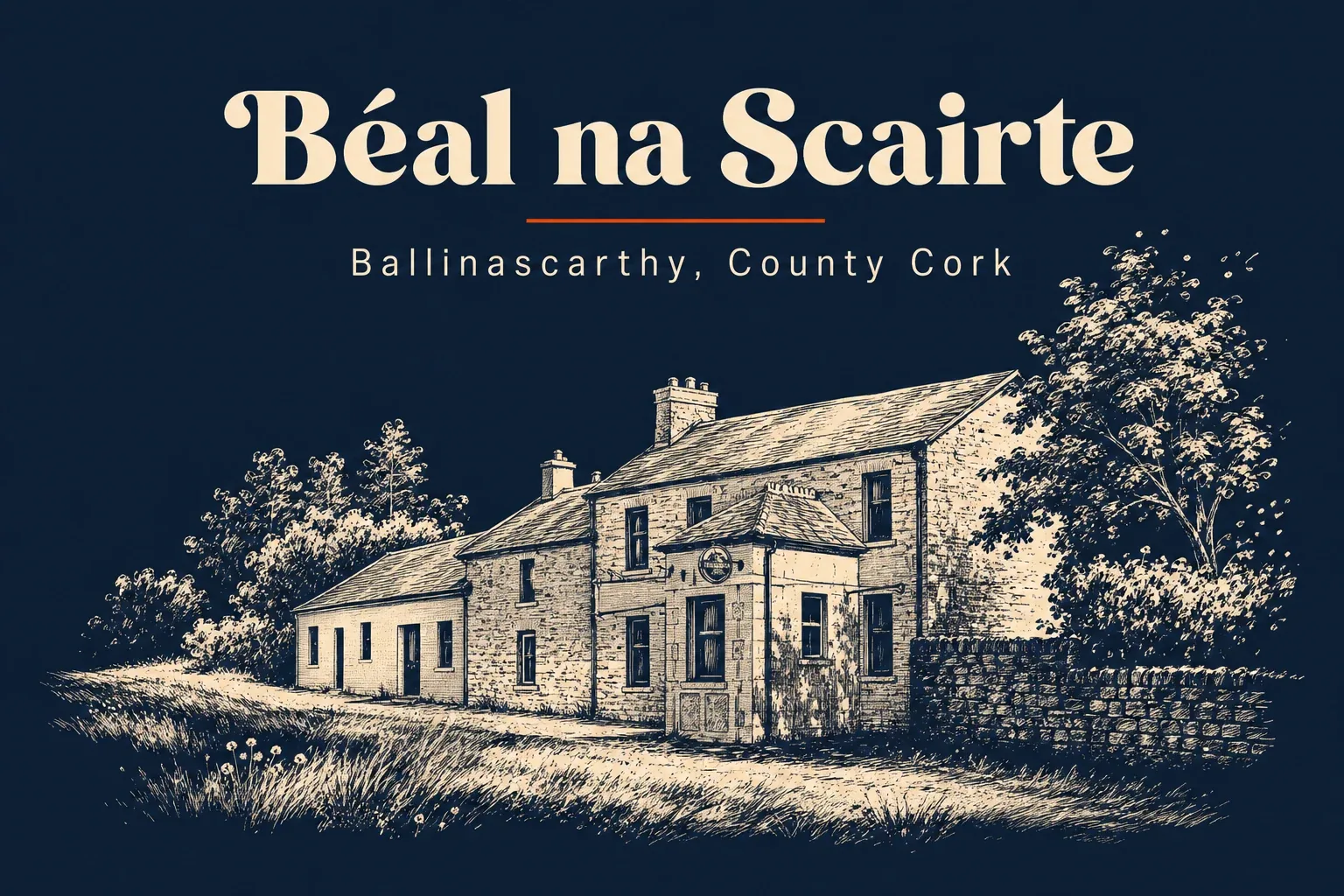
Béal na Scairte, Co. Cork

The West Cork
STOP 07 / 07
Béal na Scairte · Co. Cork

Henry Ford's father was born here. There is a silver Model T on the green and a pub named after him. That is the village.

Ballinascarthy is a roadside village on the N71, about seven kilometres north-east of Clonakilty and fifteen south-west of Bandon. If you have driven into West Cork you have driven through it, probably without slowing, because the silver Model T Ford on the green is the only thing that makes you look twice. The name is Béal na Scairte, the mouth of the thicket. It is a small place and it does not pretend to be anything else.

The reason anyone stops is the Fords. William Ford, the father of Henry Ford who built the Model T and the Ford Motor Company, was born in this parish and emigrated to America in 1847, during the worst of the Famine, at twenty-one. His son came back in 1912 with his own son Edsel, drove out to the family ground at Lisselane, and tried to buy the place. He was refused by the tenants and went home with the hearthstone of the old cottage instead, which he set into a house he built in Dearborn. In 2000 the village put up a silver Model T on a stone plinth to mark the connection. It is the headline and, honestly, most of the story.

There is one other thing, and it is gone now. Ballinascarthy was a railway junction. The Clonakilty branch opened from here in 1886, and four years later a second line ran south to Timoleague and on to Courtmacsherry, carrying summer crowds to the seaside in a couple of hours. The whole West Cork system closed on Good Friday 1961. The trackbed and the memory are all that is left, but for seventy-odd years this quiet crossroads was where the lines split.

Treat it as a two-minute stop, not a destination. Read the plaque, look at the car, have a pint in the Henry Ford Tavern if it is open, and carry on to Clonakilty for the evening. The Lisselan gardens a mile down the road are worth a look if they happen to be open, but they have changed hands and access is not reliable. The good of West Cork is all around it, not in it.
Population
A small roadside village, a few hundred in the parish
Coords
51.6742° N, 8.8586° W
01 / 07

At a glance.

Three things every local will eventually mention. Read these and you've already understood more than most day-trippers do.

02 / 07

The pubs.

None of these are themed Irish pubs, because they don't need to be. A few that earn the trip:

The Henry Ford Tavern

Small roadside local with a wood fire
Village pub on the N71

The one pub, named for the obvious reason, right on the main road by the green. A warm, plain country bar with a stove going in the cold months. Hours can be quiet midweek, so do not bank on it being open in the afternoon. If it is, it is the natural place to stop and look at the Model T over a pint.

03 / 07

Stories & lore.

The reason to come back. The things every local will eventually tell you about, usually after the second pint.

From a West Cork tenant farm to Detroit

The Fords of Ballinascarthy

The Fords had been tenant farmers in this parish since the early 1700s, the family having come over from Somerset and worked their way up from a forty-odd-acre holding. John Ford and his sons, William among them, farmed leased land near Lisselane until 1847, when the Famine drove them to emigrate to Michigan. William was twenty-one. His second son, Henry, born in Dearborn in 1863, became the man who put the world on wheels. Henry came back in 1912 with his son Edsel, looked at the family ground, and tried to buy it; the sitting tenants would not sell, so he took the hearthstone from the ruined cottage and brought it to America. In 1917 he chose Cork city for the first Ford factory built outside North America, on the Marina, which gave work to generations of Corkmen until it shut in 1984.

Unveiled 3 September 2000

The Model T on the green

The village marks the connection with a full-size silver replica of a Model T Ford, set on a stone plinth on the roadside, unveiled in September 2000 with help from the Ford company toward the stonework. It is unmissable on the N71 and it is the reason most cars slow down here at all. There is no museum, no ticket, no car park to speak of - just the car, the plaque, and the road. Pull in, read it, and you have done Ballinascarthy.

Where the West Cork lines split, 1886 to 1961

The junction that vanished

For seventy-five years Ballinascarthy was a railway junction. The West Cork Railway opened the nine-mile branch to Clonakilty from here in 1886, and in 1890 a second line struck south to Timoleague, extended the next year to the seaside at Courtmacsherry. In summer it carried day-trippers to the coast in a little over two hours, and it was busy. The whole West Cork network was closed by the state in one go: the last trains ran on Good Friday, 1961. The station is gone and the lines are lifted, but the crossroads where they parted is still the crossroads.

04 / 07

Things to do outside.

Wear waterproofs. Bring a sandwich. Tell someone where you're going if it's the mountain.

The village and the Model T There is no marked trail here. Park near the green, walk to the silver Model T, read the plaque, and have a look down the side roads off the N71. That is the village in a quarter of an hour. For a proper walk, drive on to the coast at Clonakilty or the estuary at Timoleague.
A few hundred metresdistance
15 minutestime
Lisselan grounds Lisselan Estate, a mile south on the N71, has thirty acres of Robinsonian gardens laid out along the River Argideen, with riverside walks, a walled garden and wooden bridges. It has been open to the public in the past, but the estate has changed hands and access has been unreliable - ring ahead before you rely on it.
About 1 mile from the villagedistance
Half a day if opentime
05 / 07

When to go.

There is no bad time. There are different times.

Spring
Mar-May

West Cork at its greenest and the N71 quiet before the summer traffic. A two-minute stop costs you nothing on the way to the coast.

◉ Go
Summer
Jun-Aug

The road is busy with people heading for Clonakilty, Skibbereen and the beaches. The village is a handy leg-stretch and photo stop on the run west.

◉ Go
Autumn
Sep-Oct

Good light on the West Cork hills and the seaside crowds thinned out. The anniversary of the statue's unveiling falls in early September.

◉ Go
Winter
Nov-Feb

Short days and a quiet road. The statue is there year-round but the pub may not be open when you pass. Push on to Clonakilty for anything more.

◐ Mind yourself
06 / 07

What to skip.

Honestly? Don't bother.

If a local was sitting beside you, this is the bit where they'd lean in.

×
Expecting a Ford visitor centre

There is no museum, no exhibition, no admission. The connection is marked by a roadside statue and a plaque, and that is all. The genuine Ford material is in Cork city and in Dearborn, Michigan, not here.

×
Counting on the Lisselan gardens being open

They have been open to visitors in the past and they are lovely when they are, but the estate has changed ownership and public access is not guaranteed. Check before you build a day around it.

×
Treating Ballinascarthy as a destination

It is a crossroads with a statue and a pub. Stop for ten minutes, then drive the seven kilometres to Clonakilty or the short hop to Timoleague for somewhere with an evening in it.

+

Getting there.

By car

On the N71, the main West Cork road, about 7 km north-east of Clonakilty and 15 km south-west of Bandon. The silver Model T on the green marks the spot - hard to miss if you are watching the road.

By bus

Bus Éireann route 237 (Cork - Clonakilty - Skibbereen) runs along the N71 through the village; check current timetables, as not every service stops at the smaller villages. Local Link West Cork covers the rural routes around Clonakilty and Bandon.

By train

None. The Clonakilty and Courtmacsherry branches that once met here closed on Good Friday 1961. The nearest working station is Cork (Kent), with the West Cork leg of the journey by road.