County Cork Ireland · Co. Cork · Kilbrittain Save · Share
POSTED FROM
KILBRITTAIN
CO. CORK · IE

Kilbrittain
Cill Briotáin, Co. Cork

The Wild Atlantic Way
STOP 07 / 07
Cill Briotáin · Co. Cork

A castle reputed to be one of the oldest inhabited in Ireland, one pub left standing, and 238 people who keep it going.

Kilbrittain sits in the fold of West Cork where the land drops toward Courtmacsherry Bay, eight kilometres south of Bandon and roughly halfway along the scenic coast road between Kinsale and Clonakilty. The name is Cill Briotáin, the church of Briotán. The 2022 census counted 238 people. This is a small place, and it is honest about being small.

The castle is the reason the village is here. It is reputed to be one of the oldest inhabited castles in Ireland, with a founding tradition that runs back to 1035 and the O'Mahony clan, before it became the principal seat of the MacCarthy Reagh - Princes of Carbery, Kings of Desmond - from the early fifteenth century. It changed hands the hard way: surrendered after a Confederate bombardment in 1642, granted to the McCarthys of Muskerry at the Restoration, forfeited after the Battle of the Boyne in 1690, and finally restored and enlarged by the Stawell family across the eighteenth and nineteenth centuries. It is a private house today. You see it from below, stone above the rooftops, and that is as close as you get.

What is left in the village is real and unforced. One pub - the Kilbrittain Inn, known to everyone as Josephine's. A T-plan church from 1790 that once held the Bandon Militia. A GAA club founded in 1904 that still fields football and hurling. A loop of waymarked trails that start at the village park and run out through quiet roads to the castle gates, the estuary, and a set of beaches on Courtmacsherry Bay. Come for that, and for the walking, and do not expect a tourist machine. There isn't one.
Population
238 (2022)
Pubs
1and counting
Founded
Castle origins traditionally dated c. 1035 (O'Mahony); MacCarthy Reagh seat from the early 15th century
Coords
51.6583° N, 8.7500° W
01 / 07

At a glance.

Three things every local will eventually mention. Read these and you've already understood more than most day-trippers do.

02 / 07

The pubs.

None of these are themed Irish pubs, because they don't need to be. A few that earn the trip:

The Kilbrittain Inn

The last pub standing, and a busy one
Village pub (known locally as Josephine's)

Josephine Dineen has run it since August 1995, more than thirty years now, with her son Cian O'Leary working alongside her. It is the only pub left in the village - Cashman's next door closed during Covid. Darts and poker tournaments, the GAA lads in after training, the soccer team in after matches. Farmers at one end of the bar, young lads at the other. This is the gathering spot, full stop, and the village leans on it.

03 / 07

Stories & lore.

The reason to come back. The things every local will eventually tell you about, usually after the second pint.

One of the oldest inhabited in Ireland

Kilbrittain Castle

The founding tradition dates the castle to 1035 and the O'Mahony clan, which would make it among the oldest continuously inhabited castles in the country. The Norman de Courcey family held it and likely extended it in the thirteenth century, but it is the MacCarthy Reagh who matter here - Princes of Carbery and Kings of Desmond, who made Kilbrittain their principal seat from the early 1400s. A Confederate party surrendered it after a bombardment in 1642; it was granted to the McCarthys of Muskerry at the 1660 Restoration, then forfeited after the Battle of the Boyne in 1690, and the ruins eventually passed to the Stawell family who restored and enlarged it through the 1700s and 1800s. It is a private residence now. You look up at it from the village street and leave it at that.

Compiled here in the 15th century

The Book of Lismore

The Book of Lismore, a medieval Gaelic manuscript of 166 vellum folios, is believed to have been compiled at Kilbrittain Castle in the fifteenth century to commemorate the marriage of the prince Finghin MacCarthy Reagh to Caitilín, daughter of the seventh Earl of Desmond. The manuscript itself led an extraordinary afterlife - it was found walled up inside a castle at Lismore in 1814, having been lost for centuries. For a village of this size to sit at the origin of one of the great Irish manuscripts is the kind of fact that gets understated locally and should not be.

Built 1790, garrisoned in 1798

St Patrick's Church, Glanduff

The Roman Catholic church at Glanduff is a T-plan gable-fronted building of 1790 - two-bay nave, transepts, dressed rubble stone and a limestone belfry. During the 1798 rebellion it was used to billet the Bandon Militia. It was extended in the 1840s and formally dedicated to St Patrick by Bishop O'Callaghan in 1892, with refurbishments in 1982 and 2004. Plain, weathered, still in use. It is the kind of country chapel that records more local history in its walls than in any guidebook.

An 18-metre fin whale, January 2009

The Courtmacsherry whale

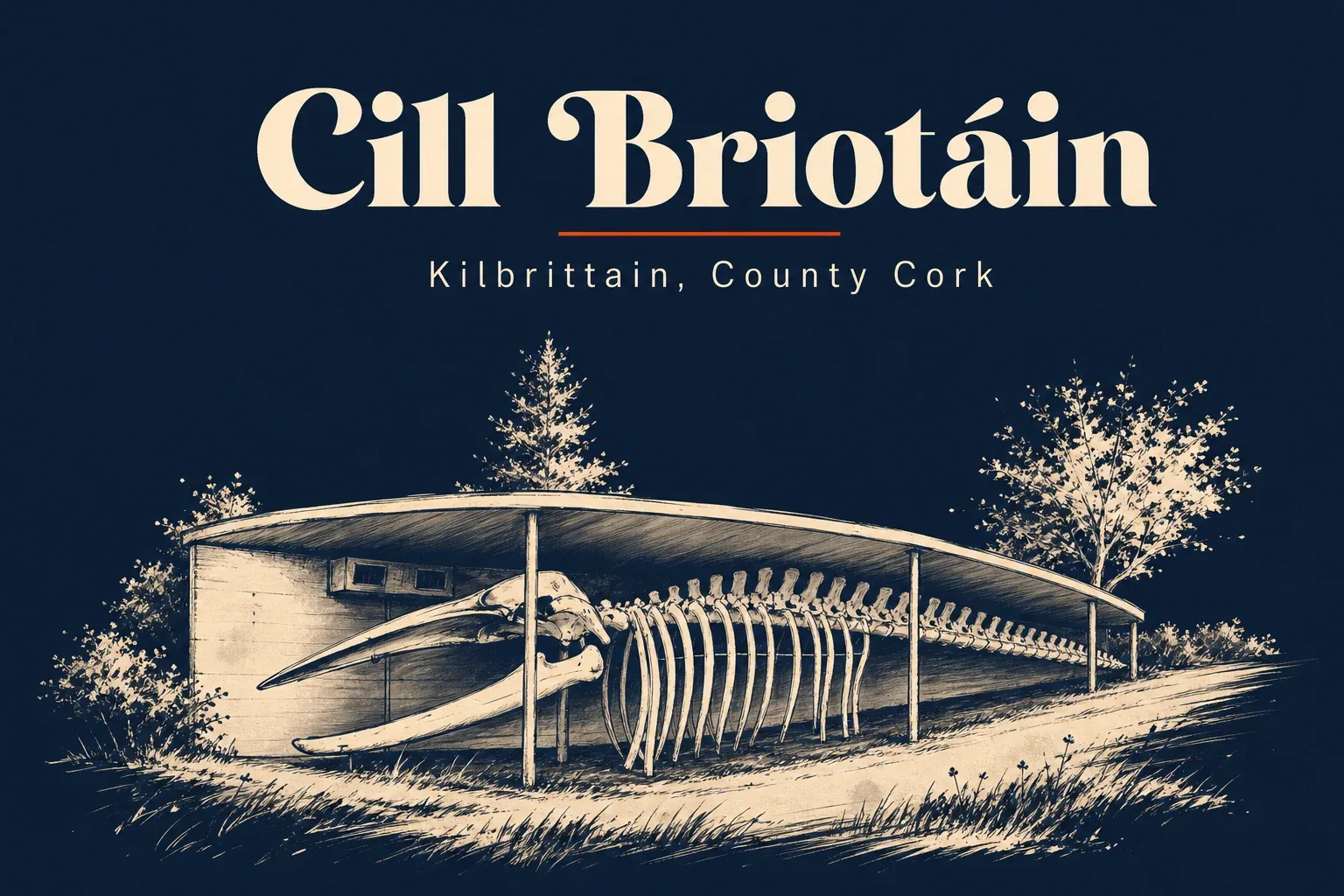
On 15 January 2009 an eighteen-metre fin whale stranded in Courtmacsherry Bay just north of the village. Its skeleton was recovered, cleaned, and put on display in a park east of Kilbrittain, and the whole affair ended up in a Channel 4 documentary. It is a strange and genuine local landmark - a full whale skeleton in a small Cork village - and worth the short detour if you are passing.

04 / 07

Things to do outside.

Wear waterproofs. Bring a sandwich. Tell someone where you're going if it's the mountain.

Castle Walk The short one and the obvious first choice. Quiet country roads from the village park, out through the Village Park to the castle gates and back. Moderate, with a gentle climb. The closest you legitimately get to the castle on foot.
4.3 km loopdistance
1 to 1.5 hourstime
Estuary Walk Quiet roads, sea views and woodland, down toward the Courtmacsherry estuary. The bay does the work here - low water, mudflats, birds. Moderate grade, starts and finishes at the village park.
7 km loopdistance
2 hourstime
Rathclaren Walk Country roads past an old church and graveyard, woodland and estuary views. The middle-distance option if the Castle Walk felt too short and the Kiln Walk too long.
9 km loopdistance
2.5 to 3 hourstime
Kiln Walk The long haul. Country roads, church ruins, estuary views, around 85 to 95 metres of ascent. A proper half-day on foot for walkers who want the full set. Boots, water, and an eye on the weather coming off the bay.
14.5 km loopdistance
4 hourstime
05 / 07

When to go.

There is no bad time. There are different times.

Spring
Mar-May

Quiet roads, the trails at their greenest, the bay light sharp. The best time to walk the loops without meeting a soul.

◉ Go
Summer
Jun-Aug

Busy down at the Courtmacsherry Bay beaches - Harbour View, Coolmain, Howe Strand fill up. Kilbrittain itself stays calm; it is the beaches that draw the crowd.

◐ Mind yourself
Autumn
Sep-Oct

The locals' season. Good walking weather, the GAA in full swing, the castle better against grey skies than blue.

◉ Go
Winter
Nov-Feb

Short days and weather off the bay. The pub keeps going and the trails are walkable in boots, but daylight is tight and not much else is open.

◐ Mind yourself
06 / 07

What to skip.

Honestly? Don't bother.

If a local was sitting beside you, this is the bit where they'd lean in.

×
Trying to get into the castle

It is a private residence and has been for a long time. There are no tours, no open days, no public access. Walk the Castle Walk to the gates, photograph it from the village below, and leave the owners their privacy.

×
Expecting a string of pubs and cafes

There is one pub - Josephine's - and that is the lot since Cashman's closed during Covid. This is a village of 238 people, not a resort. The food and the crowds are down the coast at Courtmacsherry, Timoleague and Clonakilty.

+

Getting there.

By car

Eight kilometres south of Bandon on local roads, midway between Kinsale (about 15 km east) and Clonakilty on the scenic coast route. Courtmacsherry and Timoleague are a few minutes away. Cork city is roughly 40 minutes. Not on a through-route - you come here on purpose.

By bus

Sparse. The nearest real connections are at Bandon and Clonakilty; Local Link covers some rural West Cork runs but check the timetable before you rely on it.

By train

No rail in West Cork. Cork city (Kent Station) is the nearest line, then car, bus or taxi for the last stretch.

By air

Cork Airport (ORK) is the closest, around 45 minutes by car. The practical arrival point for international visitors.