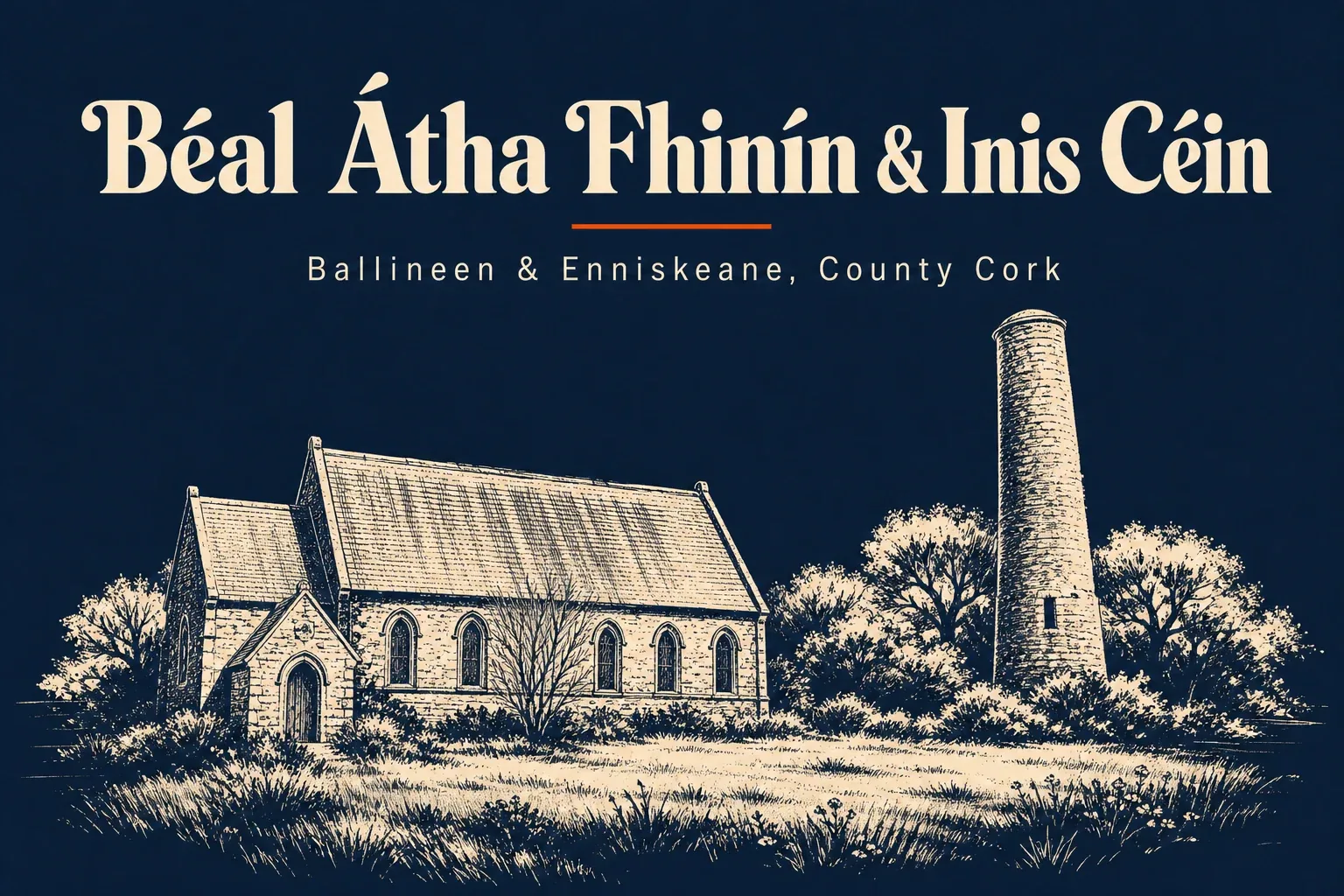
Béal Átha Fhinín & Inis Céin · Co. Cork
Twin villages on the Bandon River, joined by a bridge and a railway, with the only hexagonal round tower in Ireland in the hills above.
Ballineen and Enniskeane are two small West Cork villages on the Bandon River, half a mile apart, on the R586 between Bandon and Dunmanway. Cork city is 43 kilometres east, Bandon 15 kilometres. The two villages were always distinct - Ballineen, Béal Átha Fhinín, the mouth of Fighin's ford, named for Fighin Owen McCarthy who built the bridge in the 1740s; Enniskeane, Inis Céin, the island of Cian, after a local O'Mahony chieftain. The railway station built between them in 1891, and the flax mill and businesses that grew up around it, gradually closed the gap. People now say the two names in one breath.
This is farming country - dairy, tillage, the working landscape of the Bandon valley. The Carbery Group cheese plant outside the villages is one of the larger employers in the area; a quarter of all Irish cheese is reckoned to come off the Carbery line. Grainger's sawmill is one of the biggest in the country. The villages keep a couple of bars, shops, a church and a strong run of GAA and athletics - St Mary's is the local club, and the sprinter Phil Healy, who ran three events at the Tokyo Olympics, is a Ballineen woman.
Do not come for tourism in the brochure sense. There is no hotel and no destination restaurant in the villages themselves - the pubs do the eating and the talking. What is here is older and quieter: the bridge, the river, and the round tower at Kinneigh in the hills above, which is one of the genuinely odd and good things in West Cork and which most people drive straight past on the N71 without ever knowing it is there.