County Cork Ireland · Co. Cork · Dunmanway Save · Share
POSTED FROM
DUNMANWAY
CO. CORK · IE

Dunmanway
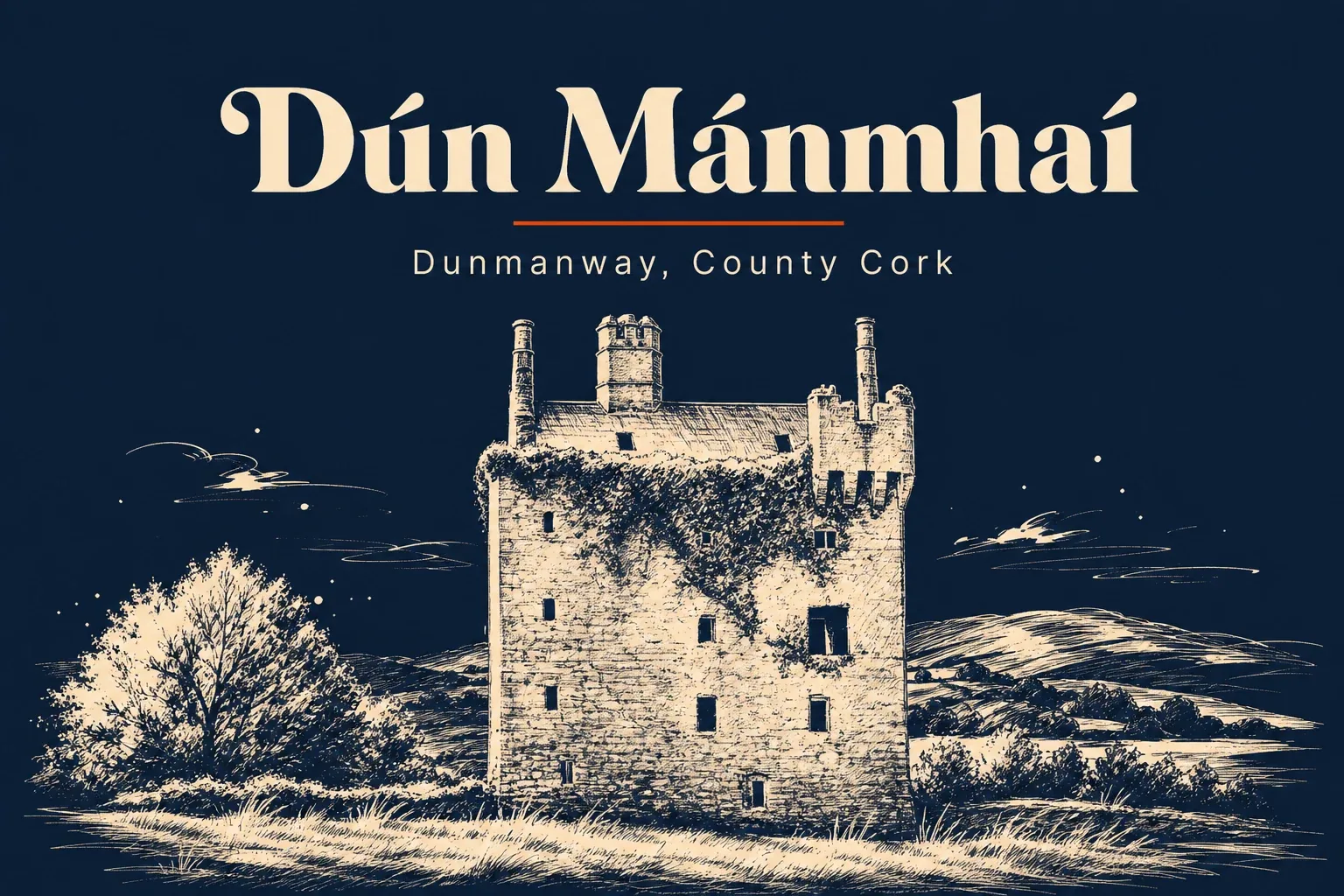
Dún Mánmhaí

The Wild Atlantic Way
STOP 09 / 09
Dún Mánmhaí · Co. Cork

Sam Maguire's town — the GAA man whose name lives on the All-Ireland Cup.

Dunmanway is a West Cork market town of about 1,900 people, perched on the Bandon River in a valley that runs south-west toward the Sheep's Head Peninsula. It is not a postcard place and does not pretend to be. The stone buildings on Main Street are built for work — shops, pubs, a church, the museum. The river is honest. The hills are green. The weather comes straight in off the Atlantic.

The town's fame — such as it is — rests on two things. The first is Sam Maguire, born here in 1877, who became a GAA organizer and went to London where he died in 1927. The All-Ireland Senior Football Championship trophy — the Sam Maguire Cup — is his immortality. Every footballing family in Ireland knows his name even if they've never heard it spoken out loud. The museum tells his story plainly. The second is darker. In April 1922, just weeks after the Treaty was signed, thirteen Protestant men were killed over three days in sectarian violence — one of the worst massacres of the post-Treaty period. The town does not hide from it. The locals will talk about it straightforwardly. That honesty — the refusal to make it romantic or to pretend it didn't matter — is worth more than any plaque.

The Bandon River valley runs through here and continues south-west toward the Sheep's Head Peninsula. The landscape is quiet and working — sheep, small farms, roads that curve with the contour rather than cutting across it. Dunmanway is the last real town before the peninsula starts. It sits at the junction between West Cork's inland valleys and the sea-facing coast. The Sheep's Head Way starts a short drive south; the walking is serious and the views are elemental.

Come for the history if you know the town's name. Come for the walking if you know the peninsula. Come for a night in a proper market town if you want to see how people actually live in rural Cork. Do not come expecting a manicured postcard — you will not find one. Come expecting the real thing, and you will.
Population
~1,900
Pubs
6and counting
Walk score
Main street walked end to end in five minutes
Founded
Market town, medieval origins
Coords
51.7494° N, 8.9189° W
01 / 09

At a glance.

Three things every local will eventually mention. Read these and you've already understood more than most day-trippers do.

02 / 09

The pubs.

None of these are themed Irish pubs, because they don't need to be. A few that earn the trip:

O'Donoghue's

Locals, steady
Main street pub

Right on Main Street. A proper local pub — the kind where the same people sit in the same seats and the newcomer learns the rhythm by watching. Good pint, no fuss.

Hennigan's

Working pub
Traditional bar

Up from the square. Sparse, dark wood, the kind of bar where market day brings in farmers and the conversation does not stop. No music, no machines — just the pub.

McCarthy's

Central, solid
Bar & food

On Main Street, food till late. The crowd changes through the evening — early dinner people, then the after-work crowd. Reliable without being fancy.

The Copper Pot

Newer, mixed
Town bar & lounge

Modern enough without being slick. Attempts at atmosphere that mostly work. TVs for the rugby, enough quiet corners to avoid them.

03 / 09

Where to eat.

PlaceTypeLocal note
Hen's Teeth Café & lunch spot Coffee and simple food done properly. Soups, salads, the kind of sandwiches that use good bread. Open for lunch, closed by six. The coffee is worth an extra stop.
McCarthy's Bar & Restaurant Pub food €€ Main Street. Standard pub fare — steaks, fish, pies — cooked without pretension. Reliable and filling. Booking on weekends recommended.
Biddy O'Flynn's Takeaway Chipper Fish and chips as they should be. Fresh catch from the suppliers, proper frying oil, eaten outside with the town passing by. Closes early; do not get caught hungry at eight.
Market day vendors Seasonal market If you hit the market days right — check locally — there are cheese, bread and vegetable vendors set up around the square. Grab lunch and eat on a bench by the river.
04 / 09

Where to sleep.

PlaceTypeLocal note
Dunmanway Hotel Main street hotel Main Street. Simple rooms, simple breakfasts, the kind of place business people stay on a Tuesday. Nothing fancy but clean and quiet. The bar downstairs is the social centre of the town on weekends.
Cúpla Áit B&B Village guesthouse A few rooms in a converted townhouse. Cooked breakfast, the owners know every walking route in the peninsula. Good base if you are planning to spend days in the Sheep's Head.
05 / 09

Stories & lore.

The reason to come back. The things every local will eventually tell you about, usually after the second pint.

1877–1927

Sam Maguire

Born in Dunmanway in 1877, Sam Maguire was at the heart of the GAA in its first decades. He travelled to London and became involved in the movement there, organizing and fundraising. He died in 1927 in London — relatively young, not wealthy, not celebrated. Yet his name became the most important in Irish football. When the All-Ireland Senior Football Championship trophy was commissioned in 1923, it was named for him. Every player who has ever held the Sam Maguire Cup holds it in his name. The museum on Main Street tells his story in the plainest terms: the photographs, the documents, the life of an ordinary man who became extraordinary by accident. His mother is buried in the local churchyard.

April 1922

The 1922 Dunmanway Massacre

Three weeks after the Treaty was signed, thirteen Protestant men were killed over three days in and around Dunmanway in a burst of sectarian violence. It was one of the worst massacres of the post-Treaty period. The violence was brutal and the aftermath bitter. The town and county took years to heal — in some ways the healing is still happening. What matters now is that Dunmanway does not hide from it. The locals will talk about it straightforwardly, without romance or justification. That honesty — the refusal to make it into a story with a moral — is what separates Dunmanway from towns that pretend history is something that happened elsewhere.

Geography as destiny

The Bandon River valley

The Bandon River runs through Dunmanway and on south-west toward the Atlantic. The valley it carves is older than the road — the river came first, then the people learned to follow it. The landscape here is working — small farms, stone walls, roads that curve with the land rather than cutting across it. The Sheep's Head Peninsula is where this valley opens up to the sea, but the real geography is the river itself, the way the hills fold around it, the way the weather comes in from the south-west. Walking the Bandon River valley — properly, with a map and a sense of where you are — teaches you how the land works. The market town is just the place you stop to eat.

06 / 09

Things to do outside.

Wear waterproofs. Bring a sandwich. Tell someone where you're going if it's the mountain.

Sheep's Head Way (east section) The Sheep's Head Way is an 88-kilometre loop walk. The eastern section starts a short drive south of Dunmanway and heads up onto the peninsula. Walking poles recommended, boots essential. The loop option means you can do day sections or pick a quieter season and do the full circle. Maps and guides are essential — this is not signposted like the tourist trails.
20 kmdistance
5–6 hourstime
Bandon River walk Following the Bandon from the town north or south. Paths are not always obvious — ask locally for the best section. The river is the point — the way the valley follows the water, the old mills, the working landscape. Not manicured, but real.
5 km returndistance
90 mintime
Town to Seefin Hill Up out of the town to a hill with a view back over the Bandon valley. Steep enough to feel earned. The view is across the working landscape — farms, fields, the river making its way south-west.
3 km returndistance
1.5 hourstime
07 / 09

When to go.

There is no bad time. There are different times.

Spring
Mar–May

The walking season is starting. The days are getting longer. The peninsula is becoming walkable. The town is quiet — no summer crowds, just the people who live here.

◉ Go
Summer
Jun–Aug

If you are serious about the Sheep's Head Way, summer is warm and long. But the town itself does not get busy — it never does. The weather is most reliable; the midges can be fierce if you are heading into the peninsula.

◐ Mind yourself
Autumn
Sep–Oct

Best walking weather. The Sheep's Head Way is in full season and the paths are clear. The town is emptier still as the summer people go home. The Atlantic light is honest and cold.

◉ Go
Winter
Nov–Feb

The weather is raw. The peninsula becomes serious — wind, rain, reduced daylight. The town is at its most itself. The pubs are warm. The hotel bar gets busy. It is not gentle, but it is real.

◐ Mind yourself
08 / 09

What to skip.

Honestly? Don't bother.

If a local was sitting beside you, this is the bit where they'd lean in.

×
Expecting Dunmanway to be a polished tourist destination

It is not. It is a working market town that happens to have a museum about a famous GAA man and sits near a famous peninsula. The postcard-town marketing has not arrived and hopefully will not. If you want manicured, go to Kenmare. Come here if you want the real thing.

×
Doing the Sheep's Head Way without proper maps and boots

The walking is serious. The paths can be unclear. The weather changes fast. Walking it as a casual stroll in trainers with a phone and hope is a mistake. Treat it like a hill walk, because it is.

×
Visiting on a day that has no real plan or time

The museum deserves an hour. The stories deserve an ear. The walking deserves half a day at minimum. Dunmanway rewards a slow approach. A rush-through misses the point entirely.

+

Getting there.

By car

Cork city to Dunmanway is 80 kilometres on the N71 through Bandon — about 80 minutes. The road is two lanes and follows the valley. Parking in town is on the street and easy. Dublin is a 3-hour drive via the M8 and N71.

By bus

Bus Éireann serves Dunmanway from Cork city, but not frequently — check the schedule. The journey is about two hours. The service is reliable but runs to market-day schedules rather than tourist schedules.

By train

No train. Cork Kent is the nearest station; bus or car from there.

By air

Cork Airport (ORK) is 120 km north. Dublin is 360 km north-east. Shannon is 230 km north-west.