County Cork Ireland · Co. Cork · Drimoleague Save · Share
POSTED FROM
DRIMOLEAGUE
CO. CORK · IE

Drimoleague
Droim Dhá Liag, Co. Cork

The Wild Atlantic Way
STOP 08 / 08
Droim Dhá Liag · Co. Cork

A West Cork crossroads village that the railway built and the railway left - now a walking base under the Castle Donovan hills, roughly equidistant from Bantry, Skibbereen and Dunmanway.

Drimoleague is a working West Cork village of fewer than five hundred people, sitting at the junction of the R586 and the R593 about 60 km west of Cork city and roughly 12 km from each of Bantry, Skibbereen and Dunmanway. It is the kind of place you reach by deciding to, not by passing through. The name - Droim Dhá Liag, the ridge of the two standing stones - is older than anything you will see on the main street, and points at a landscape full of prehistoric and early-Christian remains rather than at the village itself.

The village you actually stand in was made by the railway. Before 1877 this was a scattered hamlet; then the West Cork Railway put a junction here, the Bantry and Skibbereen branches split at Drimoleague, and a proper village grew around the station. The line closed in the early 1960s. What is left is a tidy main street with two pubs, a Centra, a post office, a pharmacy and a butcher - enough to keep a farming hinterland supplied, which is the job it still does.

Come for the walking and the quiet, not for a night out. The Drimoleague Heritage Walkways thread through the hills under Castle Donovan, and the revived St Finbarr's Pilgrim Path starts here and climbs north to Gougane Barra over two days. The one architectural surprise is the 1956 Catholic church by Frank Murphy, credited as West Cork's first building in the modernist style and worth a look if you have any interest in church architecture. If the place feels faintly familiar, the village stood in for the fictional Duneen when Graham Norton's novel Holding was filmed here in 2021.
Population
482 (2022 census)
Pubs
2and counting
Founded
Grew up around the railway junction from c. 1851; station opened 1877
Coords
51.6597° N, 9.2608° W
01 / 08

At a glance.

Three things every local will eventually mention. Read these and you've already understood more than most day-trippers do.

02 / 08

The pubs.

None of these are themed Irish pubs, because they don't need to be. A few that earn the trip:

The Drimoleague Inn

Small, family-run, walker-friendly
Pub, restaurant and guesthouse, village centre

The main hospitality stop in the village. A family-run inn doing home-cooked food with local produce, a bar, and bed-and-breakfast rooms upstairs - which makes it the obvious base if you are walking the heritage trails or the pilgrim path and want to stay in the village itself rather than out at a farm. Check ahead for food and room availability; this is a small operation, not a hotel.

03 / 08

Where to sleep.

PlaceTypeLocal note
Top of the Rock Pod Páirc & Walking Centre Camping pods and walking centre, edge of village Run by David and Elizabeth Ross on the family farm, opened in 2014 and billed as Ireland's first pod park. Quirky camping pods, a campers' kitchen, shower block, games room and laundry, set among the heritage walkways. It is the trailhead for St Finbarr's Pilgrim Path and the natural base for a walking trip here. Book ahead, especially in summer.
The Drimoleague Inn Guesthouse rooms above the pub, village centre Bed-and-breakfast rooms over the inn in the middle of the village. Plain, friendly, and walkable to everything Drimoleague has - which is the main street and the trails. The right choice if you want to be in the village rather than out on a farm road.
04 / 08

Stories & lore.

The reason to come back. The things every local will eventually tell you about, usually after the second pint.

West Cork Railway, 1877-1960s

The village the railway built

Drimoleague barely existed before the trains. The West Cork Railway reached here in the late 1870s, the station opened in 1877, and crucially this is where the line forked - one branch on to Bantry, one on to Skibbereen. A junction needs a village around it, and so a scattered rural hamlet in the townland of Baurnahulla thickened into a proper main street within a generation. The Cork, Bandon and South Coast Railway ran the line; it carried cattle, creamery traffic and people into Cork city for the better part of a century. Then, like most of the West Cork network, it was closed in the early 1960s and lifted. The trackbed and the shape of the village are the memorial.

Daniel O'Donovan's tower, c. 1560

Castle Donovan

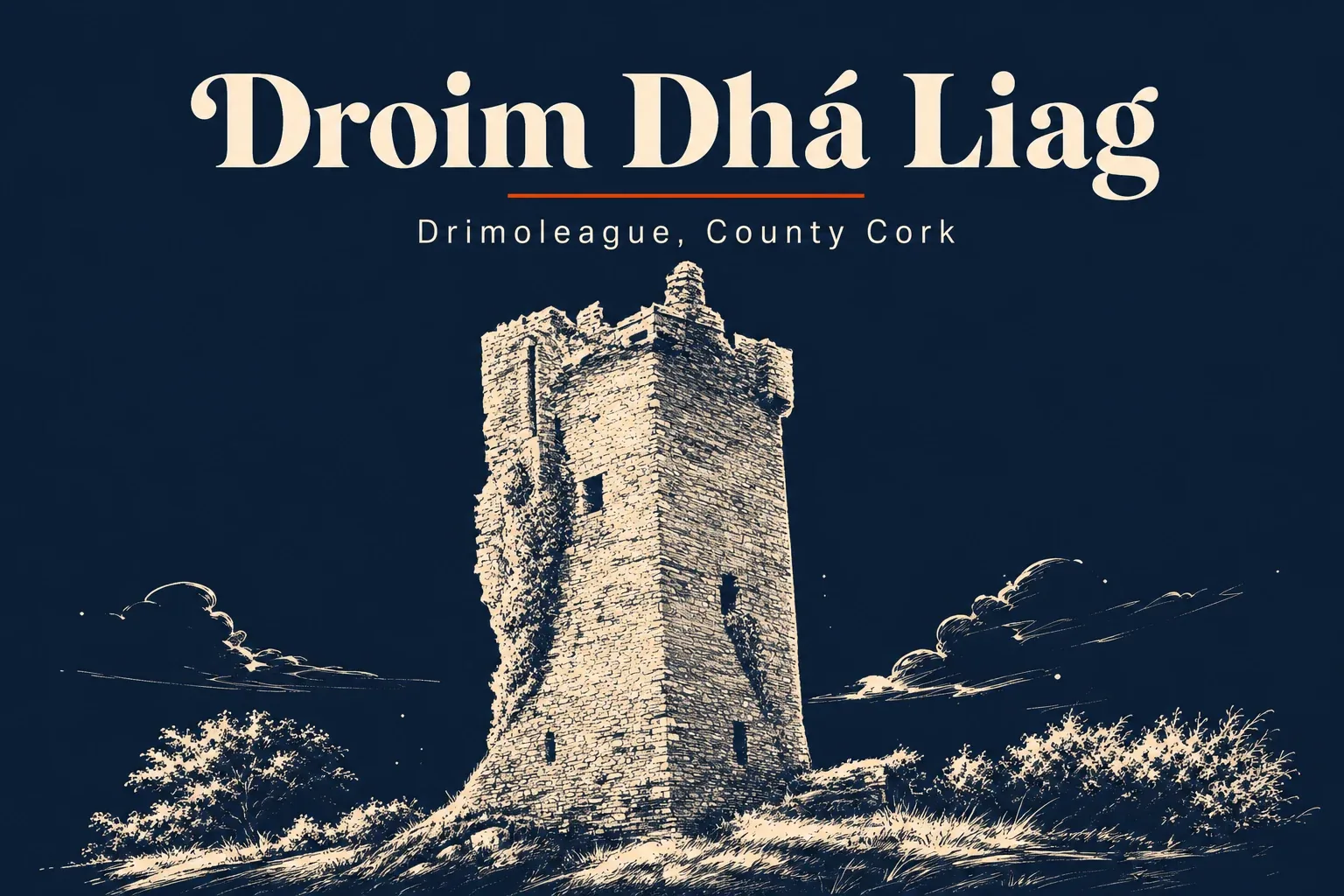
About six kilometres north of the village, on a rocky outcrop over the Ilen River, stands Castle Donovan - a four-storey rectangular tower house built around 1560 and the principal seat of the O'Donovan clan. It was raised by Daniel O'Donovan, known as Donall na gCroiceann, Daniel of the skins, from a story that his mother wrapped him in hides as an infant to hide him from enemies. Tradition says Cromwellian forces slighted the tower after the 1641 rebellion, and it has stood roofless ever since, with a further collapse recorded in 1936. The Office of Public Works conserved it between 2001 and 2014; it is a National Monument, open year-round and free, though only the ground-level viewing area is accessible and the interior stair is closed for safety.

Drimoleague to Gougane Barra, 35 km

St Finbarr's Pilgrim Path

Tradition holds that St Finbarr preached at Barr na Carraige - the rock above Drimoleague - in the late sixth century before going on to found his hermitage at Gougane Barra. The pilgrim route between the two was reopened and waymarked in 2009. It runs 35 km north over two days, crossing three mountain-and-valley systems before its long descent into Gougane Barra, where Finbarr is said to have lived and prayed. It starts at Top of the Rock on the edge of the village, which doubles as the walking centre and accommodation for people doing the route.

Frank Murphy, 1956; Holding, 2021

A modernist church and a television village

Two things mark recent Drimoleague. The Catholic church completed in 1956, designed by architect Frank Murphy, is credited as West Cork's first building in the modernist style - a real piece of mid-century design dropped into a farming village, worth pausing for. And in 2021 the village and its surrounds were used as the fictional town of Duneen for the screen adaptation of Holding, the debut novel by Graham Norton, who grew up in nearby Bandon. The Church of Ireland St Matthew's, dedicated 1858, and an older ruined church from 1790 round out the village's small ecclesiastical record.

05 / 08

Things to do outside.

Wear waterproofs. Bring a sandwich. Tell someone where you're going if it's the mountain.

Drimoleague Heritage Walkways A network of waymarked paths developed around Top of the Rock, running through the hills toward Castle Donovan. Farm tracks, quiet roads and open ground, with the prehistoric and early-Christian sites of the parish strung along them. Start at Top of the Rock, where you can pick up the routes and current conditions. Good honest walking country rather than dramatic clifftop.
Around nine miles of trailsdistance
Half a day to a full day depending on the looptime
St Finbarr's Pilgrim Path The revived pilgrim route from Drimoleague to Gougane Barra. It crosses three mountain-and-valley systems and finishes with the descent into Gougane Barra. Guided two-day walks run from Top of the Rock; you can also walk it independently. This is hill walking - boots, layers, a map and a weather check before you set off.
35 km, two daysdistance
Day one up to 20 km, day two around 12 kmtime
Castle Donovan Six kilometres north on the road toward the Ilen. Park and walk in to the OPW viewing area at the foot of the tower. Free, open year-round, no facilities. The interior is closed for safety, so this is a look-and-photograph stop rather than a clamber, but the setting on the rock over the river is the reason to come.
Short visit on foot from the car parkdistance
30-45 minutestime
06 / 08

When to go.

There is no bad time. There are different times.

Spring
Mar-May

Lengthening days and green hills, the walkways drying out, lambs in the fields. A good window for the pilgrim path before the summer. Quiet.

◉ Go
Summer
Jun-Aug

Warmest and longest, best for the two-day Gougane Barra walk and for the pods at Top of the Rock. Book accommodation ahead - there is very little of it. Otherwise the village stays uncrowded.

◉ Go
Autumn
Sep-Oct

Strong light on the hills and the heritage walkways at their best. The walking season is winding down but the weather can be kind. Probably the nicest time to be here.

◉ Go
Winter
Nov-Feb

Wet, short days and exposed hill ground. Castle Donovan and the church are still there to see, and the pub is warm, but save the longer trails and the pilgrim path for the lighter half of the year.

◐ Mind yourself
07 / 08

What to skip.

Honestly? Don't bother.

If a local was sitting beside you, this is the bit where they'd lean in.

×
Expecting a Sheep's Head Way trailhead here

Drimoleague is sometimes lumped in with the Sheep's Head, but the Sheep's Head Way proper runs out of Durrus and Bantry to the southwest, not from here. Drimoleague's own walking is the Heritage Walkways and St Finbarr's Pilgrim Path. Plan around those, not around a peninsula loop that starts elsewhere.

×
A big night out or a range of restaurants

This is a village of under five hundred people with two pubs, a Centra and a butcher. The Drimoleague Inn does food; beyond that, the proper dining and the busy pub scene are in Bantry, Skibbereen or Dunmanway, all about twenty minutes away. Come here for quiet and walking, eat out in the towns if you want choice.

×
The interior of Castle Donovan

The tower is a conserved ruin and the OPW keeps the inside closed for safety - the staircase is not open to the public. You can walk to the ground-level viewing area and photograph it from the rock, and that is the visit. Do not drive out expecting to climb it.

+

Getting there.

By car

Drimoleague sits at the junction of the R586 and R593, about 60 km (just over an hour) west of Cork city on the R586 via Dunmanway. Bantry, Skibbereen and Dunmanway are each roughly 12 km away, about twenty minutes. Park on the main street.

By bus

Bus and Local Link services through Drimoleague are limited and rural - the village lost its railway in the 1960s and was never well served by replacement coaches. Check Local Link West Cork timetables in advance; a car is by far the easier way to get here and to reach the trailheads.