County Cork Ireland · Co. Cork · Drinagh Save · Share
POSTED FROM
DRINAGH
CO. CORK · IE

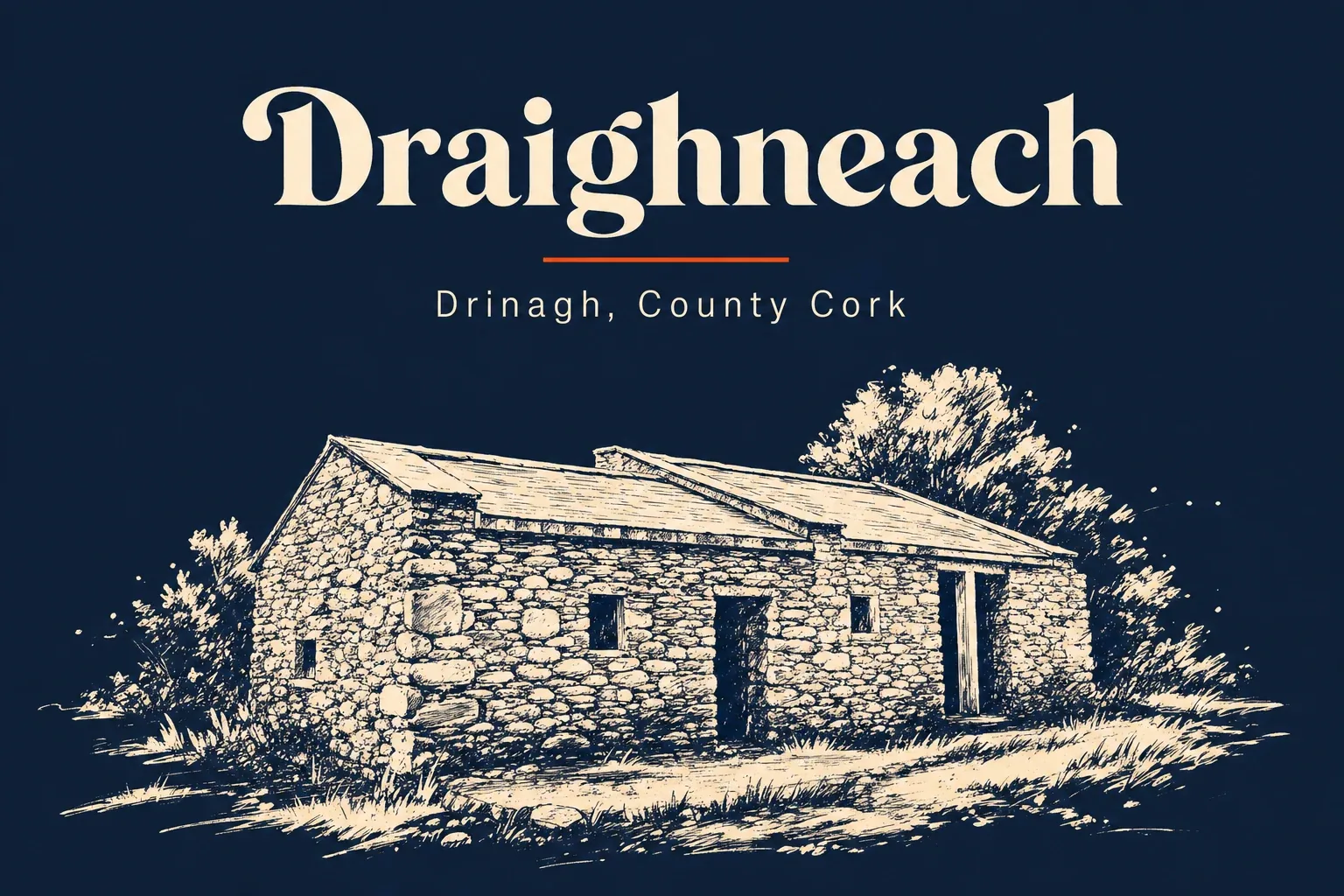
Drinagh
Draighneach, Co. Cork

The West Cork
STOP 05 / 05
Draighneach · Co. Cork

A West Cork creamery village on the R637 between Dunmanway and Skibbereen. The co-op built it, and the co-op still runs it.

Drinagh is a small inland village in West Cork, on the R637 road between Dunmanway and Skibbereen, in the rolling farm country north of Rosscarbery. The Irish name, Draighneach, means a place of blackthorns. The electoral division around it held about 360 people at the 2016 census, which tells you the scale: a church, a school, a grocery, a hardware shop, two pubs, a tennis court, and the creamery that is the whole reason the village exists.

That creamery is the story. Drinagh Co-operative was registered in November 1923 and started churning butter in May 1924, the work of a local priest, Fr John Crowley, who pushed the farmers into organising together. It grew into one of the big West Cork co-ops, eventually thirty-odd branches reaching from Kilmeen to the Beara Peninsula, and a founding shareholder in Carbery. A village of a few hundred people that runs a business turning over serious money is a particular West Cork thing, and Drinagh is the clearest example of it.

Do not come expecting a tourist village. Drinagh serves the surrounding townlands first and visitors barely at all. Skibbereen, the unofficial capital of West Cork, is about fifteen minutes south and has everything you will actually need. Drimoleague is a few minutes west. Drinagh is a place you pass through on a longer West Cork drive, or a place you stop because you know what the co-op meant. Both are honest reasons.

Population
~360 (2016 electoral division)
Founded
Co-operative creamery registered 1923
Coords
51.6500° N, 9.1494° W
01 / 05

Stories & lore.

The reason to come back. The things every local will eventually tell you about, usually after the second pint.

Drinagh Co-op, 1923

The co-op that built the village

Drinagh Co-operative Creamery was registered on 13 November 1923 and took in its first milk in May 1924. The man behind it was Fr John Crowley, the local priest, who pushed the West Cork farmers into pooling their milk and selling their butter together rather than one at a time. It worked. By the late 1930s there were a further nine branches; by the 1950s Drinagh was only the fourth co-op in the country to pass a million pounds in turnover. In 1965 it helped found Carbery, the joint venture between the four West Cork creamery co-ops, and by 1992 it was Carbery's largest shareholder. A village of a few hundred people running a business of that size is the most West Cork story there is. The centenary was marked in 2023 with a published history.

1887 - 1916

Sean Hurley, the only Cork man of 1916

Sean Hurley was born in Drinagh in 1887 and was the only Cork-born Volunteer killed in action during the 1916 Easter Rising. He had gone to primary school in Clonakilty alongside Michael Collins, and the two were close - they emigrated to London, played GAA for the Geraldines club, joined the Gaelic League and the Irish Republican Brotherhood and later the Volunteers together. In Easter Week, Hurley was with the Four Courts garrison under Commandant Ned Daly, in the heavy fighting around Church Street. On 29 April, just before the surrender, he took a gunshot wound to the head and was carried to Fr Matthew Hall, where he was anointed before he died, aged 29. His pocket watch and 1916 medal are now in the Michael Collins House exhibit in Clonakilty. Drinagh has commemorated him since 1966.

Medieval church, 1818 tower

Drinagh West and the steeple

Above Curraghalickey lake, a couple of kilometres outside the village, is Drinagh West graveyard - the site of a late-medieval church that was in use up to the early 1800s. Nothing of the medieval building survives, but a Church of Ireland tower put up in 1818 still stands, and the locals call it the steeple. The graveyard is mostly unmarked Roman Catholic graves; the earliest legible inscription dates to 1843. There was once a watch-house in the corner, the kind built to guard fresh graves from body-snatchers in the days when anatomy schools paid for cadavers. Skibbereen Heritage Centre surveyed and recorded the burials. It is a quiet spot over the water, and worth the short detour if old graveyards hold you.

02 / 05

Things to do outside.

Wear waterproofs. Bring a sandwich. Tell someone where you're going if it's the mountain.

Curraghalickey lake The lake sits about 3 km east of the village and supplies the local mains water. No formal trail, but the lanes around it and the view from Drinagh West graveyard above the water make a quiet half-hour. Boots if it has rained, which out here it has.
Short drive plus a wanderdistance
30-45 minutestime
Sheep's Head and the western peninsulas Drinagh sits at the inland edge of the country that runs west to the Sheep's Head and the Mizen. There is no serious walking in the village itself - drive to Drimoleague or Bantry and pick up the Sheep's Head Way, or carry on to the coast. This is a base or a waypoint, not a trailhead.
Drive out, walk theredistance
Half a day plustime
03 / 05

When to go.

There is no bad time. There are different times.

Spring
Mar-May

The farm country greens up and the days lengthen. Quiet, working, no crowds because there never are any. A good time to pass through on the way to the coast.

◉ Go
Summer
Jun-Aug

Longest days and the most reliable weather, such as West Cork weather is ever reliable. Skibbereen and the coast nearby are busy; Drinagh itself stays as quiet as ever.

◉ Go
Autumn
Sep-Oct

Good light over the farmland and the lake, weather turning dramatic and fast. The coast empties out again. A fine month for the inland drive.

◉ Go
Winter
Nov-Feb

Short days, wet roads, and not much open beyond the pub and the shop. Nothing wrong with it, but there is little reason to stop unless you are visiting the co-op country or the graveyard.

◐ Mind yourself
04 / 05

What to skip.

Honestly? Don't bother.

If a local was sitting beside you, this is the bit where they'd lean in.

×
Expecting a destination village

Drinagh is a working creamery village of a few hundred people. It has two pubs, a shop, a church and a co-op, and it serves the surrounding farms before it serves you. Come for the co-op story, the Sean Hurley connection, or the drive - not for a day out. If you want a West Cork town with restaurants and atmosphere, Skibbereen is fifteen minutes south.

×
Hunting for the medieval church at Drinagh West

There is nothing of it left. What survives above Curraghalickey lake is the 1818 Church of Ireland tower, the steeple, and a graveyard of mostly unmarked graves. Go for the setting and the quiet, not for ruins to photograph.

+

Getting there.

By car

On the R637 between Dunmanway and Skibbereen. Skibbereen is about 15 minutes south, Dunmanway a similar run north, Drimoleague a few minutes west. Cork city is around 1 hour 30 minutes via the N71. Park on the street.

By bus

Rural Local Link and Bus Eireann services in this part of West Cork are sparse and timed for locals rather than visitors. Check timetables in advance; Skibbereen and Dunmanway are the better-served hubs.