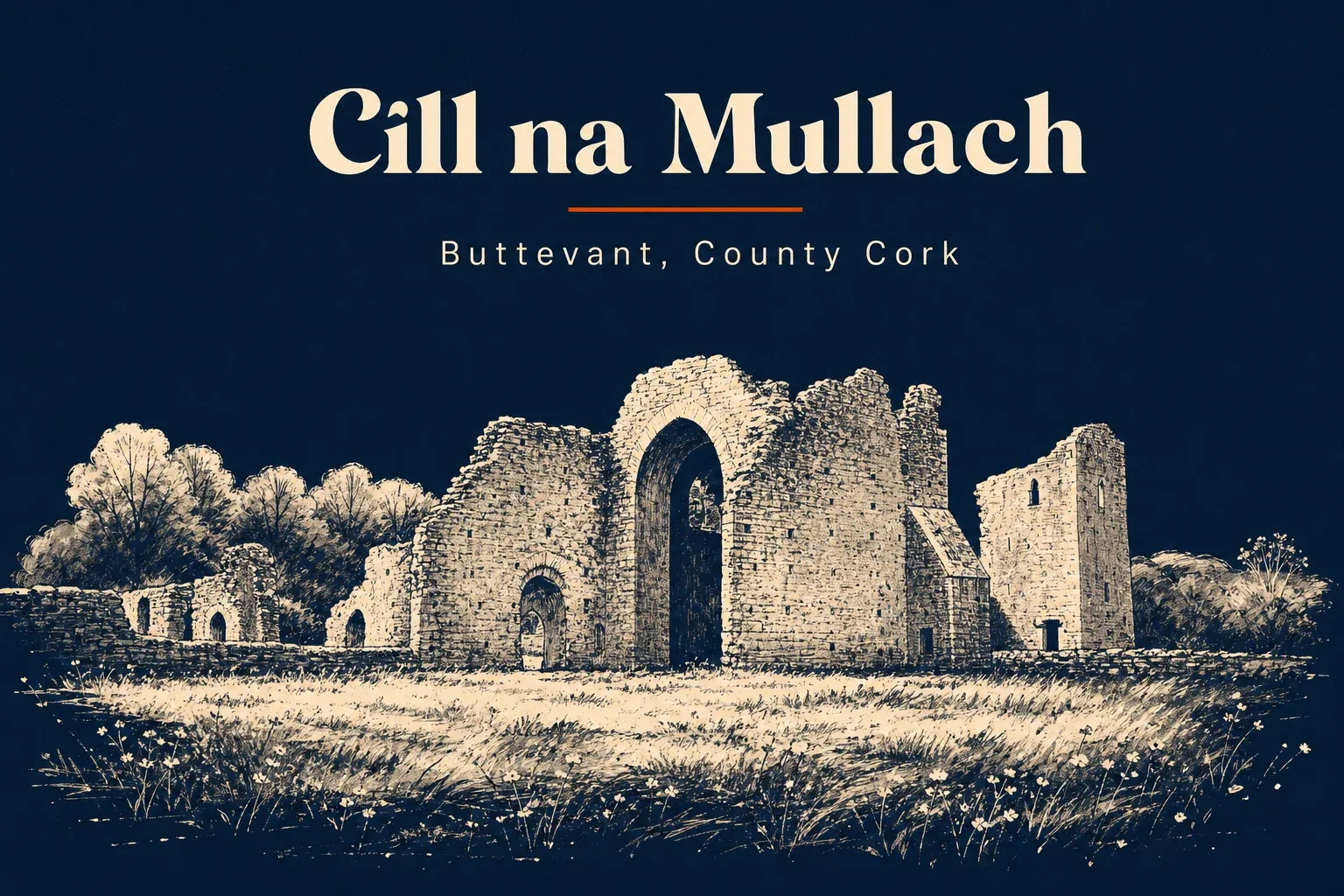
Cill na Mullach · Co. Cork
The place that invented the steeplechase, sitting on a thin medieval street that has been quietly emptying out for two hundred years.
The name is Anglo-Norman. Boutez en avant - push forward - was the de Barry family motto, and the Barrys held this stretch of the Awbeg valley hard enough that the motto became the town. The Irish name tells a different story: Cill na Mullach, the church of the hillocks, older than the Normans and pointing at something that was here before they came.
It was a proper walled town once. The crown gave murage grants in 1317 to pay for the walls; there were two gates, north and south, and Edward III put more money into the North Gate in 1375. Almost all of that is gone now - you get one fragment of wall beside the friary gable and the rest is in the line of the street. The de Barrys built their stronghold here, and a separate tower, Lombard's Castle, went up around 1400 for a family of wool merchants who had come over from Italy.
Two religious houses bracket the town and they are the reason to stop. The Franciscan friary stands roofless in the middle of Main Street, over the Awbeg, one of the earliest Franciscan churches left in Ireland. A mile south at Ballybeg, the Augustinian priory keeps the finest medieval dovecote in the country - a round stone columbarium with hundreds of nesting niches built into the wall. Neither charges admission. Neither is busy.
Don't arrive expecting a destination. Buttevant is a working North Cork street on the Cork-Limerick road, quieter now than it was in the nineteenth century, with the kind of services a town of a thousand people keeps and no more. Come for the friary, the priory, the steeplechase story, and the sense of a place that was once a good deal bigger than it is. Mallow, fifteen minutes south, has the restaurants and the train.