County Cork Ireland · Co. Cork · Crookstown Save · Share
POSTED FROM
CROOKSTOWN
CO. CORK · IE

Crookstown
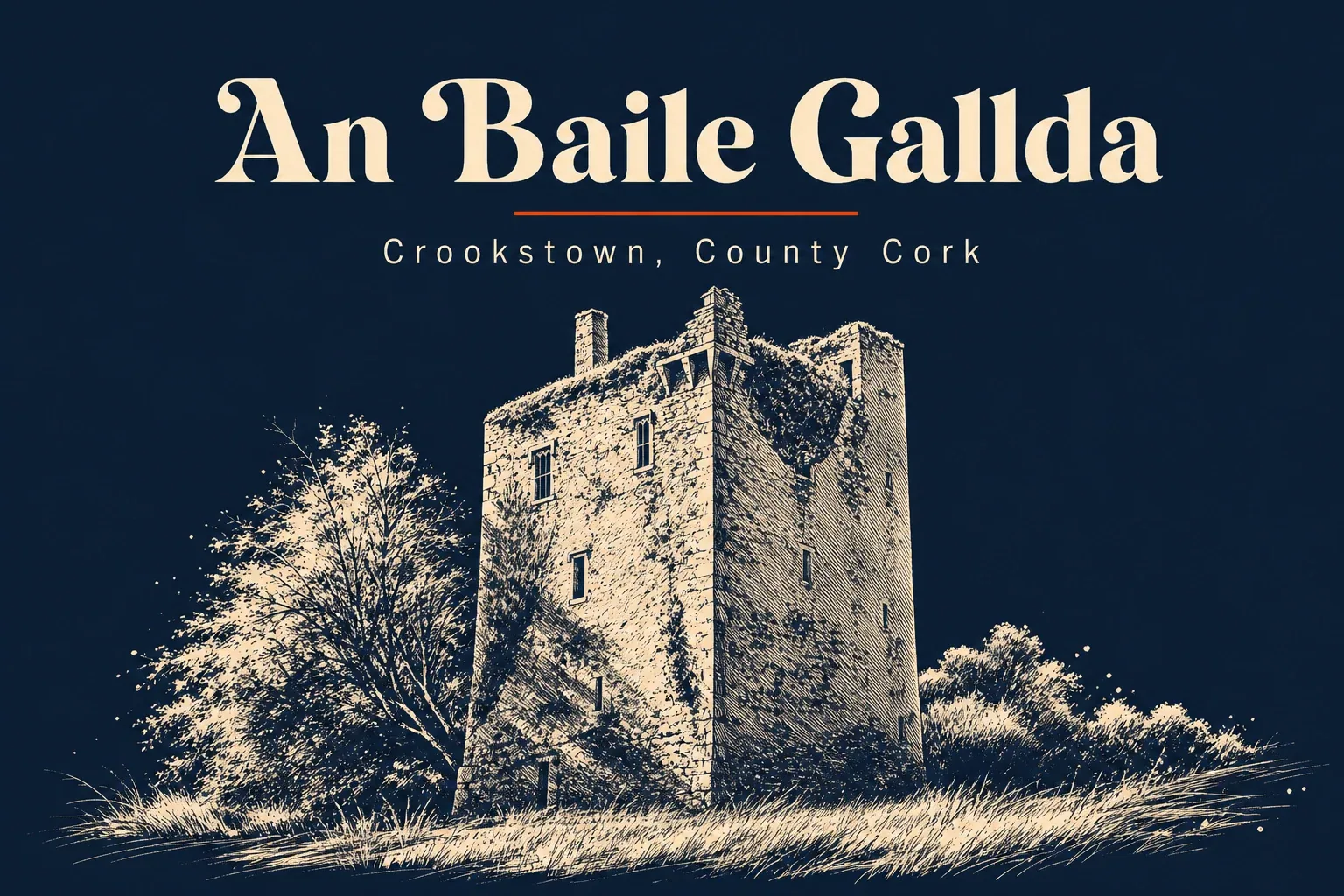
An Baile Gallda, Co. Cork

The West Cork
STOP 06 / 06
An Baile Gallda · Co. Cork

A small mid-Cork crossroads with two ruined castles, a vanished railway, and the road Michael Collins was driving the day he was killed up at Béal na mBláth.

Crookstown is a small village in the Lee Valley, about twelve kilometres east of Macroom and a kilometre off the N22 Cork to Killarney road. The Irish name, An Baile Gallda, means the town of the foreigner or the invader, and that is exactly what it was: a plantation settlement named after Thomas Crook, an English planter. The population has been falling for a long time - 353 in 1991, 222 in 2011, 183 at the 2022 census - and the village today is a Garda station, a post office, a pub, and the houses around them. You would not stop here unless you knew why to.

The why is history rather than scenery. Two ruined castles bracket the village: Clodagh Castle to the south, a sixteenth-century ruin once held by a branch of the McSweeney clan, and Castlemore Castle (also called Dundrinan) to the north. A mill was built around 1810 at Bellmount and was once the making of the place. The railway came in 1866 - Crookstown Road station, about two kilometres out near Castlemore, on the Cork and Macroom Direct line - and went again in the 1940s, which is roughly the shape of the village's last two centuries: a brief industrial moment, then a long quiet.

What put Crookstown on the map for good is something that happened on the road outside it. On 22 August 1922, during the Civil War, Michael Collins was shot dead in an ambush at Béal na mBláth, a few minutes west. He was very likely heading for Crookstown when it happened, and after the ambush his body was brought back through the village on the way to a priest at Cloughduv. The winding road up to the ambush site from Crookstown is little changed in a century, and the memorial cross at Béal na mBláth is one of the most visited spots in the country every August.
Population
183 (2022)
Founded
Plantation village named for Thomas Crook, an English planter
Coords
51.8331° N, 8.8447° W
01 / 06

The pubs.

None of these are themed Irish pubs, because they don't need to be. A few that earn the trip:

Clifford's Bar

Family-run local with a function room and beer garden
Village pub, just off the N22

The village pub, family-run, sitting just off the N22 as the road heads west towards West Cork. There is a function room and a beer garden for events. In a village of fewer than two hundred people this is the social centre, and on a quiet evening it is the place to ask anyone local for directions to Béal na mBláth.

02 / 06

Stories & lore.

The reason to come back. The things every local will eventually tell you about, usually after the second pint.

The road Collins was on

Béal na mBláth

Béal na mBláth - the mouth of the flowers - is a townland a short drive west of Crookstown, and on 22 August 1922 it became the most consequential few hundred yards of road in the new Irish state. Michael Collins, by then commander-in-chief of the National Army, was ambushed there in the early evening and shot dead, the only fatality of the action. He had passed through the area that morning and was likely making for Crookstown when the convoy was caught. After the ambush his body was carried back through Crookstown village and on towards Cloughduv. A simple memorial cross now stands at the ambush site; the commemoration held there every August draws crowds and, traditionally, a keynote speaker from front-line Irish politics. The lane that climbs to it from Crookstown is barely altered in a hundred years, which is much of the reason people make the trip.

Clodagh, Castlemore, and Thomas Crook

Two castles and a planter

The village owes its English name to Thomas Crook, a planter who settled here in the plantation era - hence An Baile Gallda, the town of the foreigner. It sits between two older ruins. South of the village is Clodagh Castle, a sixteenth-century tower-house ruin once held by a branch of the McSweeney clan, a gallowglass family. North of the village is Castlemore Castle, also called Dundrinan, another ruin. Neither is a managed visitor site - they are field ruins, best viewed with respect for whoever farms the land around them - but together they mark Crookstown as a much older place than the plantation village that took the name.

Crookstown Road station, 1866 to the 1940s

The line that came and went

For about eighty years Crookstown had a railway. The Cork and Macroom Direct Railway opened in 1866, and Crookstown Road station stood roughly two kilometres from the village near Castlemore Castle. The line carried the area for the rest of the nineteenth century and into the twentieth, then closed to passengers and finally shut altogether in the 1940s. A mill built around 1810 at Bellmount had been the earlier engine of the local economy. In the War of Independence the village saw its share of trouble: Crookstown House, the Warren family estate house, was burnt out by the IRA in June 1921 and later rebuilt. The brick and concrete works at Castlemore is the industry that outlasted them all.

03 / 06

Things to do outside.

Wear waterproofs. Bring a sandwich. Tell someone where you're going if it's the mountain.

The Béal na mBláth memorial road The reason most outsiders come. Drive or cycle the winding lane west from Crookstown towards Béal na mBláth and walk the last stretch to the memorial cross marking where Michael Collins was shot on 22 August 1922. The road is little changed in a century. Park considerately - this is a working rural road, not a car park - and give the spot the quiet it asks for.
Short drive plus a walk at the sitedistance
30-45 minutestime
Castle and crossroads loop Crookstown is a crossroads village rather than a beauty spot, but a slow walk takes in the bones of the place: the post office, the Garda station, Clifford's, and the field ruins of Clodagh Castle to the south and Castlemore to the north. Both castles are on private farmland - view from the road and do not climb fences.
Around the villagedistance
1 hourtime
04 / 06

When to go.

There is no bad time. There are different times.

Spring
Mar-May

Quiet, green, and the Lee Valley at its freshest. The roads to the castle ruins and Béal na mBláth are at their best before the summer hedges close in.

◉ Go
Summer
Jun-Aug

Long evenings and the easiest driving. Late August brings the annual Béal na mBláth commemoration a few minutes west, the one time of year the area is genuinely busy.

◉ Go
Autumn
Sep-Oct

Soft light over the valley and the crowds gone home after the August commemoration. A good time for the memorial road without the company.

◉ Go
Winter
Nov-Feb

Short days and wet rural roads. The pub keeps going, but the castle ruins and the memorial lane are muddy and dark early. Bring boots if you come at all.

◐ Mind yourself
05 / 06

What to skip.

Honestly? Don't bother.

If a local was sitting beside you, this is the bit where they'd lean in.

×
Expecting a postcard village

Crookstown is a working mid-Cork crossroads of under two hundred people, not a tourist village. There is a pub, a post office and a Garda station, and that is honestly most of it. Come for the history on the roads around it, not for the streetscape.

×
Treating the castle ruins as an attraction

Clodagh and Castlemore are field ruins on private farmland with no facilities, no signage and no access arrangements. View them from the road. They are landmarks, not a day out.

×
Confusing this with the Kildare Crookstown

There is another Crookstown in Co. Kildare, and the name gets muddled with the Dunmanway and Sam Maguire story too. This is the Macroom-area Crookstown in the Lee Valley - An Baile Gallda - and its claim to fame is the Collins ambush road, nothing to do with the GAA trophy.

+

Getting there.

By car

On the N22 Cork to Killarney road, about a kilometre off it. Macroom is 12km west, Cork city about 30km (40 minutes) east. The whole point of the village's location is that it is a quick turn off a main road.

By bus

The N22 carries Bus Éireann services between Cork and Macroom/Killarney that pass close to the village; check current timetables for the nearest stop, as services do not all call at the village itself. Local Link covers the rural mid-Cork routes.

By train

No railway. Crookstown Road station on the Cork and Macroom Direct line closed in the 1940s and the line is long gone. Kent Station in Cork city is the nearest operational rail hub, about 30km away.

By air

Cork Airport (ORK) is about 40 minutes east. Kerry Airport (KIR) at Farranfore is roughly an hour west on the N22.