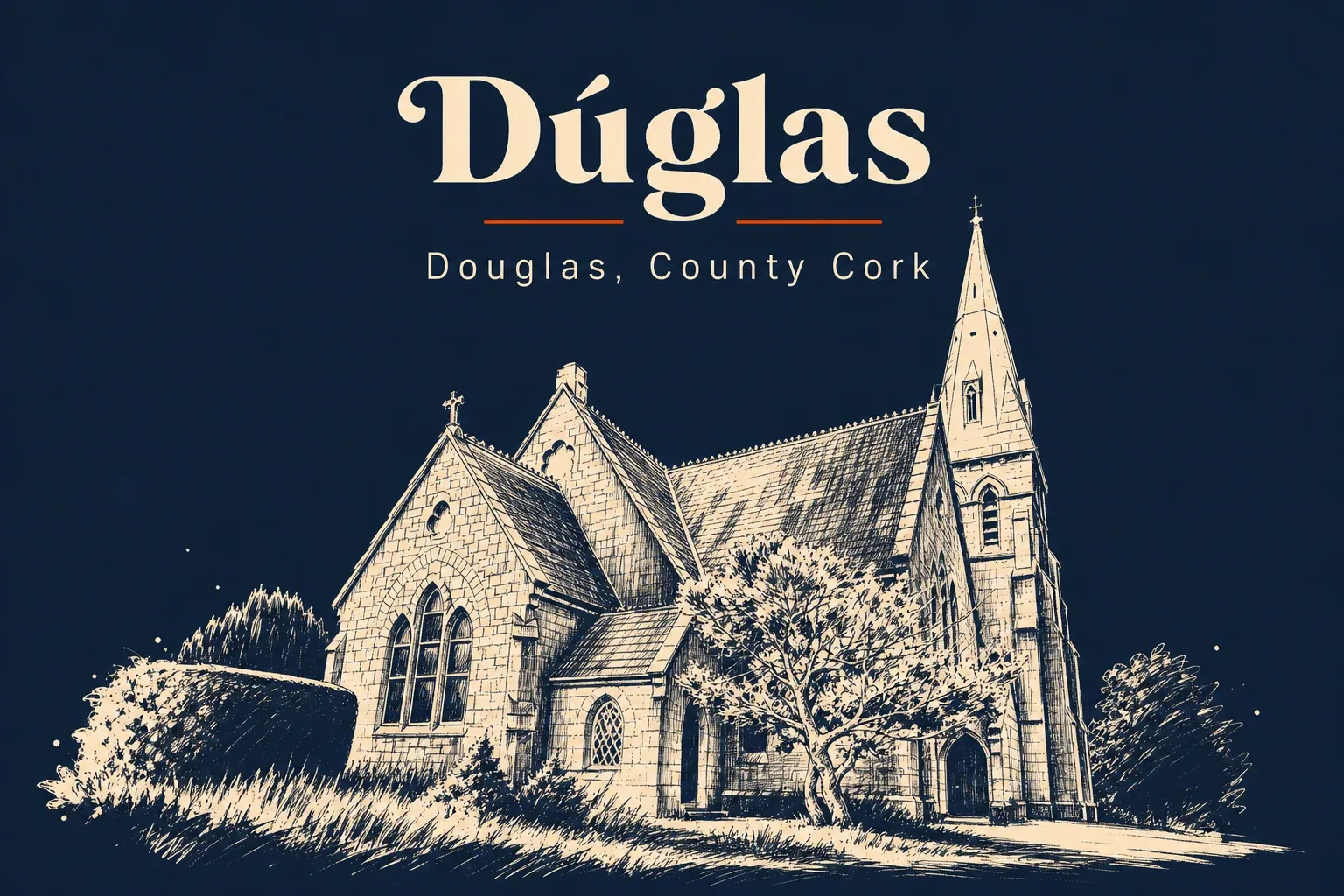
Dúglas · Co. Cork
Cork's southside suburb with a real village heart - a sailcloth town that the city grew over, still arguing about whether it counts as a village.
Douglas is what happens when a mill village gets swallowed by a city and refuses to admit it has stopped being a village. The name is Dúglas, the dark stream, and that stream is the whole reason the place is here. In 1726 a sailcloth factory opened on the water and the village grew up around it. By the early 1800s Douglas was sewing canvas for the Royal Navy and a thousand spinners worked the trade from their own houses. The wheels turned on the river. The village turned on the wheels.
The people who built it were Huguenots and incomers - the Besnard family acquired the mills in 1783 and put the first powered spinning machines in Ireland to work here in 1801, with skilled hands brought in from Ulster and Scotland. (The old stub that lived on this page blamed the Quakers; the records say sailcloth and Huguenots, so that is what is written here.) More mills followed through the 19th century, corn and flax and rope, until the trade faded and the suburb arrived and wrapped the old core in housing estates.
What remains is a real village centre doing real work. Barry's pub has been pouring pints on the main street for the guts of two hundred years. KC's chipper, open since 1958, is the kind of takeaway people drive across the city for and argue about. There is a Saturday market at the shopping centre, two golf courses on the hills above, and a community park on the site of a mill that ground corn from 1845. It is honest and it is busy and it is not pretending to be Kinsale.
Use Douglas for what it is. It is not a heritage destination - the great house, Vernon Mount, burned in 2016 and stands as a shell - but it is a good base on the southside with the city fifteen minutes one way and the harbour villages fifteen minutes the other. Walk the Mangala woodland, eat the chipper, drink in the South County, and route to Cork for the rest.