County Cork Ireland · Co. Cork · Fermoy Save · Share
POSTED FROM
FERMOY
CO. CORK · IE

Fermoy
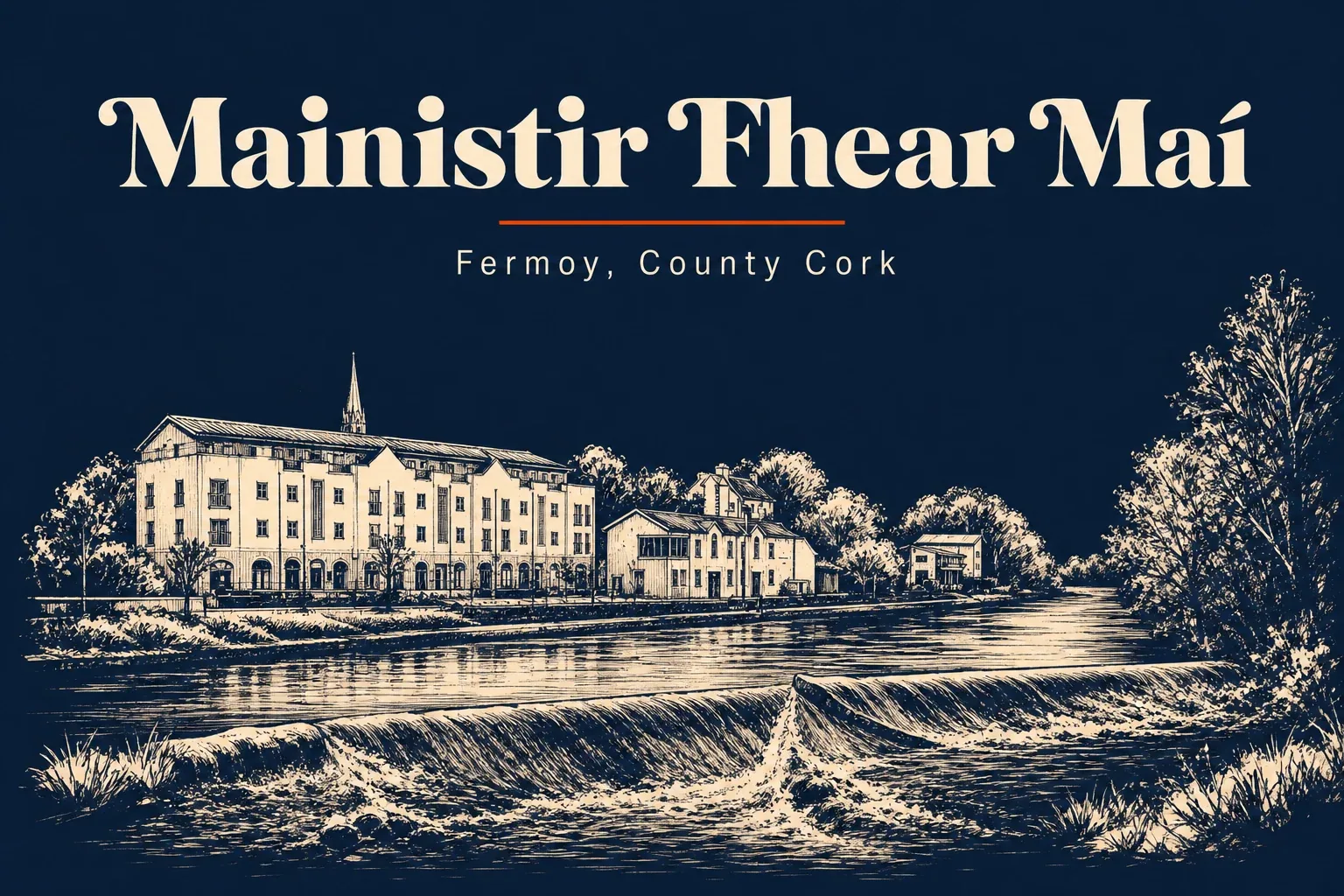
Mainistir Fhear Maí

STOP 08 / 08
Mainistir Fhear Maí · Co. Cork

A Scottish merchant built a garrison town on the Blackwater in 1791 and salmon have been running the river ever since.

Fermoy sits on the Blackwater in North Cork — a garrison town that was built from nothing in 1791 by a Scottish merchant named John Anderson. He laid it out clean: a big central square, a grid of wide streets, a plan. It worked so well the British Army moved in and held the place for two centuries. The town's Georgian bones haven't changed much since.

What draws people now is the river. The Blackwater is one of Europe's great salmon runs. Fishermen book lodges here the way they book lodges in Scotland. The hotels know the runs season by season — spring, summer, autumn, each one different. The Blackwater Way walking trail follows the river for miles; you don't have to fish to walk it. The town sits at a good point on the trail.

The garrison is long gone — January 1922 was the end of that — but the infrastructure remains. The big Church of Ireland on Main Street. The wide streets Anderson planned. The barracks are repurposed now. The town is quiet most of the year and fills up with fly-fishers in season. The square is still the centre. The streets still make sense.
Population
~6,800
Pubs
14and counting
Walk score
Town centre walked end-to-end in ten minutes
Founded
1791
Coords
52.0333° N, 8.2667° W
01 / 08

At a glance.

Three things every local will eventually mention. Read these and you've already understood more than most day-trippers do.

02 / 08

The pubs.

None of these are themed Irish pubs, because they don't need to be. A few that earn the trip:

Rory's Bar

Fishing talk, fishing books
Town centre pub

Main Street opposite the square. The kind of place where the fish of the season get discussed at length and the tales get taller as the whiskey empties. Locals and visiting fishermen alike. No pretension, all river.

The Hibernian Hotel Bar

Quiet early, livelier after dark
Hotel bar & lounge

Main Street, the pub side of the hotel. Comfortable, solid, the sort of place officers used to drink. Still draws a mix of locals and fishing guests. Food available till late.

The Market Bar

Steady working pub
Market Street local

Off the main drag, corner site. Where locals drink when tourists aren't looking. Sky Sports on, pool table available, proper bar chat.

Devitt's Bar & Lounge

Mixed crowd, music most weekends
Town-centre bar

Main Street. Live music regularly, decent drinks, the kind of place you land in and stay longer than planned.

03 / 08

Where to eat.

PlaceTypeLocal note
The Hibernian Hotel Restaurant Hotel dining room €€ Main Street, inside the hotel. Traditional Irish cooking, decent wine list. Locals eat here for Sunday lunch. Not fancy but reliable.
Café Mali Daytime café & lunch Good coffee, sandwiches, the kind of place that fills up at noon. Homemade soups, salads. Open till mid-afternoon.
The Anglers Rest Restaurant & fishing bar €€€ Catering to the fishing trade. Fish-focused menu, whiskey and wine list aimed at people who know what they're after. Booking essential during salmon season.
Market Street Chipper Takeaway The local chipper. Fish and chips, proper portions. Grab it and eat on the square.
04 / 08

Stories & lore.

The reason to come back. The things every local will eventually tell you about, usually after the second pint.

Built in 1791 from scratch

John Anderson's planned town

John Anderson was a Scottish merchant who had the land and the plan to build a town. In 1791 he laid out Fermoy in a clean Georgian grid — a big central square, wide streets, a formal layout. No Irish town was built quite like this before; most grew ad-hoc around a bridge or church. Anderson's grid survives intact. Walk the main streets now and you're walking the lines he drew 230 years ago. The square still anchors the town the way he planned it.

1850s–1922

The garrison and its end

The British Army saw the value of the location — the Blackwater, the road network, the garrison-ready town Anderson had already built. By the mid-1800s, Fermoy was a significant garrison posting. Officers' quarters, parade grounds, military infrastructure. The big Church of Ireland on Main Street belonged to that era. Independence came fast in 1922. The garrison withdrew. The barracks were repurposed. The officers' houses became family homes. But Fermoy carried the weight of that long occupation for a long time — and some of the traces remain.

Spring, summer, autumn

The Blackwater salmon runs

The Blackwater is one of Europe's premier Atlantic salmon rivers. Fishermen have been coming to Fermoy for two centuries — first to feed their families, then as a sport and business. The runs vary by season: spring fish are different from summer fish, autumn fish again different. Local knowledge matters — which stretch fishes best when, which pools hold fish in low water, how the weather changes it all day to day. Hotels and fishing lodges grew up around this knowledge. The Blackwater Way walking trail follows the river; walkers and fishermen share the banks.

05 / 08

Things to do outside.

Wear waterproofs. Bring a sandwich. Tell someone where you're going if it's the mountain.

The Blackwater Way The trail runs along the Blackwater from Lismore (west) through Fermoy to Cappoquin and beyond. Pick a section. Through-hikers do it over days; locals walk it in chunks. The town is well-positioned on the trail. A 2-hour section takes you through farmland and alongside the river, returning to town.
40 km total (many sections)distance
Sections vary: 2–4 hourstime
Fermoy town riverside Walk downstream from the bridge, cross at the lower bridge, return along the far bank. Fishing people along the water. Quiet. The water in autumn when the salmon are running is worth seeing.
3 km loopdistance
45 minutestime
Rathcormac viewpoint Drive north to Rathcormac (site of the 1834 Tithe War battle). A short walk up gives views back over the Blackwater valley and the surrounding farmland. Rathcormac itself is quiet — the significance is historical.
8 km (car to start)distance
1.5 hourstime
06 / 08

When to go.

There is no bad time. There are different times.

Spring
Mar–May

Spring salmon run. Fishermen arrive. The Blackwater is high and cold — serious fishing season. The town fills with guides and guests. Lodges book up.

◉ Go
Summer
Jun–Aug

Calmer water, summer tourists on the Blackwater Way. Walking the trail is easier, the fishing lighter. The town is busier but not crowded. Fine weather for riverside time.

◉ Go
Autumn
Sep–Oct

The autumn run of salmon returns — big fish, serious fishing again. Weather can turn. The Blackwater Way is quieter than summer but still walks well. Book fishing guides ahead.

◉ Go
Winter
Nov–Feb

Cold, wet, quiet. Some pubs and shops close or reduce hours. The fishing is winter fishing — experienced anglers only. The town is itself but sparse.

◐ Mind yourself
07 / 08

What to skip.

Honestly? Don't bother.

If a local was sitting beside you, this is the bit where they'd lean in.

×
Planning a fishing trip without booking a guide in advance during salmon season

The runs fill quickly and the good stretches book up weeks ahead. Guides know the water day-to-day. Booking at the last minute means either no fish or poor conditions.

×
Driving to Rathcormac expecting a visitor centre

The Battle of Rathcormac (1834, Tithe War) was significant but the town is quiet and has no dedicated museum. It's a walking destination if you're interested in the history, not a built attraction.

×
Treating Fermoy as a day-trip from Cork

It's 45 minutes north and the value is in time on the river or the Blackwater Way walk. A morning visit doesn't do it. Come for a night or two to walk or fish properly.

+

Getting there.

By car

Cork city to Fermoy is 45 minutes on the N8 north. Dublin is 2.5 hours via the M8. Mitchelstown is 20 minutes north. Parking in the town centre is free and easy.

By bus

Bus Éireann 501 runs Cork–Fermoy–Mitchelstown several times daily. About 1 hour from Cork city. Mallow is also on the route (20 minutes south).

By train

No direct train. Cork Kent is the nearest station; bus from there.