County Cork Ireland · Co. Cork · Rathcormac Save · Share
POSTED FROM
RATHCORMAC
CO. CORK · IE

Rathcormac
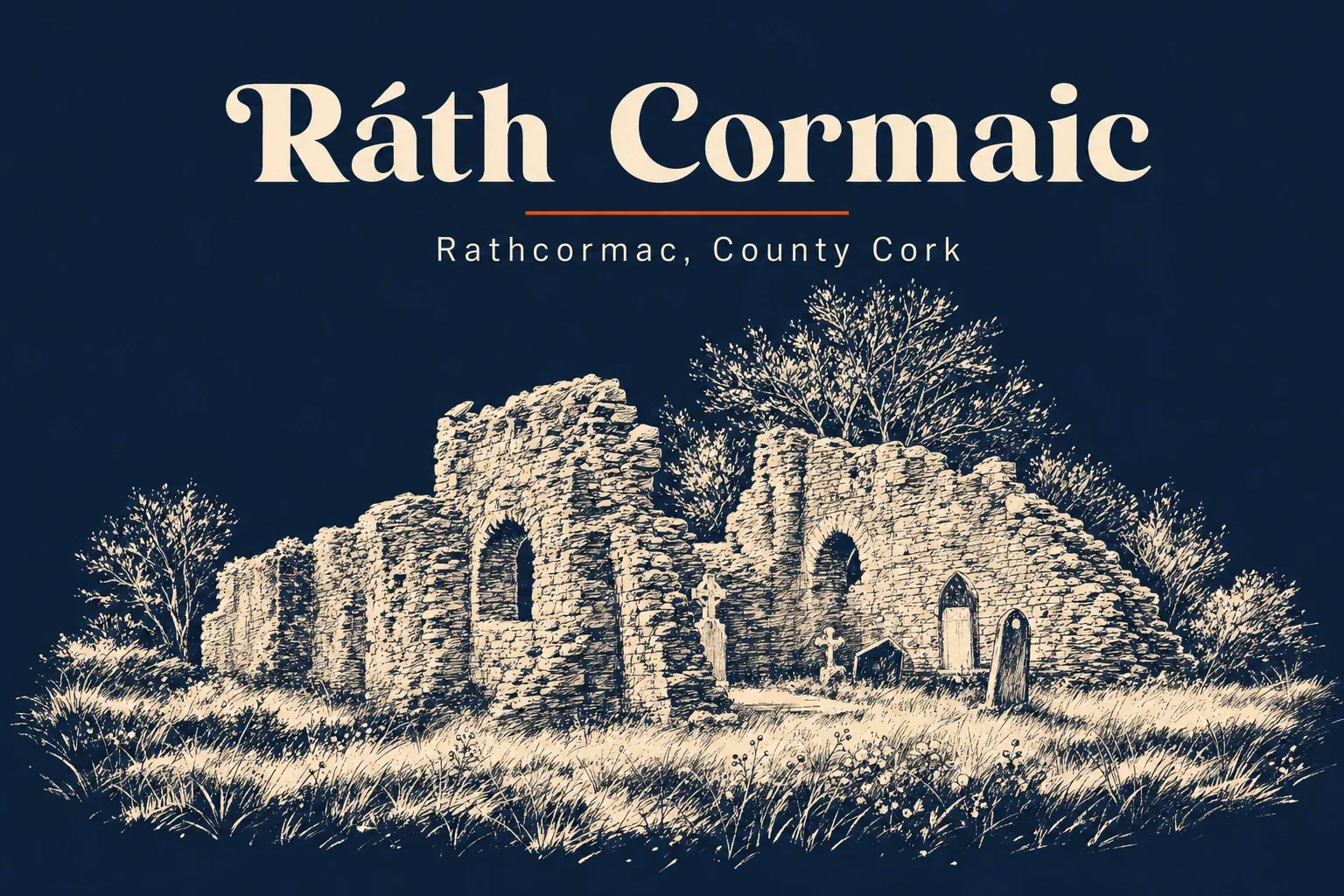
Ráth Cormaic

The East Cork
STOP 08 / 08
Ráth Cormaic · Co. Cork

A widow refused to pay church tithes. Soldiers came. Twelve people were shot dead. October 1834. Nothing was the same after.

Rathcormac is a small agricultural village in East Cork — dairy farming country, green fields, quiet. It sits on the old Cork–Dublin road, which is now the M8 motorway running past. The village is older than the road, older than the motorway, older than memory. But one day in October 1834 changed what the place meant.

A widow named Ryan lived here and kept a small holding. The parish priest demanded tithes — eleven shillings — paid to the Church of Ireland, the established church, which most Irish Catholics did not belong to. Ryan refused. Police came to seize her goods. A crowd gathered — maybe two hundred. Soldiers were brought in. Someone ordered them to fire. Twelve people were shot dead. Many more were wounded. The soldiers reloaded and fired again, as if this were a battle and not a village in Ireland in broad daylight.

The Rathcormac massacre, as it became known, happened because the tithe system was unjust and everyone knew it. Catholics were forced to pay tithes to support a church they didn't attend. For years they'd resisted quietly, refusing to pay. By 1834, the resistance was violent and the government response was violent. Rathcormac was the breaking point. The incident caused outrage in parliament and on both sides of the Irish Sea. Tithe reform came within months. The worst part of the system ended. But not before the widow's village had bought that change with blood.

Today Rathcormac is quiet again. The M8 means the through-traffic doesn't come down the village road anymore. It's farming country — cattle, grass, the shape of the land unchanged since Ryan's time. The historical marker is there but unobtrusive. The violence has settled into history. What remains is the fact that twelve people were killed here, that a widow's refusal to pay an unjust tax was answered with soldiers' bullets, and that something about Ireland changed because of it.
Population
~700
Coords
52.0808° N, 8.2831° W
01 / 08

At a glance.

Three things every local will eventually mention. Read these and you've already understood more than most day-trippers do.

02 / 08

The pubs.

None of these are themed Irish pubs, because they don't need to be. A few that earn the trip:

The Main Bar

Locals, quiet
Village pub

The working pub. Farm talk, tea, the kind of place you'll find the same faces on the same stools. No menu, no music, no fuss.

Healy's

Steady
Local pub

Another village pub. Solid, reliable, the sort of place that doesn't pretend to be anything other than what it is.

03 / 08

Where to eat.

PlaceTypeLocal note
Village shop café Café & grocery The shop does tea and sandwiches midday. Close it, and you've got to drive to Fermoy.
Local chipper Takeaway Fish and chips. Eat in your car or take them back to the B&B.
04 / 08

Stories & lore.

The reason to come back. The things every local will eventually tell you about, usually after the second pint.

October 18, 1834

The Rathcormac massacre

The tithe system made Catholics pay taxes to support the Church of Ireland — a church they did not attend. For years, Irish farmers resisted passively. By 1834, the resistance was hardening into refusal. The widow Ryan — her first name lost to time — lived in Rathcormac and refused to pay her eleven-shilling tithe. Police came to distrain her goods (seize them to pay the debt). A crowd of maybe two hundred gathered. Soldiers were ordered to the scene. Someone — an officer, never clearly identified — gave the order to fire. The soldiers opened on the crowd. Twelve people were shot dead. Many more wounded. The soldiers reloaded and fired again, as if clearing a battlefield. The widow's name is gone but the date is not. Rathcormac massacre, October 18, 1834. The incident caused parliamentary uproar in London and Dublin. Tithe reform came within months. The worst aspects of the system were dismantled. The price was paid in blood.

1831–1836

The Tithe War

The tithe system had always been resented — Catholics didn't want to pay taxes to support a Protestant church. But by the 1830s, the economy was tight and the resentment was becoming organized. Farmers and labourers began refusing to pay. The system tried to collect. Armed police came. Resistance turned violent. The Tithe War was a period of agrarian conflict, most serious in Leinster and Munster, that lasted six years and turned Ireland's rural landscape into a battleground of sorts — ambushes, house-burnings, military convoys. Rathcormac was the climax. The incident was so shocking, the violence so clear, that reform had to follow. The system was scaled back. The tension eased, but slowly.

05 / 08

Things to do outside.

Wear waterproofs. Bring a sandwich. Tell someone where you're going if it's the mountain.

The massacre site The village road, roughly where the crowd gathered. There's a small marker if you know where to look. Walk it in the afternoon when the light is sideways and the place is quiet. Think about twelve people.
2 km walkdistance
30 minutestime
Rathcormac to Fermoy Walk the old road north toward Fermoy. It's uphill and then downhill, through farmland. The M8 runs parallel but hidden mostly. You'll pass the same fields that would have been there in 1834.
8 kmdistance
1.5–2 hourstime
Ring road circuit The village sits at the edge of a farming valley. Walk the back roads that ring it — stone walls, gates, cattle. It's the working landscape.
5 kmdistance
1 hourtime
06 / 08

When to go.

There is no bad time. There are different times.

Spring
Mar–May

Lambs, new grass, the landscape waking up. Quiet. Good walking weather.

◉ Go
Summer
Jun–Aug

The pubs stay open longer. The walking is easy. Still quiet — it's not a tourist destination.

◉ Go
Autumn
Sep–Oct

October especially — the month of the massacre. The weather can be moody. The light is good for walking.

◉ Go
Winter
Nov–Feb

Cold, wet, quiet. Not much to do except think about history. Some people like that.

◐ Mind yourself
07 / 08

What to skip.

Honestly? Don't bother.

If a local was sitting beside you, this is the bit where they'd lean in.

×
Expecting a visitor centre or museum

Rathcormac is not set up for tourists. The historical significance is real but there's no built infrastructure around it. Bring a book about the Tithe War.

×
Coming as a day-trip from Cork

There's not enough to do for a half-day visit. The interest is historical and quiet. Stay at least a night if you're genuinely interested in the place.

×
Driving fast through on the M8

The M8 bypasses the village and you'll miss the entire point. Get off the motorway. Go through the village slowly. Look around.

+

Getting there.

By car

From Cork city, take the N8 north toward Dublin. Exit at Rathcormac (there's a sign). The old road runs through the village. Fermoy is 8 km north. Dublin is 2 hours past Fermoy.

By bus

Bus Éireann runs Cork–Fermoy–Mitchelstown. Rathcormac is on the route (1 hour from Cork). Ask the driver to drop you in the village centre.

By train

No train station. Cork Kent is the nearest; bus from there.