County Cork Ireland · Co. Cork · Kilworth Save · Share
POSTED FROM
KILWORTH
CO. CORK · IE

Kilworth
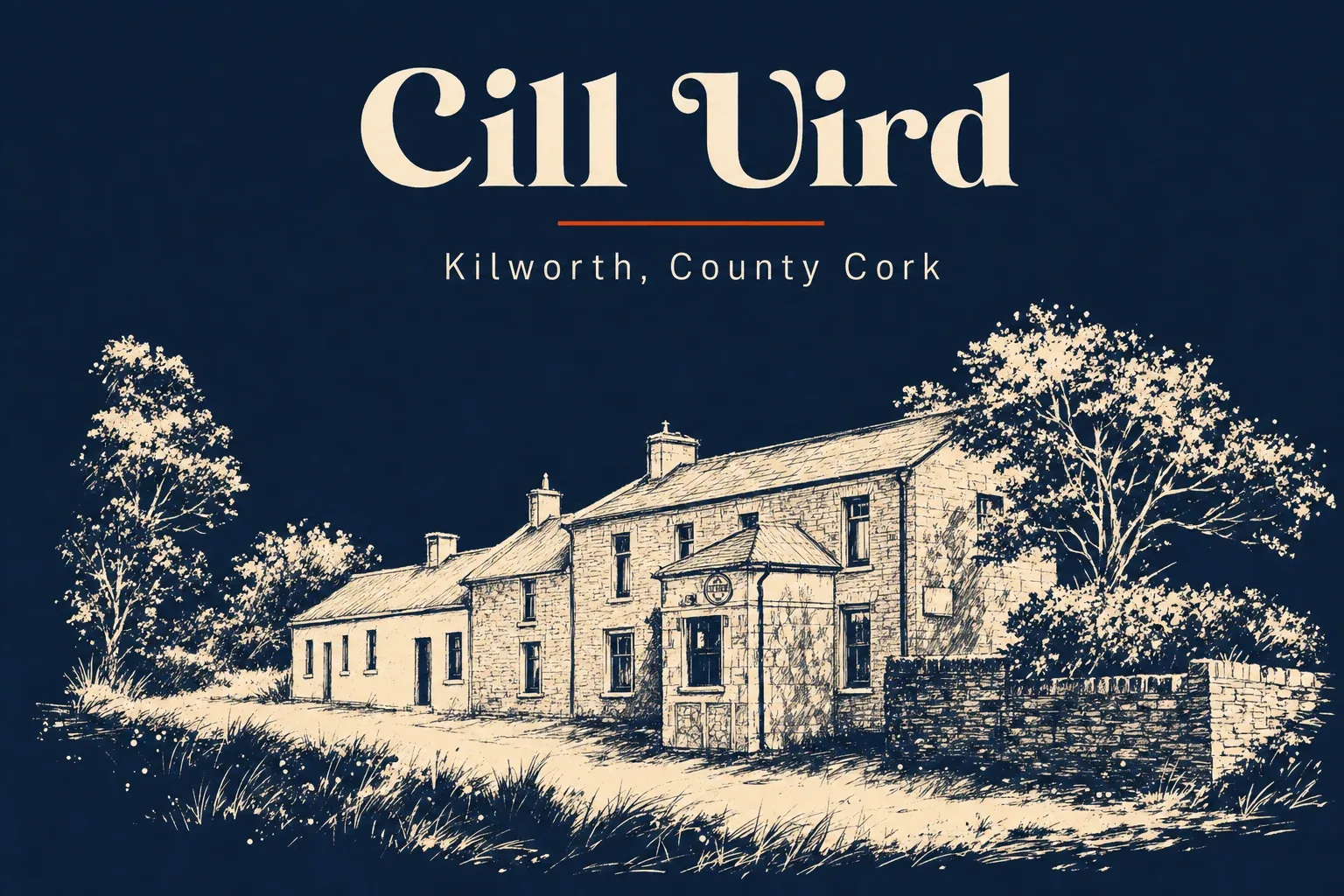
Cill Uird, Co. Cork

The Ireland's Ancient East
STOP 07 / 07
Cill Uird · Co. Cork

A faded coaching town two kilometres above Fermoy, with an old church turned arts centre and the first British camp handed over to the Irish Army.

Kilworth is a town that used to be busier. In the seventeenth and eighteenth centuries it sat on the main Dublin-to-Cork road and made a living off the passing trade - coaches, posting inns, a market. Then the road was rebuilt to run through Fermoy, the Bianconi cars stopped calling, and the bigger town two kilometres south took the rest. By the nineteenth century Kilworth was already in decline, and it has stayed a small, quiet village since.

The name is Cill Uird, the church of the order. St Colman is traditionally said to have founded a monastic settlement here around 636 AD. The most visible church now is the Church of Ireland on the village square, which was deconsecrated in 1977 when the congregation fell away. Rather than let it rot, the village took it over and turned it into an arts centre and theatre - which is a better second life than most rural churches get.

The other reason Kilworth exists is the army. The British opened firing ranges here in 1896, and before the First World War the camp was a training hub, often the last billet for soldiers before they shipped out. On 4 February 1922, weeks after the Anglo-Irish Treaty, Kilworth became the first major military installation handed over to the new Irish National Army. It is still active. Renamed the General Liam Lynch Camp in 1966, it trains Defence Forces personnel before overseas deployment. You will see soldiers in the village. Nobody remarks on it.

Do not come expecting a tourist village - it has none of that apparatus. Come for a pint in a plain bar, the arts centre if something is on, a forest walk up at Glansheskin, or as a quiet base two minutes off the M8 between Fermoy and the Galtees. Across the Funshion, Teagasc runs its national dairy research station at Moorepark, which is most of what the wider parish does for a living.
Population
~1,179 (2022)
Pubs
3and counting
Founded
Monastic settlement traditionally founded by St Colman c. 636 AD; coaching town on the old Dublin-Cork road
Coords
52.1764° N, 8.2442° W
01 / 07

At a glance.

Three things every local will eventually mention. Read these and you've already understood more than most day-trippers do.

02 / 07

The pubs.

None of these are themed Irish pubs, because they don't need to be. A few that earn the trip:

Corbett Court

The all-rounder, open from breakfast
Bar, restaurant & guesthouse, on the old Cork-Dublin road

The largest place in the village and the one most likely to have food on. Bar, restaurant and rooms, two minutes off junctions 13 and 14 of the M8 between Fermoy and Mitchelstown. Serves through the day. If you only stop once in Kilworth, this is the practical choice.

Aherne's Bar

Plain local
Village bar

A traditional village bar run by the Aherne family. No frills, no programming - a pint and the regulars. The honest end of the village.

The Butcher's Bar

Old-school local
Village bar

A long-standing local run by the Dalton family. The kind of small-village bar where the conversation does not stop when you come in, but it does turn to look. Drinking pub, not a food stop.

03 / 07

Stories & lore.

The reason to come back. The things every local will eventually tell you about, usually after the second pint.

Deconsecrated 1977

The arts centre in the old church

The Church of Ireland on the village square was deconsecrated in 1977 after attendances fell away, and instead of being sold off or left to ruin it was handed over to the community. It now runs as Kilworth Arts Centre, a small theatre and arts venue in the body of the old church. It is the cultural heart of a village that otherwise has very little programmed life, and worth checking what is on before you assume there is nothing to do.

British ranges 1896, Irish Army since 1922

Kilworth Camp and the 1922 handover

The British army opened ranges at Kilworth in 1896 and built it into a sizeable training camp; in the years before the First World War it was often the last Irish ground a soldier stood on before the front. During the War of Independence it held IRA internees, with a notable tunnel escape in 1921. On 4 February 1922, just after the Treaty, it became the first major military installation handed over to the new National Army - the troops who took it over were led by a Tom Barry from nearby Glanworth, not the famous West Cork column commander of the same name. Renamed the General Liam Lynch Camp in 1966, it is still an active Defence Forces training ground.

Redmond Barry, 1813-1880

The judge who sentenced Ned Kelly

Sir Redmond Barry, the colonial judge in Melbourne who sentenced the Australian bushranger Ned Kelly to hang in 1880, came from Ballyclough House near Kilworth. The same corner of north Cork produced the Pigot family of judges - David Pigot, Chief Baron of the Irish Exchequer, and his son John Edward Pigot, a founder of the National Gallery of Ireland. A lot of legal and public weight for a village this size, and none of it advertised on the way in.

04 / 07

Things to do outside.

Wear waterproofs. Bring a sandwich. Tell someone where you're going if it's the mountain.

Glansheskin forest walk A Coillte forest about 1.5km northeast of the village on minor roads toward Ballyporeen. The Douglas River runs down the wooded glen and meets the Araglin nearby, both feeding the Blackwater. Quiet, wooded, well off the tourist track. The waymarked Blackwater Way long-distance trail begins not far away at Araglin.
Forest loops, variousdistance
1-2 hourstime
Kilworth Slí na Sláinte A signed community health walk in two loops, one starting in the village and one at the V cross. Roadside walking rather than wild country, but a straightforward way to stretch the legs without a car. Nothing dramatic, just the lanes and the river country.
3.1 km / 4.2 kmdistance
45 min - 1 hourtime
Funshion riverside The Funshion (Funcheon) runs below the village before joining the Blackwater near Fermoy. There is no formal riverside trail, but the lanes down toward the water are quiet and green. A morning amble rather than a destination.
Short, out and backdistance
30-45 minutestime
05 / 07

When to go.

There is no bad time. There are different times.

Spring
Mar-May

The river country greens up and the forest at Glansheskin is at its best before the bracken takes over. Quiet, mild, no crowds - there never are crowds.

◉ Go
Summer
Jun-Aug

Longest evenings for the walks and the easiest weather. A useful, cheap M8 base for the Galtees and the Blackwater valley. Check whether the arts centre has anything on.

◉ Go
Autumn
Sep-Oct

The Glansheskin woods turn over and the salmon rivers below are at their most atmospheric. Good walking light, few people.

◉ Go
Winter
Nov-Feb

Short days and not much open beyond the bars. Fine as an overnight off the motorway, but there is little to do in the village itself in the dark months.

◐ Mind yourself
06 / 07

What to skip.

Honestly? Don't bother.

If a local was sitting beside you, this is the bit where they'd lean in.

×
Expecting a tourist village

Kilworth has no visitor centre, no craft shops, no harbour of restaurants. It is a small, plain, working village with an arts centre, a few bars and an army camp. Come for the quiet and the walks, or use it as a base, but do not arrive expecting Kinsale.

×
The army camp as a sight to visit

The General Liam Lynch Camp is an active Defence Forces training ground, not a heritage attraction. The history is real and worth knowing, but it is a working military installation - read about it, do not drive up to the gate expecting a tour.

×
Confusing Kilworth with Mitchelstown for the Galtees

The proper Galtee mountain walks launch from Mitchelstown, twenty kilometres north. Kilworth sits below the lower Kilworth Mountains and the Glansheskin forest. Good for a forest hour, not for a high mountain day.

+

Getting there.

By car

Kilworth is on the R639, two kilometres north of Fermoy and about twenty south of Mitchelstown. The M8 Cork-Dublin motorway runs alongside; junctions 13 and 14 put you in the village in minutes. Cork city is about 45 minutes south, Cashel 40 minutes north.

By bus

Services are sparse. Fermoy, two kilometres south, is the local hub for Bus Éireann connections on the Cork-Dublin corridor; check timetables and consider a taxi or lift for the last stretch.

By train

There is no railway in this part of north Cork. The nearest mainline stations are Mallow (about 40 minutes west) and Limerick Junction, both on the Dublin-Cork line. Fermoy lost its line decades ago.