Gleannúir · Co. Cork
A Norman castle on a rock, a 13-arch bridge below it, and the largest wedge tomb in Ireland down the road. Tiny, and stacked with stone.
Glanworth is a small village in North Cork, eight kilometres northwest of Fermoy, and for its size it carries an unusual weight of stone. The Funshion River - you will also see it spelled Funcheon - runs below the village, and the whole place is arranged around the crossing.
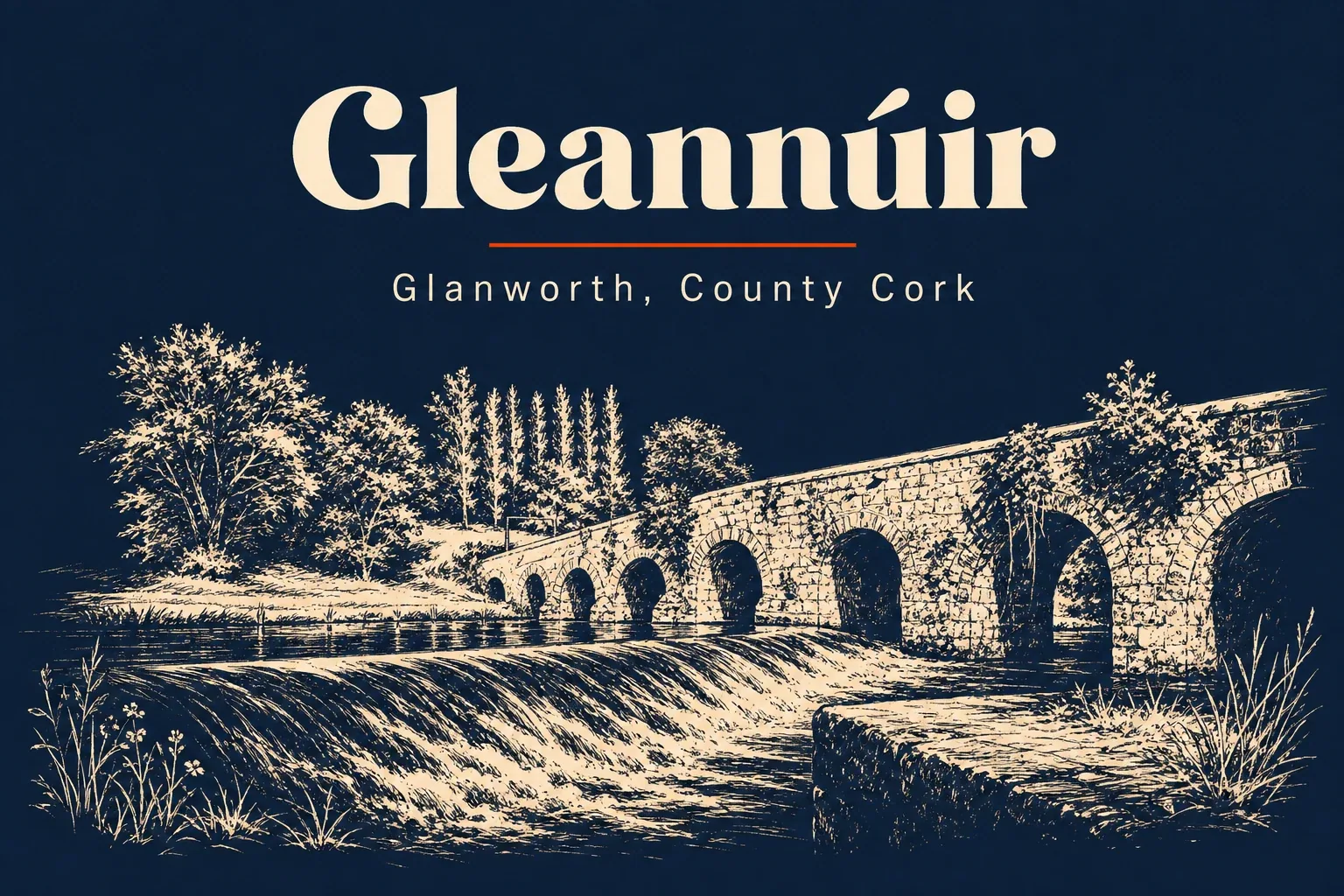
The set-piece is the castle. The Condons, Norman settlers, built a stronghold on the rocky outcrop above the river in the late 12th or 13th century; by around 1300 it had passed to the Roches, Lords of Fermoy, who held it for centuries. The keep and the curtain wall still stand, and the site is now a quiet public walk. Directly below, the old mill - built in the 1840s as a famine relief scheme and later turned to woollen work - still holds one of the last reverse undershot water wheels in Ireland. And below that, the long 13-arch bridge, narrow enough that it is locally claimed as the oldest public bridge still in daily use in Europe. Castle, mill, bridge, river: it stacks up in a single view.
There is more in the ground around the village than in it. Two kilometres southeast, in a field, sits Labbacallee - the largest wedge tomb in Ireland, around 2300 BC, with three huge capstones and a folklore name, the Hag's Bed. In the village itself the ruined Dominican friary, founded by the Roches in 1475 and shut at the Dissolution in 1541, sits among the houses.
This is a stop, not a stay. An hour or two does it - the castle walk, the bridge from the riverbank, a pint, then on to Fermoy or Mitchelstown. Glanworth does not pretend to be more than it is, which is part of why it is worth the detour.