County Derry Ireland · Co. Derry · Bellaghy Save · Share
POSTED FROM
BELLAGHY
CO. DERRY · IE

Bellaghy
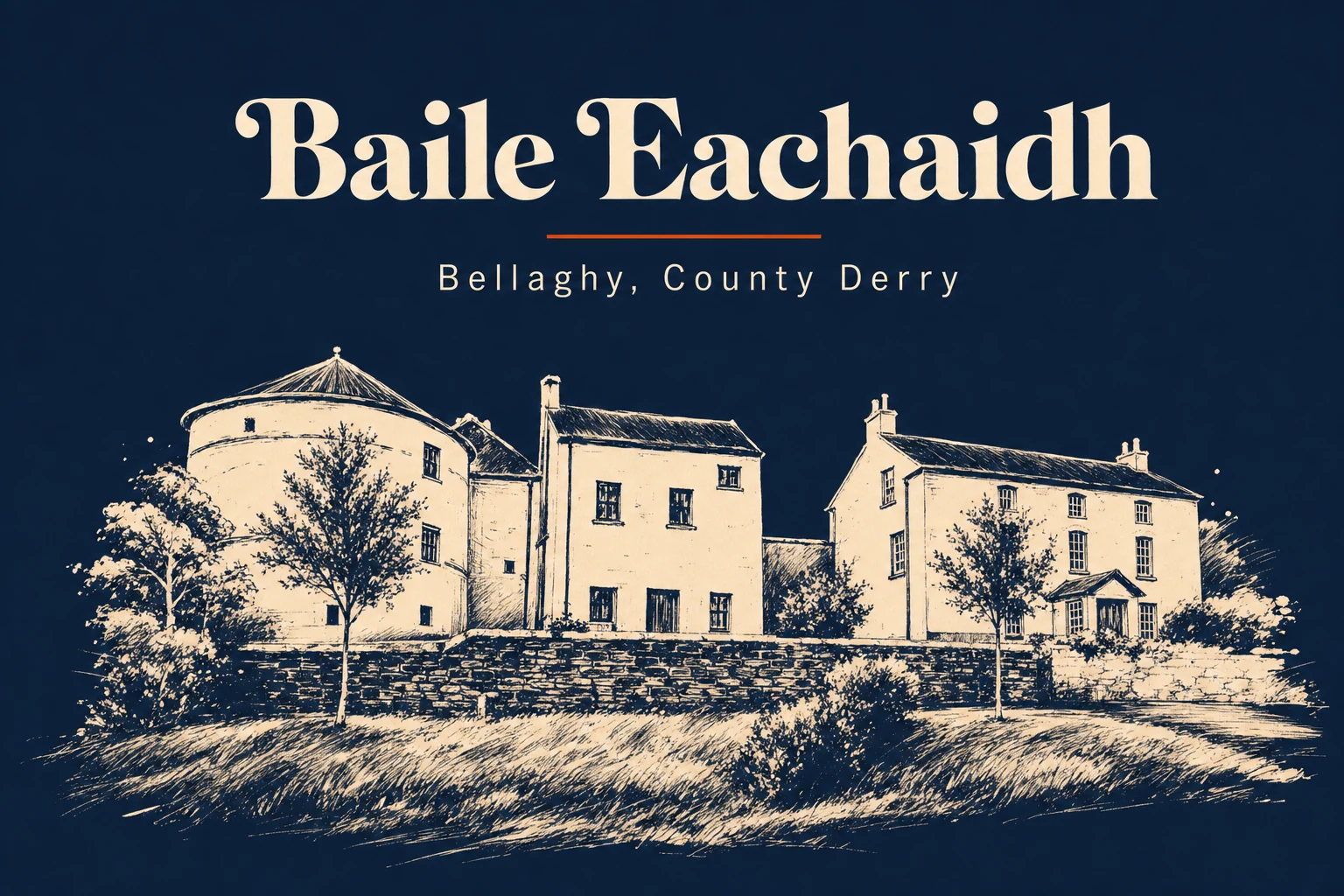
Baile Eachaidh

The Mid Ulster
STOP 03 / 06
Baile Eachaidh · Co. Derry

The Heaney village. He's buried in the churchyard. Everything else follows from that.

Bellaghy is a one-street village in south Derry with about a thousand people in it and one of the great literary lives of the twentieth century buried in its churchyard. Seamus Heaney was born on 13 April 1939 at Mossbawn farm a couple of miles outside the village, went to school at Anahorish, won the eleven-plus to St Columb's in Derry, and spent fifty years writing the fields and bogs and place-names of this small parish into poetry that took the Nobel in 1995. He died in Dublin on 30 August 2013. They brought him home and put him under a slab in St Mary's that says "Walk on air against your better judgement." That's the line you came for.

The village itself is short. A long Main Street, a couple of pubs, a chipper, the war memorial, the church up at one end and the Bawn out at the other. Three years after Heaney died, the council took the abandoned police barracks halfway up Main Street and turned it into HomePlace — a literary centre devoted entirely to one poet. It is the best thing of its kind in Ireland. They kept the basalt of the old fort in the new walls, which feels right for a body of work that never let you forget what was underneath.

What you do here: HomePlace in the morning, the Bawn after lunch, Lough Beg in the late afternoon when the light goes flat. Read "The Strand at Lough Beg" before you walk it, or after, whichever way round you prefer your grief. Then you drive to Magherafelt to sleep, because Bellaghy doesn't really do hotels, and that's fine. Come back the next day if there's a reading on.

It is not a tourist village. There is no harbour, no festival every weekend, no coach trade. There is a poet, a fort, a lough, and a churchyard, and most days that is more than enough.
Population
~1,155
Pubs
2and counting
Walk score
Top of Main Street to bottom in eight minutes
Founded
Vintners' Company plantation settlement, c. 1614
Coords
54.8067° N, 6.5147° W
01 / 08

At a glance.

Three things every local will eventually mention. Read these and you've already understood more than most day-trippers do.

02 / 08

The pubs.

None of these are themed Irish pubs, because they don't need to be. A few that earn the trip:

The Taphouse Bar & Restaurant

Family-friendly, food-led
Pub & restaurant, 35 Main Street

Opened 2018. The closest thing the village has to a destination dining room — locally sourced, weekend music in the Orchard Room out the back, big beer garden. Where you'll end up after HomePlace whether you meant to or not.

Docs Bar

Local, refurbished
Pub, 25 Main Street

Recently done up, friendly. The sit-on-a-stool-and-talk pub of the two. If The Taphouse is the dinner pub, this is the late-pint pub.

03 / 08

Where to eat.

PlaceTypeLocal note
The Taphouse kitchen Pub food €€ Steaks from local farms, Sunday roast, the standard Ulster pub-restaurant repertoire done properly. Book at weekends — Mid Ulster turns up.
04 / 08

Stories & lore.

The reason to come back. The things every local will eventually tell you about, usually after the second pint.

A poet, a parish, a slab

Mossbawn to St Mary's

Heaney was born at Mossbawn farm in 1939, the eldest of nine. The family later moved to a farm called The Wood, also in the area. He's buried in St Mary's churchyard at the top of the village, beside his parents and his younger brother Christopher (the four-year-old killed by a car in 1953, mourned in "Mid-Term Break"). The headstone reads "Walk on air against your better judgement" — the line is from his Nobel lecture and the poem "The Gravel Walks." Visitors leave pens. The grass around the stone is wearing thin. The parish keeps an eye on it.

A literary centre in a former barracks

HomePlace

The RUC barracks on Main Street stood empty after the demilitarisation of the late 1990s. Mid Ulster District Council bought it, and in late September 2016 it reopened as the Seamus Heaney HomePlace — a literary and arts centre devoted entirely to one writer. The architects kept the basalt stonework of the old fort in the new building's facade. Inside is a permanent exhibition, an archive, a 190-seat theatre that runs readings most weeks, and a cafe. The shift from police barracks to poetry centre is itself the story.

1618, the Vintners' Company, and a long second life

Bellaghy Bawn

The Bawn at the edge of the village was a fortified house with a brick perimeter wall and corner flankers, built between 1614 and 1619 by the Vintners' Company of London after the Plantation of Ulster carved up the county. The Vintners briefly tried to rename the village Vintnerstown; nobody used it. The Bawn was burnt in the 1641 rising, rebuilt by 1643, lived in for the next three and a half centuries, and finally vacated in 1987. Heritage NI restored it and opened it to the public in 1996. For years it housed a Heaney exhibition; HomePlace took that over in 2016. The Bawn is now a heritage site in its own right.

The strand, the church, the elegy

Lough Beg and Colum McCartney

Lough Beg lies just south of the village — a shallow lake with Church Island in it, where there's a ruined medieval church and a separate spire raised in the 1780s. Heaney's father grazed cattle on the strand, and Heaney walked it as a boy. "The Strand at Lough Beg" is the elegy he wrote in 1979 for his second cousin Colum McCartney, a young Catholic shot dead by loyalists in south Armagh in 1975. It's in Field Work. It is one of the great Troubles poems, and it is set on a piece of mud you can stand on this afternoon.

An All-Ireland from a south Derry village

The Wolfe Tones

Bellaghy Wolfe Tones GAC, founded 1939, won the 1971–72 All-Ireland Senior Club Football Championship — a south Derry village against the rest of the country. They've taken twenty-one Derry county titles since. The pitch is at Wolfe Tone Park, Drumanee, just outside the village. The club is also where the Irish language and culture get carried in this parish, week in, week out, separately from the council and the gallery.

05 / 08

Things to do outside.

Wear waterproofs. Bring a sandwich. Tell someone where you're going if it's the mountain.

St Mary's churchyard to HomePlace to the Bawn The whole Heaney triangle in one short walk along Main Street. Grave at one end, HomePlace in the middle, Bawn at the other. Do it slow. Read something between each stop.
1.5 kmdistance
30 min on foot, longer with a notebooktime
Lough Beg & Church Island Drive south out of the village toward Church Island. Park where the road runs out and walk the strand. The island and its spire sit a hundred metres offshore; you can wade out in a dry summer, otherwise admire from the bank. Bring "The Strand at Lough Beg."
Variabledistance
1–2 hourstime
Anahorish & the Heaney roads Drive the back roads west of the village — Mossbawn, Anahorish (the school site, the "hill of clear water"), Broagh, the river. None of it is signed; that's the point. The poems are the map.
Drive, ~10 km loopdistance
1 hourtime
06 / 08

When to go.

There is no bad time. There are different times.

Spring
Mar–May

The book festival at Ballyscullion Park is in May and pulls a serious literary crowd into the village for a weekend. Light's good, hedgerows in flower, HomePlace events ramping up.

◉ Go
Summer
Jun–Aug

Quiet enough that you'll have the Bawn to yourself most weekday mornings. HomePlace runs its summer programme. Lough Beg dries back and you can walk further onto the strand.

◉ Go
Autumn
Sep–Oct

The Heaney anniversaries fall here — birthday in April, death in late August — and HomePlace tends to programme around them. The light Heaney wrote about most is the September light. Come in September.

◉ Go
Winter
Nov–Feb

HomePlace stays open but the village empties. The Bawn checks its winter hours. The churchyard in low cloud is a thing, if you're equipped for that kind of pilgrimage.

◐ Mind yourself
07 / 08

What to skip.

Honestly? Don't bother.

If a local was sitting beside you, this is the bit where they'd lean in.

×
Doing HomePlace in under an hour

It's a real archive with a real reading programme, not a photo stop. Give it two hours minimum. Watch a film in the auditorium. Read in the library. They've made space for you to sit; sit.

×
Looking for Heaney's house at Mossbawn

The original Mossbawn farmhouse is gone, the land is private, and there is no plaque. The poems are the monument. Drive the road, don't knock on doors.

×
Treating the grave like a selfie

It's a working parish churchyard with active burials. People come here to grieve. Take the photograph if you must, but keep the volume down.

×
Trying to make a night of it in Bellaghy

Two pubs, no late venues, no hotel in the village. Have your dinner at The Taphouse, then drive the seven minutes to Magherafelt for a bed. That's how the place works.

+

Getting there.

By car

Bellaghy is two miles off the A6 Belfast–Derry road, midway between the two cities. From Belfast, 50 minutes. From Derry, an hour. From Magherafelt, seven minutes.

By bus

Translink Ulsterbus 127 connects Bellaghy to Magherafelt and Antrim/Ballymena. From Belfast, take the train to Ballymena and pick up the 127. Patchy on Sundays.

By train

No station. Nearest is Antrim or Ballymena, both about 25 minutes by road. Then bus or taxi.

By air

Belfast International (BFS) is 35 minutes by car — easily the closest. Belfast City (BHD) is an hour. Dublin is two and a half.