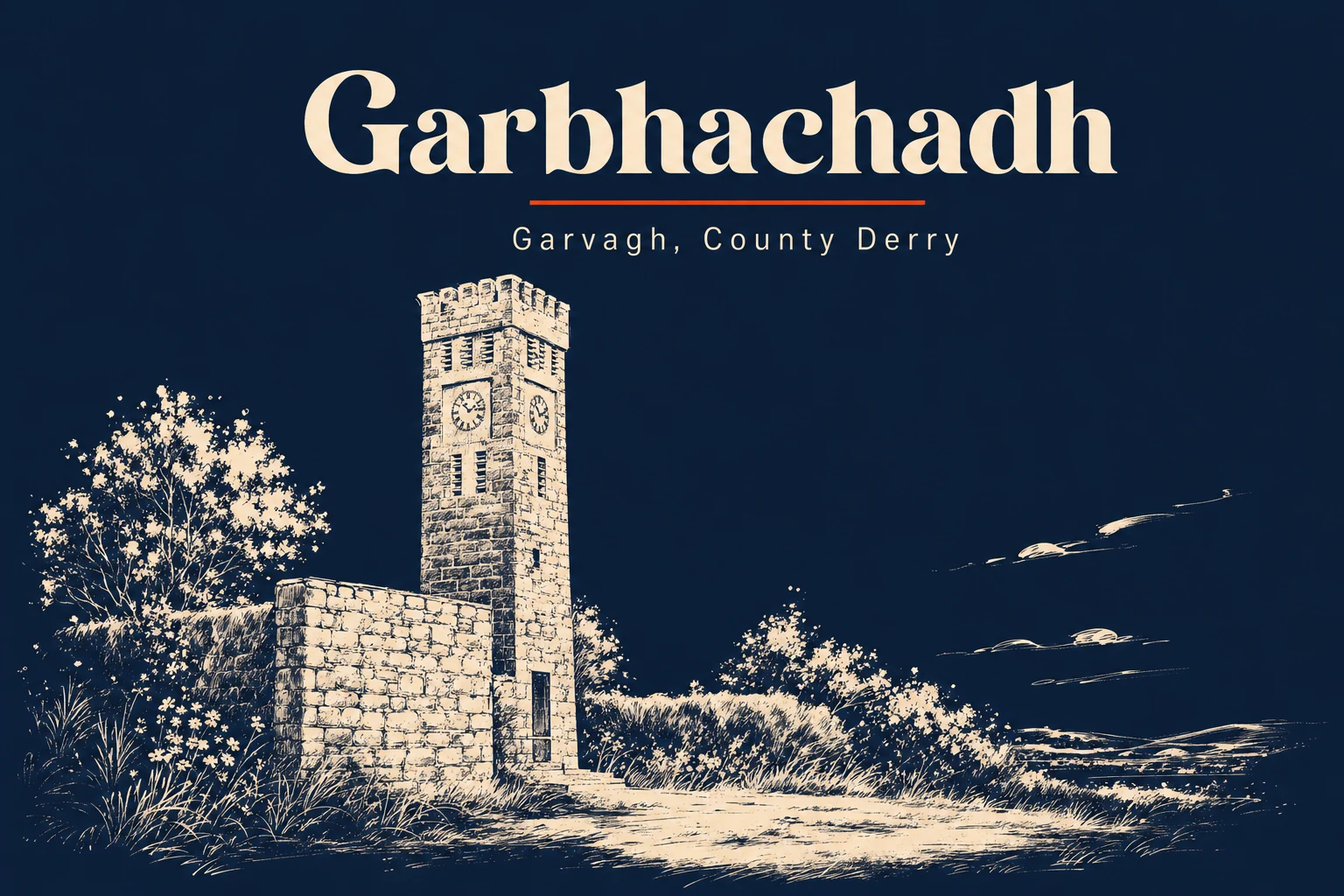
Garbhachadh · Co. Derry
Plantation town on the A29 that produced a Prime Minister and a ballad about a tavern fight.
Garvagh is a planned plantation town on the A29 between Coleraine and Maghera - eighteen kilometres south of the coast, far enough inland that the Causeway coaches sail past without noticing. The geometry is still the geometry the Cannings drew in the seventeenth century. Broad Main Street, a side road or two, fields at the edges. About 1,250 people live here. You can walk from one end of it to the other before your tea goes cold.
The angle is the family. The Cannings of Warwickshire arrived in 1615 as the Ironmongers' Company's agents, built St Paul's parish church, laid out the town, eventually bought the lands outright, and held them for three centuries. One of them - George Canning, born 1770 to a father from Garvagh who had been disinherited and fetched up in London - became Prime Minister of the United Kingdom on 10 April 1827 and was dead of pneumonia 119 days later. A separate cousin took the barony in 1818 and lived in Garvagh House up the back of what is now the forest.
The two things to see flow from that. The museum, in the old walled garden of the Canning house, holds about two thousand objects from the Bann Valley running back four millennia and is one of the better small-town folk collections in the north. The forest is what's left of the estate - two hundred hectares of woodland, three named walking trails, a mountain-bike network laid on in the 2010s, and the longest of the walks is called the Canning Trail. The third thing is the ballad - "The Battle of Garvagh", written about a sectarian skirmish at a Main Street tavern in 1813 - and it tells you more about pre-Famine Ulster than most history books.
Don't make a special trip unless you're a Plantation-history person or you ride bikes. Do stop on the way to or from the coast. The Imperial on Main Street feeds you and puts you up, the museum opens a few afternoons in summer, and the forest will eat an hour or three depending on the legs.