Cloth merchants of London
The Mercers' town
When King James I divvied up confiscated Ulster land in 1613, the Worshipful Company of Mercers — one of the great medieval livery companies of London — drew the lot for this stretch of the Bann. They built their first manor at Movanagher, two miles downstream, then moved their estate centre up to the high ground at Kilrea. The Diamond, the church above it, and the regular street grid are all theirs. The 1641 rebellion burned much of it; they rebuilt, and the Victorian shopfronts you can still read on The Diamond date from the second wave of investment in the 1800s.
Seven arches into Antrim
Kilrea Bridge
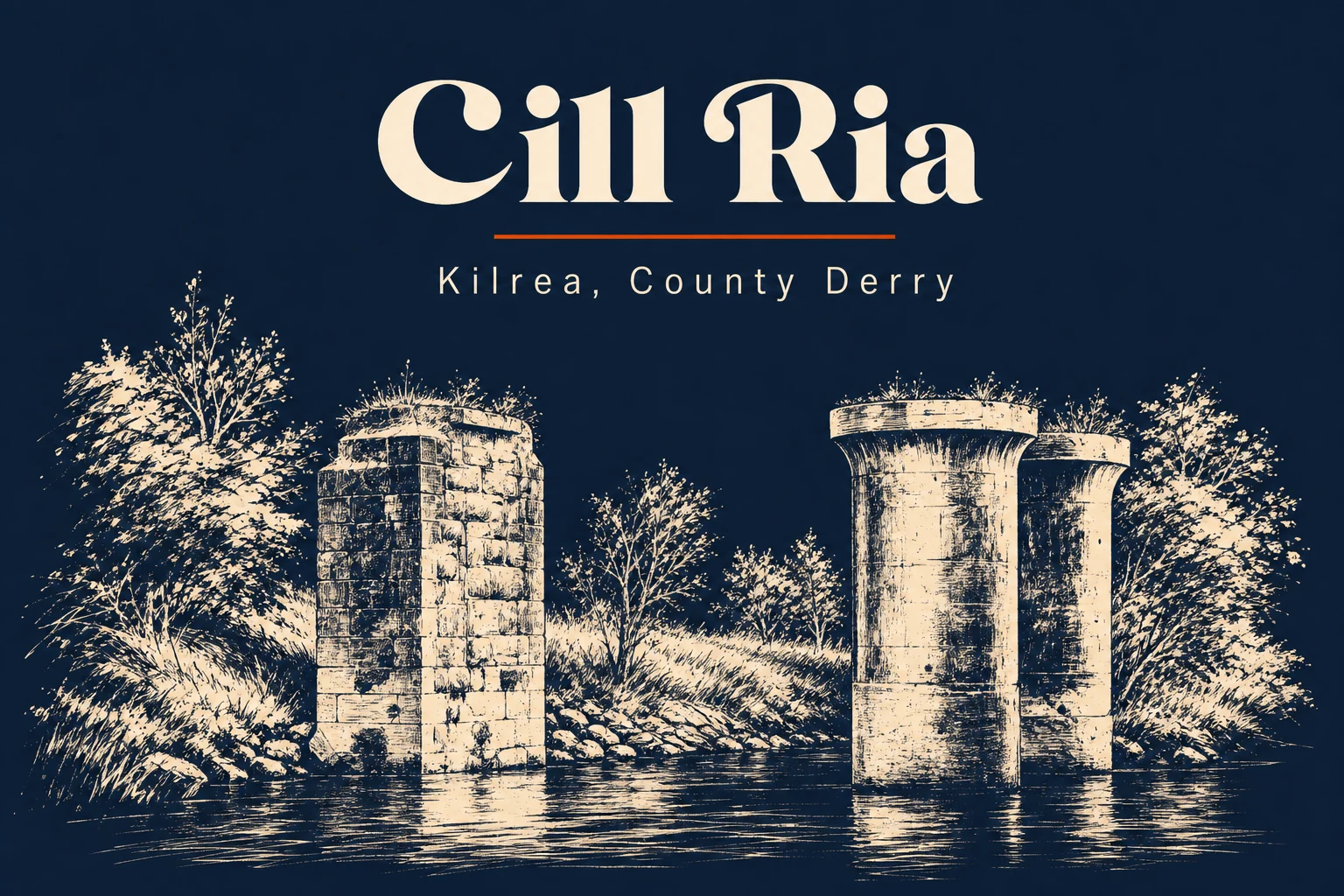
The bridge over the Bann was built in 1783 by Henry Roach, at a cost of £2,000. Seven arches, each a twenty-five-foot span. The stone came from a redundant eel weir at Portna upstream — Plantation-era recycling. It is the river crossing that puts Kilrea on the map: the B64 from The Diamond runs straight at the bridge and into County Antrim on the other side. The cracks that close it from time to time are the cracks of a 240-year-old bridge doing a job nobody designed it for.
Trout for the country
Movanagher Fish Farm
Two miles downstream from Kilrea, on an island between the Movanagher Canal and the Lower Bann, sits the DAERA fish farm. About four hectares of concrete raceways and fibreglass tanks, raising brown and rainbow trout from egg to takeable size — 25cm and bigger — to stock the angling waters of Northern Ireland. Tens of thousands of fish a year go out of here. The site has had hard recent years: a 2025 cull of more than forty thousand fish, a stocking suspension under the Wildlife Order. Visit the riverbank; the farm itself is working ground.
McIlrath's, since 1917; the mart since 1954
The mart
H.A. McIlrath & Sons have been auctioneering in Kilrea since 1917 — valuations, estate agency, livestock — and the Kilrea Livestock Market they run on the edge of town has been going since 1954. Four weekly sales now: fat lambs, hoggets and ewes through to cattle, with seasonal breeding stock and machinery sales on top. The mart is the reason Kilrea is still Kilrea and not just a postcode — it is the weekly economic event that keeps the cafés open, fills the car parks, and gives the farmers a reason to come into town. Online bidding through MartEye now too; the buyers in the ring still matter.
Pádraig Pearse's, since 1943
Kilrea GAC
The first Gaelic football club in Kilrea was founded on 15 November 1943 as O'Cahan's Kilrea, in blue and gold. In the early 1950s it renamed itself the Kevin Barry's, in honour of the patriot, and changed to black and amber. It later took its present name — Pádraig Pearse's GAC Kilrea — and the black-and-amber jersey stuck. The club fields Gaelic football and camogie sides and remains the GAA centre of gravity in this corner of Derry, where the county line and the Mercers' grid have never quite agreed on whose town this is.
Outside First Kilrea Presbyterian
The Fairy Thorn
There is a hawthorn standing in the grounds of First Kilrea Presbyterian Church that nobody will cut. Hawthorns belong to the Sídhe in Irish folk belief — disturb one and luck leaves with it — and the tradition was strong enough that it survived the Plantation, the Presbyterian church being built around it, and four hundred years of municipal tidying. It is still there. So is the church. Make of that what you will.