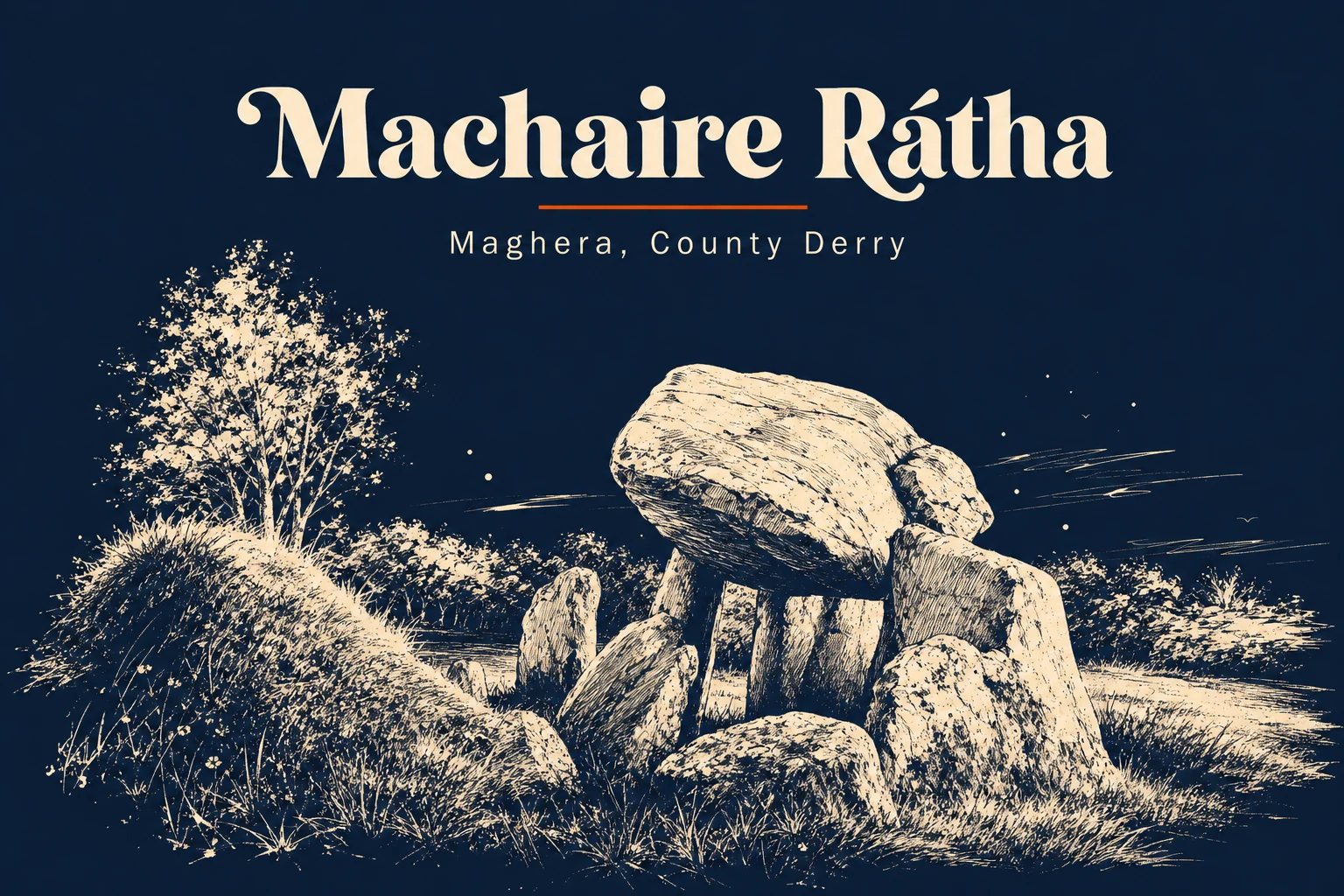
Machaire Rátha · Co. Derry
A market town at the foot of the Glenshane, with a 12th-century carved doorway people drive past without knowing.
Maghera sits at the foot of the Glenshane Pass - the high road that climbs out of Mid-Ulster and crosses the Sperrins on its way to Derry. Most traffic going west doesn't stop. The town isn't trying to make them. It's a working market town with a creamery, a couple of supermarkets, a Catholic secondary school people travel for, and the kind of square where everyone parks at the wrong angle and nobody minds.
What's worth a stop is the old church up at the top of the town. St Lurach founded a monastery here in the 6th century and the place mattered for nearly seven hundred years - bishop's seat from the mid-1100s until Bishop Germanus O'Carolan got Pope Innocent IV's sanction in 1246 to move the see to Derry on the grounds the place was too remote. By 1254 the diocese was formally called Derry, not Maghera. The current ruin is mostly mediaeval, but built around the older west door. Above that door is a carved crucifixion from the 12th century, with a row of figures along the lintel. It's one of three surviving in Ireland. Nobody charges you to look at it.
The other thing to know: the parish. Watty Graham's, the GAA club a couple of miles up the road in Glen, is named after a local Presbyterian farmer who was hanged here in 1798 for his part in the United Irishmen's rebellion. In January 2024 they won the All-Ireland Club Football final at Croke Park. The trophy came home through the town in the rain. People talk about it the way people in other places talk about the weather.
Stay one night. Walk Carntogher in the morning, the church and the walled garden in the afternoon, eat at Ardtara if you can get a table, drink in Walsh's. Drive on to the Causeway or up to Derry the next day.