County Derry Ireland · Co. Derry · Moneymore Save · Share
POSTED FROM
MONEYMORE
CO. DERRY · IE

Moneymore
Muine Mór

The Mid Ulster
STOP 06 / 06
Muine Mór · Co. Derry

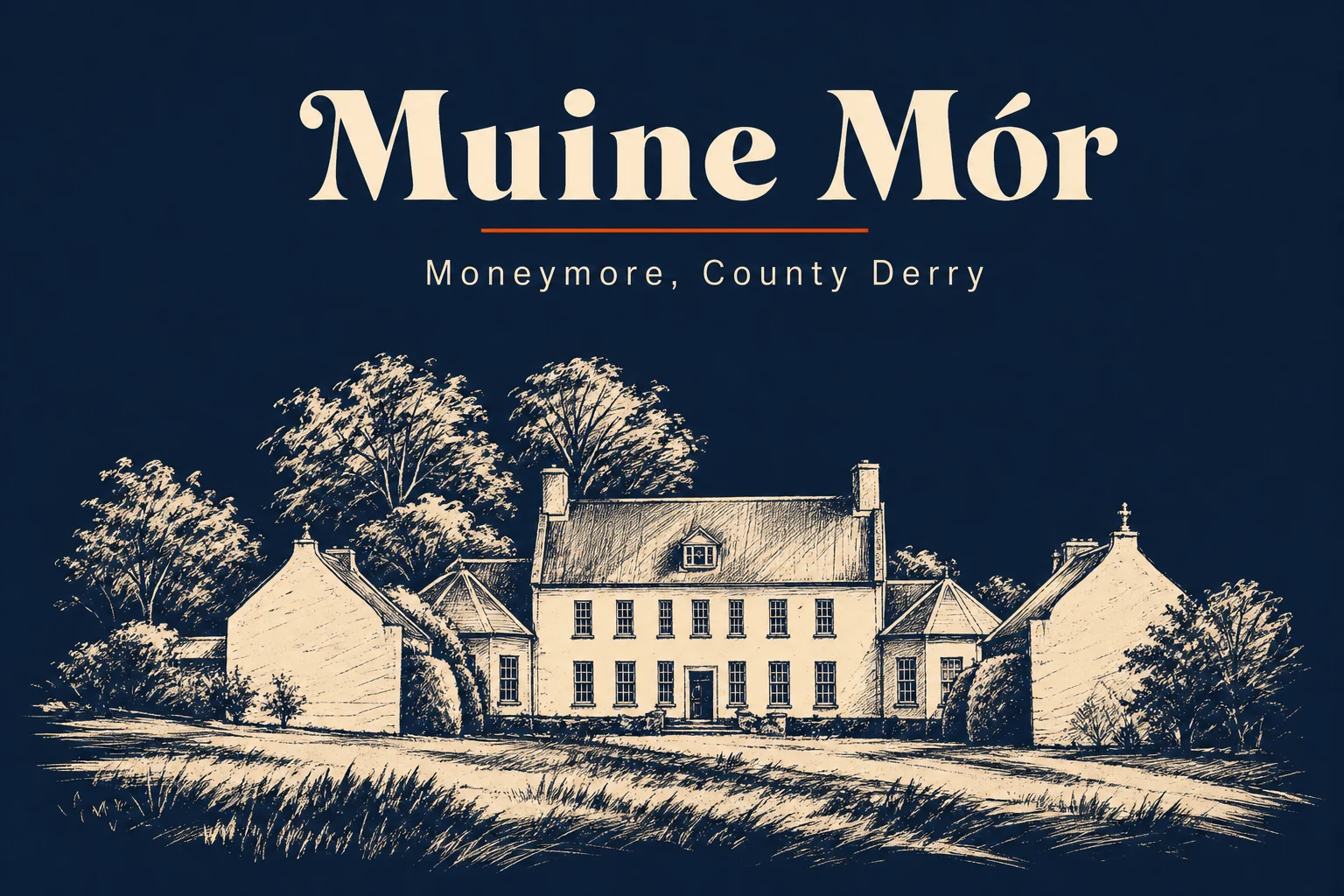
A London livery company's planned village, still mostly the shape they drew it.

Moneymore is a planned village, and it reads like one. Two streets meeting at a square — the Diamond — with a market house on it and the Drapers' Arms over a couple of the older buildings. The Worshipful Company of Drapers of London were handed this corner of south Derry in the Plantation, the same way the Skinners got Dungiven and the Salters got Salterstown, and they built themselves a tidy little town to go with it.

The reason to come, honestly, is Springhill. The house is a mile down the B18 toward Cookstown and was built about 1680 by the Conynghams — Scottish planters out of Ayrshire who later went by Lenox-Conyngham and stayed in the place for nearly three centuries. The National Trust have it now: white walls, a yew walk, a library of three thousand books, the largest costume collection in Northern Ireland in the old laundry, and the most thoroughly documented ghost in Ireland up on the landing.

The village itself is short. You can walk it before tea. Farmers come in on Thursdays. The chip shop closes when it closes. The reason the Drapers' street pattern still works is that nothing has been important enough to come along and rip it up. That is its own kind of recommendation.

Population
~1,900
Walk score
The Diamond to either end of Main Street in five minutes
Founded
Planted by the Drapers' Company, early 1600s
Coords
54.6917° N, 6.6833° W
01 / 06

At a glance.

Three things every local will eventually mention. Read these and you've already understood more than most day-trippers do.

02 / 06

Stories & lore.

The reason to come back. The things every local will eventually tell you about, usually after the second pint.

A London livery company in south Derry

The Drapers' town

The Plantation of Ulster in 1610 carved the confiscated O'Neill lands into estates and handed them to the twelve great livery companies of London — drapers, skinners, salters, vintners, ironmongers and the rest. The Drapers got Moneymore and, later, Draperstown up the road. They were absentee landlords by the standard of the day: a manager on the ground, a steady stream of rent back to London, and a programme of building — market houses, schools, churches, almshouses — to look respectable about it. By 1817 the Company had spent a fortune tidying the village up and rebuilding most of what had gone to seed in the previous century. Sir William Lenox-Conyngham at Springhill was their last agent. The estate was wound down by 1906 and the Company disposed of the last of it shortly after.

An early scheme, possibly a first

The piped water

Pynnar's survey of the Plantation, made for the Crown around 1619, recorded six good houses of stone and lime here, all supplied with water carried in wooden pipes from a well near the limestone quarry at Spring Hill. Local boasts make it the first town in Ireland to have piped water — that's hard to verify, and the date 1615 gets thrown about more confidently than the records support. What is certain is that when the high street was lowered in the 19th century, workmen dug up sections of the original wooden mains: the timber crumbled to dust, the iron hoops survived in fair condition, and a few are kept locally.

The ghost the National Trust put on the brochure

Olivia at Springhill

George Lenox-Conyngham served under Castlereagh in the Irish Volunteers, fell out with him over the 1798 business, and never recovered his nerve. In 1816 he carried a pistol up to his bedroom at Springhill and shot himself, with his second wife Olivia just outside the door. Olivia is said to have walked the upstairs landing of the house ever since — guilty, fond of children, generally well-behaved. During the Second World War American officers billeted at Springhill asked for a cot in the nursery to be removed because of a knocking sound it made on its own. The cot was removed. The knocking stopped. After the war the cot came back. The knocking came back with it. The Trust now markets her, mildly.

The reservoir over the Tyrone line

Lough Fea

Five minutes south of the village the dual carriageway is signposted for Lough Fea — a 180-acre moorland lake in the Sperrins that has supplied the drinking water for half this corner of Mid-Ulster since 1965. It is technically over the line in Tyrone but every Moneymore household has been drinking it for sixty years. There's a flat 4km path around the shore, brown trout and pike for those who fish, and a view of the Sperrins that earns the detour. A fair swap for a place that piped its own water four hundred years ago.

03 / 06

Things to do outside.

Wear waterproofs. Bring a sandwich. Tell someone where you're going if it's the mountain.

Springhill House and grounds A mile southeast on the B18. Yew walk, walled garden, costume museum in the old laundry, the library with the 1541 psalter, and the upstairs landing with the ghost. National Trust opening hours — check before driving out in winter.
1 km of paths, plus the housedistance
Half a daytime
Lough Fea circuit Drive south to the Cookstown dual carriageway and follow the signs. Flat gravel path round the reservoir, Sperrins on every side, no cafe at the end. Bring a flask. Technically just inside Tyrone but it's the local walk.
4.15 km loopdistance
45 min – 1 hourtime
Moneymore Heritage Trail A self-guided walk round the village past the old Market House, the Drapers' Arms buildings, the First Presbyterian Church, the Manor House and the gaol. Plates on the buildings do most of the talking. Pick up the leaflet at the library on Main Street.
About 2 km on footdistance
1 hourtime
04 / 06

When to go.

There is no bad time. There are different times.

Spring
Mar–May

Springhill's gardens come into themselves and the house reopens for the season. Quiet weekdays.

◉ Go
Summer
Jun–Aug

Long evenings, Springhill open most days, Lough Fea full of walkers. Busiest it gets, which isn't very.

◉ Go
Autumn
Sep–Oct

The yew walk in October is the best argument for the place. Springhill closes early November.

◉ Go
Winter
Nov–Feb

The big house shuts. The village keeps going but there's not much to come for from outside. Lough Fea is bleak in a fine way if you're dressed for it.

◐ Mind yourself
05 / 06

What to skip.

Honestly? Don't bother.

If a local was sitting beside you, this is the bit where they'd lean in.

×
Insisting on the 1615 piped-water claim

Pynnar's 1619 survey is the documented bit. Whether that makes it the first town in Ireland to have piped water depends who you ask and how you count. The well and the pipes existed. The bragging rights are softer.

×
Driving past Springhill to get to Belfast

It's the reason to stop in Moneymore. If you're going through and you don't have ninety minutes for the house, at least walk the grounds. The gate is ten yards off the road.

×
Looking for a session in the village

This isn't a music town. For trad you want Magherafelt or Bellaghy. The pubs here pour pints and watch the football and that's the deal.

×
Confusing Moneymore with Draperstown

Same livery company, different villages, ten miles apart. Draperstown is the Drapers' market town for the hill country; Moneymore is the Drapers' village on the lowland road. Both worth a stop, neither a substitute for the other.

+

Getting there.

By car

Belfast to Moneymore is about an hour on the M2 and A29 via Toomebridge. Derry is 50 minutes on the A6 and A29 via Maghera. The village sits on the A29 between Magherafelt and Cookstown.

By bus

Translink Ulsterbus 110 runs Belfast–Cookstown–Magherafelt and stops in Moneymore. Several services daily, fewer on Sundays.

By train

No station. Nearest rail is Belfast or Antrim and then bus.

By air

Belfast International (BFS) is 35 minutes by car. Belfast City (BHD) is 50.