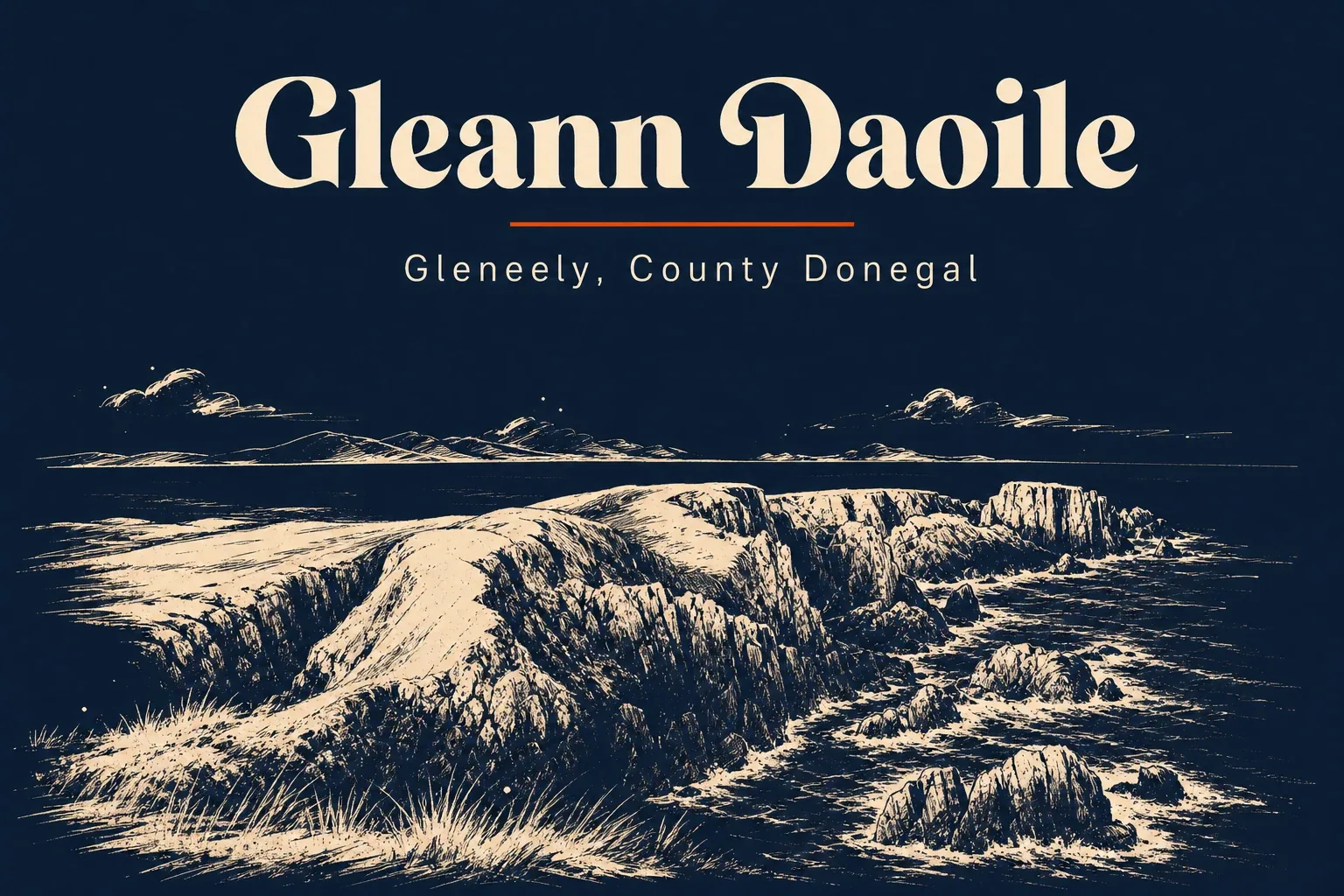
County Donegal Ireland · Co. Donegal · Gleneely Save · Share
POSTED FROM
GLENEELY
CO. DONEGAL · IE

Gleneely
Gleann Daoile

The Inishowen Peninsula
STOP 03 / 03
Gleann Daoile · Co. Donegal

A small crossroads village in the Inishowen hills, between Carndonagh and Culdaff.

Gleneely sits in the northeast hills of Inishowen, between Carndonagh to the south and Culdaff to the west, right where the map shows a cluster of farmland and two churches. Population 236 by the last count. Two pubs, a post office and shop, a petrol station, a school, a football club. The kind of place where the parish knows your business before you've finished explaining it.

The village anchors itself to two things: the land—rolling green fields, stone walls, the Atlantic never far off—and the people who've lived on it for centuries. The O'Doherty clan ruled this peninsula from their strongholds until the Plantation. Their stories are built into the landscape: Grianán of Aileach, the ringfort royal seat, sits just outside Malin. The name of the village itself, Gleann Daoile, carries the old Irish: "valley of Daoile." That deep history doesn't announce itself. It just sits there, in the names and the light.

Population
236 (2016)
Founded
Rural village, Gaelic origins, settled by O'Doherty clan era
Coords
55.3000° N, 7.3500° W
01 / 03

At a glance.

Three things every local will eventually mention. Read these and you've already understood more than most day-trippers do.

02 / 03

Stories & lore.

The reason to come back. The things every local will eventually tell you about, usually after the second pint.

Lords of the peninsula, recorded 1339

The O'Dohertys of Inishowen

The Annals of Ulster recorded Domnall Ua Dochartaigh in 1339 as arch-chief of Inishowen, with "little wanting from his having the lordship of Inis-Eogain." The O'Doherty clan controlled the entire peninsula—a territory of strategic and political weight, ringed by water, commanding trade and military access. From their strongholds they maintained Gaelic law and culture through centuries when Norman influence spread elsewhere. That rule ended with the Plantation in the 17th century, but the names and the ringforts remain.

Victorian stone, 1856, Church of Ireland

All Saints Church

All Saints Church stands in the nearby townland of Aghaglassan, built in 1856 in the Gothic Revival style that swept Irish church-building of the era. The Church of Ireland community found their place in a landscape that had been shaped by Catholic and Gaelic traditions for centuries before them. The building still stands, local stone, built to last. It's one thread in the complex religious tapestry that makes Donegal distinctive.

+

Getting there.

By car

From Derry: take the A2 coastal route south toward Moville and Carndonagh (30km, 30 min). From Dublin: N1/A1 to Belfast, then A2 coastal via Derry to Carndonagh, then local roads (4.5 hours). Gleneely sits on local roads between Carndonagh (8km south) and Culdaff (6km west).

By bus

Limited public transport. Bus Éireann and local services connect Carndonagh and Culdaff; Gleneely does not have its own bus stop. Best to reach larger towns and arrange local lift or car hire.