County Donegal Ireland · Co. Donegal · Gortahork Save · Share
POSTED FROM
GORTAHORK
CO. DONEGAL · IE

Gortahork
Gort an Choirce

The Wild Atlantic Way
STOP 07 / 07
Gort an Choirce · Co. Donegal

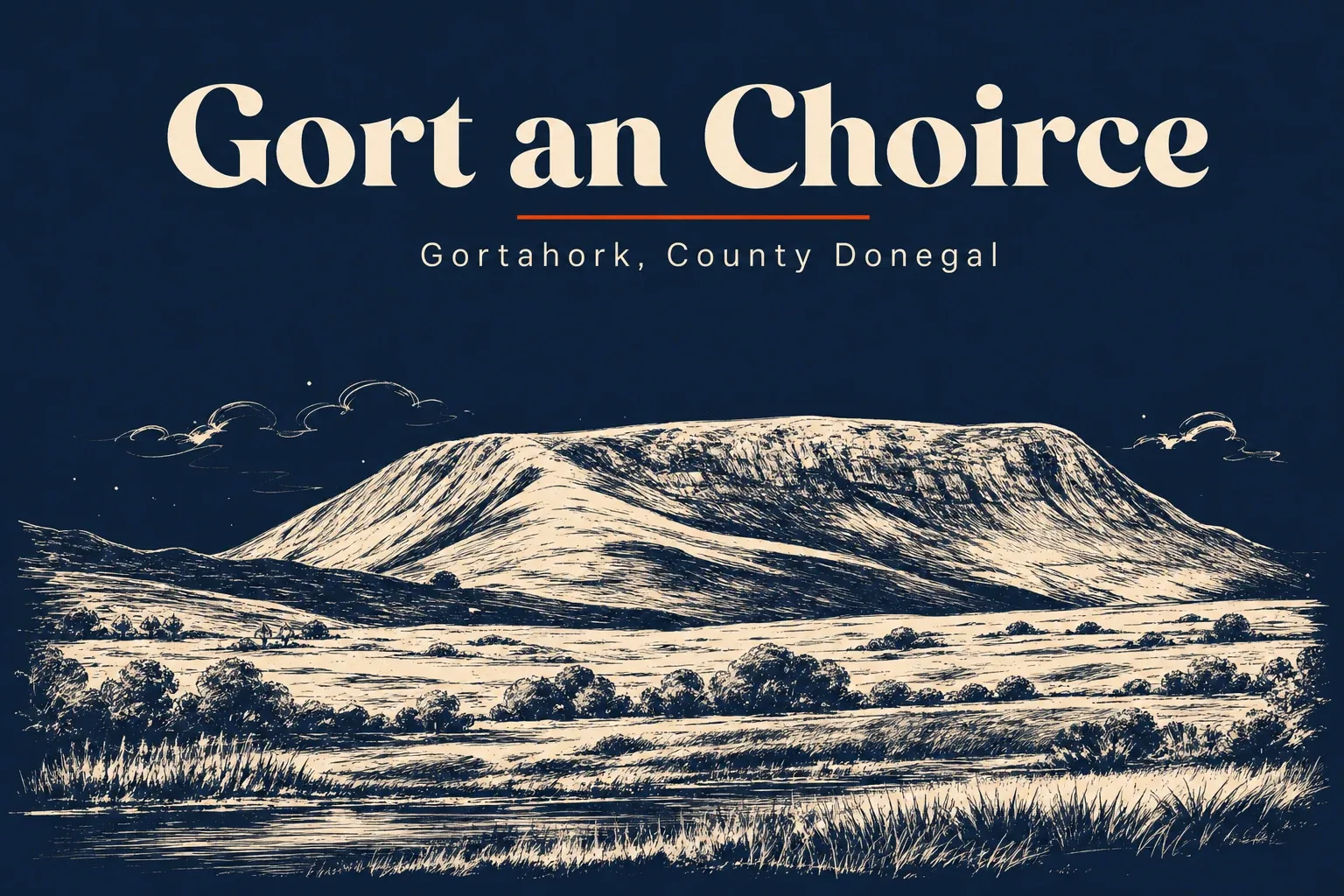
A quiet Gaeltacht village in the shadow of Muckish. The mountain owns the place.

Gortahork sits small and unselfconscious at the foot of Muckish Mountain in northwest Donegal. The name means 'field of oats' — a simple description that stuck for centuries because the people here speak Irish and never translated it into something more marketable. At ~400 people, it's the kind of village where everyone knows everyone and no one needs to perform being local for tourists.

This is Gaeltacht country — officially designated Irish-speaking territory where the language functions as daily life, not heritage. Walk into the shop and you'll hear Irish at the counter. The heritage centre (Ionad Naomh Fionnán) sits here, but not as a museum. It's a living cultural space where Irish teachers bring students, where the language classes happen, where children from Dublin come to spend the summer learning Irish the way it's actually spoken.

The mountain is the real story. Muckish dominates everything — the light, the weather, the way you navigate. Climb it from the village in three hours and you understand why people settled here. The view stretches across the Derryveagh range to Mount Errigal beyond. On a clear day you see Tory Island. On a cloudy day you remember that weather, not the view, is the real landscape here.
Population
~400
Coords
55.1539° N, 8.2306° W
01 / 07

At a glance.

Three things every local will eventually mention. Read these and you've already understood more than most day-trippers do.

02 / 07

The pubs.

None of these are themed Irish pubs, because they don't need to be. A few that earn the trip:

Gleann's

Locals, quiet
Pub

The pub. No pretense. Irish spoken at the bar. This is where the village happens.

03 / 07

Stories & lore.

The reason to come back. The things every local will eventually tell you about, usually after the second pint.

The constant sentry

Muckish Mountain

Muckish rises 667 metres from the outskirts of Gortahork, its distinctive flat top visible from every angle. Farmers navigate by it. The mountain shapes the weather, the light, the way people think about the land. A path from the village climbs the eastern flank to the summit in about three hours. On a clear day the view stretches across Donegal to the Atlantic. On a cloudy day you walk through mist and trust the path. Both experiences teach you something about why people stay here.

The heritage centre

Ionad Naomh Fionnán

The centre sits in Gortahork as a living space for Irish language and culture — not a museum but a functioning school where students learn and speak Irish year-round. The name honors St. Fionan. During the summer, Dublin schools send students here to immerse themselves in Irish speech. During winter it's quieter, but the work continues. This is how a language survives — not in books, but in a room where people speak it because they have something to say to each other.

The language lives

An Ghaeltacht

Gortahork is part of the Falcarragh / Cloughaneely Gaeltacht — an officially designated Irish-speaking area where the language isn't a symbol or a school subject but a working tool. People speak it in pubs, on the street, in homes. The road signs read Irish first. This doesn't make it exotic. It makes it normal. For anyone coming from English-speaking Ireland, that normalcy is the real shock.

04 / 07

Things to do outside.

Wear waterproofs. Bring a sandwich. Tell someone where you're going if it's the mountain.

Muckish Mountain From the village, an old path climbs the eastern slope to the flat-topped summit. The early section is gentle. The upper section steepens. On a clear day the view stretches across the Derryveagh range and out to the Atlantic. On a cloudy day bring patience.
6 km returndistance
3–4 hourstime
Trá Mhór (The Big Strand) West from the village to a curved beach with fine sand. Views toward Tory Island. Low tide reveals rock pools and a longer shoreline to walk. The wind is constant but not unfriendly.
3 km returndistance
1–1.5 hourstime
Ballyness Bay Loop South from the village toward Falcarragh. Coastal views, sheltered inlets, the landscape slowly opening up. This is the Wild Atlantic Way made walking.
4 kmdistance
1.5–2 hourstime
05 / 07

When to go.

There is no bad time. There are different times.

Spring
Mar–May

Quiet. The light lengthens. Wildflowers appear on the slopes. Locals outnumber visitors by a comfortable margin.

◉ Go
Summer
Jun–Aug

The Irish-language schools bring students. The village gets busier by small-village standards. Still quiet compared to coastal towns. Long evenings, warmest water.

◐ Mind yourself
Autumn
Sep–Oct

The schools close. The landscape becomes itself again. Light is dramatic. Weather is moody but good for walking. This is when Gortahork is most its own place.

◉ Go
Winter
Nov–Feb

Half the facilities shut. Storms roll in from the Atlantic with regularity. The village returns to pure local life. If you like that, winter is your season.

◐ Mind yourself
06 / 07

What to skip.

Honestly? Don't bother.

If a local was sitting beside you, this is the bit where they'd lean in.

×
Expecting Muckish to be accessible on days when visibility is gone

On a cloudy day you'll climb for two hours through mist and see nothing. The summit exists. You just won't see it. Come back when you can see the sky.

×
Trying to buy "authentic Gaeltacht experience" tours

You can't buy authenticity. Walk. Sit in the pub. Order a pint. That's the whole strategy. The village doesn't perform. It just is.

×
Visiting in July expecting a quiet experience

Summer brings the language schools. The village fills with students learning Irish. It's wonderful, but not quiet. Come in April or September for peace.

+

Getting there.

By car

From Letterkenny, take the N56 northwest toward Falcarragh. Gortahork is just west of Falcarragh. About 50 minutes from Letterkenny. From Dublin, 4.5 hours. The road is narrow and worth driving slowly.

By bus

Bus Éireann serves the area from Letterkenny and Dungloe. Service is regular but thin in winter. Having your own car gives you far more range.

By train

Nearest station is Letterkenny, 50km away. Then bus or hire a car.

By air

Derry Airport is ~80km. Dublin is 250km. Cork is farther still.