County Donegal Ireland · Co. Donegal · Falcarragh Save · Share
POSTED FROM
FALCARRAGH
CO. DONEGAL · IE

Falcarragh
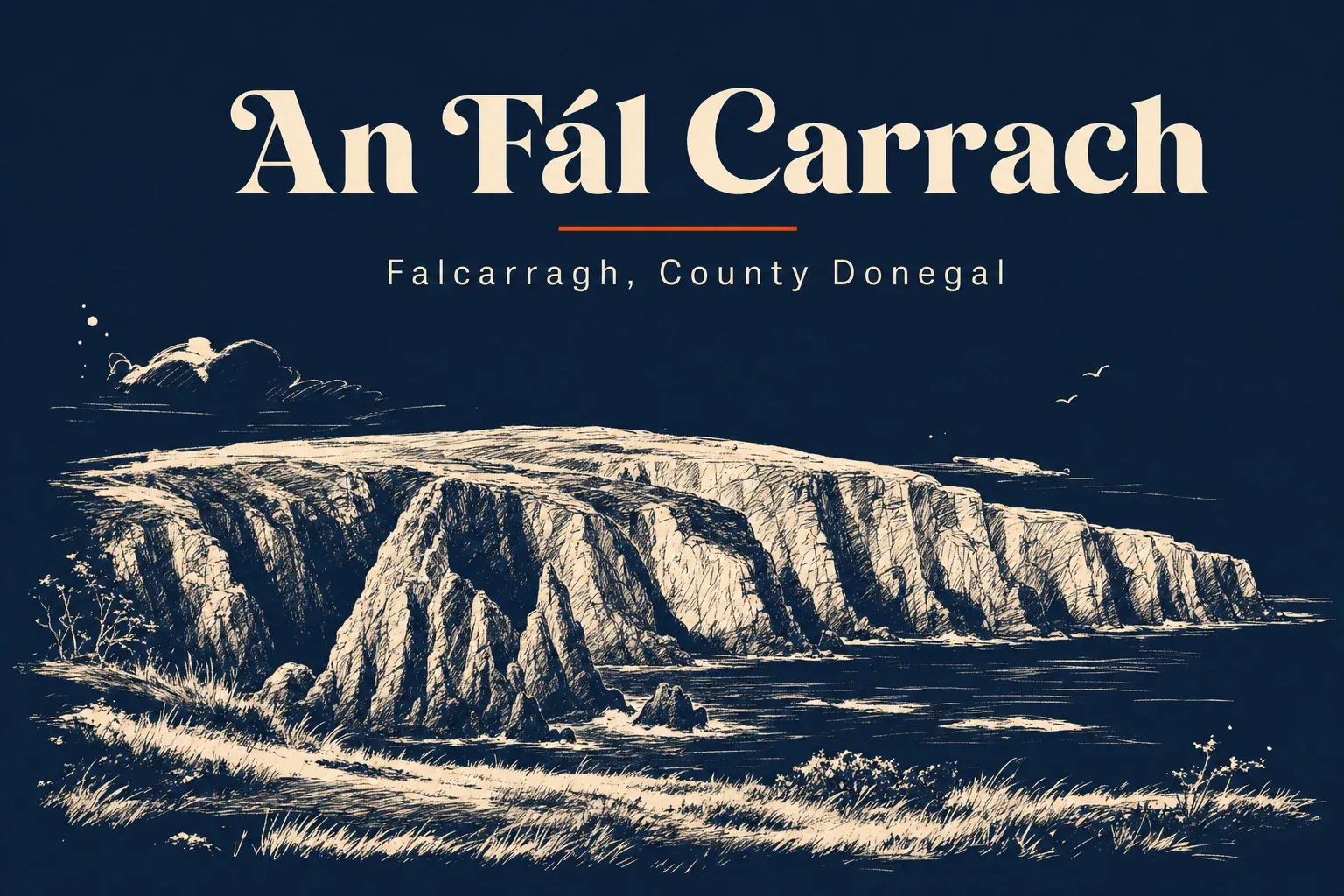
An Fál Carrach

The Wild Atlantic Way
STOP 09 / 09
An Fál Carrach · Co. Donegal

The Gaeltacht town that hasn't become a theme park yet.

Falcarragh sits at the foot of Muckish Mountain in northwest Donegal, serving the Gaeltacht area as its market town and social hub. At ~2,000 people, it's a working town first — farmers come in on Friday, fishermen come in when the boats come in, and the language you hear on the street is Irish. Not for tourists. For living.

This is not a preserved village. It's a place where Irish education colleges bring students every summer, where the school teaches through Irish, where the radio station broadcasts in Irish, and where you can spend an evening in a pub without hearing English once if the conversation wanders that way. The broader Cloughaneely area (the parish around Falcarragh) has over 4,000 people, all of them within shouting distance of the same mountains and the same ocean.

Come for the landscape — Muckish is 30 minutes' walk from the town center. Stay for the fact that you've accidentally ended up in one of the few places in Ireland where the language hasn't become a symbol. It's a tool. People use it. Life continues.
Population
~2,000
Pubs
4and counting
Coords
55.1847° N, 8.1742° W
01 / 09

At a glance.

Three things every local will eventually mention. Read these and you've already understood more than most day-trippers do.

02 / 09

The pubs.

None of these are themed Irish pubs, because they don't need to be. A few that earn the trip:

The Shamrock Bar

Locals, sessions
Pub

A proper pub. Live music many nights. GAA matches on the walls. Conversation happens in both languages depending on who walked in.

Gweedore Bar

Family-run, weekends busy
Pub & restaurant

Live entertainment every weekend. Food served 12pm–9pm (breakfast and light lunch 12pm–4pm, dinner 4pm–9pm). The place fills up on Friday and Saturday.

The Corner Bar

Quiet, local
Traditional pub

The kind of pub where conversation flows freely. Not a tourist attraction. That's the point.

The Loft

Contemporary local
Pub & restaurant

Recently under new management. Sits on the Wild Atlantic Way. Combines traditional pub charm with contemporary food service.

03 / 09

Where to eat.

PlaceTypeLocal note
Batch Donegal Restaurant €€ Locally sourced ingredients, seasonal menu. The kind of place that serves you something made in Donegal by someone you might meet at the pub.
Tandy's Wood Fired Pizza Falcarragh Pizzeria Wood-fired pizza. Crispy bases, proper smoky flavor. The kind of thing you don't expect in a small Donegal town.
Something Fishy Takeaway Chipper Fish and chips. The Atlantic is five minutes away. The fish was alive this morning. That matters.
The Strand Road Restaurant Restaurant €€ Diverse menu — Irish stew, Atlantic seafood, international. Covers all tastes in one building.
Coffee Go Lear Café Hot and cold drinks, freshly baked goods. A gathering spot for locals and visitors who need coffee before they face the wind.
04 / 09

Where to sleep.

PlaceTypeLocal note
Suaimhneas B&B Run by Mary and Willie. The name means "peace" in Irish. Patio, private parking, hosts who treat you like family.
Teach Barney Guesthouse Quiet, clean, well-located. Close enough to Glenveagh National Park (16 miles) to make a day trip realistic.
Baile Go Deo Self-catering Beachfront. Wake up to Atlantic views. Garden access, private parking.
An Teach Bán Self-catering Renovated house with garden and barbecue. Good for families or groups who want to cook their own way through a week.
05 / 09

Stories & lore.

The reason to come back. The things every local will eventually tell you about, usually after the second pint.

The mountain at your back door

Muckish

Muckish rises 667 metres from the outskirts of town, its distinctive flat top visible from miles around. Local farmers navigate by it. On a clear morning you can walk from the town center to the summit in about four hours. On a cloudy morning you can walk into the mist and spend two hours finding you walked in a circle. Both experiences are worth having.

The Bridge of Tears

The Great Famine

A modest stone bridge just outside town marks the departure point for generations of emigrants. Families walked here with their sons and daughters, shared goodbyes, then watched them continue alone to Derry Port and ships bound for America. The bridge is called Droichead an Bhróin — the Bridge of Tears. Not every place marks this moment so honestly.

The language lives here

An Ghaeltacht

Falcarragh is a Gaeltacht — an officially designated Irish-speaking area where 70% of the population speaks the language and 34% use it daily outside of school. This isn't artificial. No one translates for tourists here. If you want to be understood, you either speak Irish or you point. The road signs have argued for decades about which name to use (An Fál Carrach or Na Crois Bhealaí — locals still use both). The language won.

The tallest Celtic cross

Ray Church

Five kilometres from town, the ancient church site at Ray houses one of Ireland's most remarkable monuments — a Celtic high cross reaching 5.56 metres into the sky. Carved in the 8th century, it shows connections to Iona Abbey in Scotland. It stands against the backdrop of the cloud-covered Derryveagh Mountains like a stone exclamation mark. Connections to early medieval scholarship networks, which the monks would have valued. We just call it beautiful.

06 / 09

Things to do outside.

Wear waterproofs. Bring a sandwich. Tell someone where you're going if it's the mountain.

Muckish Mountain From the town, an old path climbs the eastern face to the flat-topped summit. Views of the Derryveagh Mountains, the Atlantic, and Mount Errigal (Donegal's highest) beyond. On a clear day you see forever. On a cloudy day you see nothing and have to trust the path.
7 km returndistance
3–4 hourstime
Ballyness Bay Five minutes west of town. A sheltered beach, fine sand, and views to Tory Island. The walk along the strand is flat and good on a calm day. On a windy day the sand will find its way into everything you own.
Variesdistance
1–2 hourstime
Tramore Beach Another coastal walk. Sand, rocks, cliffs in the distance. Good for a quick escape when the light is right.
4 km returndistance
1–2 hourstime
07 / 09

When to go.

There is no bad time. There are different times.

Spring
Mar–May

Quiet. The light starts getting long. Locals aren't dodging tourists yet. The landscape turns green overnight.

◉ Go
Summer
Jun–Aug

The Irish-language colleges bring students. The town gets busy by Donegal standards. Still quieter than most coastal towns. Longest days, warmest water.

◐ Mind yourself
Autumn
Sep–Oct

The colleges close. The locals have their town back. The light is dramatic. The weather is moody but good for walking.

◉ Go
Winter
Nov–Feb

Half the town shuts. The half that stays open is more itself. Storms roll in from the Atlantic with theatrical regularity. You're genuinely on the edge of something.

◐ Mind yourself
08 / 09

What to skip.

Honestly? Don't bother.

If a local was sitting beside you, this is the bit where they'd lean in.

×
Tourist-oriented "Irish experience" activities

This is a Gaeltacht town where Irish people live. You don't need a ceili dance show. Sit in a pub and listen to two old men argue about something in Irish. That's more authentic than any staging.

×
Visiting Muckish on a day when visibility is gone

You'll climb for two hours through mist and see nothing. The summit exists. You just won't see it. Come back tomorrow.

×
Assuming summer is the only time to visit

Summer is busier. Autumn is better for landscape and weather. Spring is quieter still. Winter is for people who actually like weather.

+

Getting there.

By car

Letterkenny to Falcarragh is 45km, about 45 minutes on the N56. The road is coastal and worth driving slowly.

By bus

Bus Éireann connects Falcarragh to Letterkenny and regional towns. Regular service, though timetables thin in winter.

By train

The Letterkenny-to-Burtonport railway closed in 1947. The nearest train is Letterkenny (45km away). The old station still stands — it featured in the 1992 film "The Railway Station Man."

By air

Nearest airport is Derry (80km). Dublin is 250km and requires a longer drive.