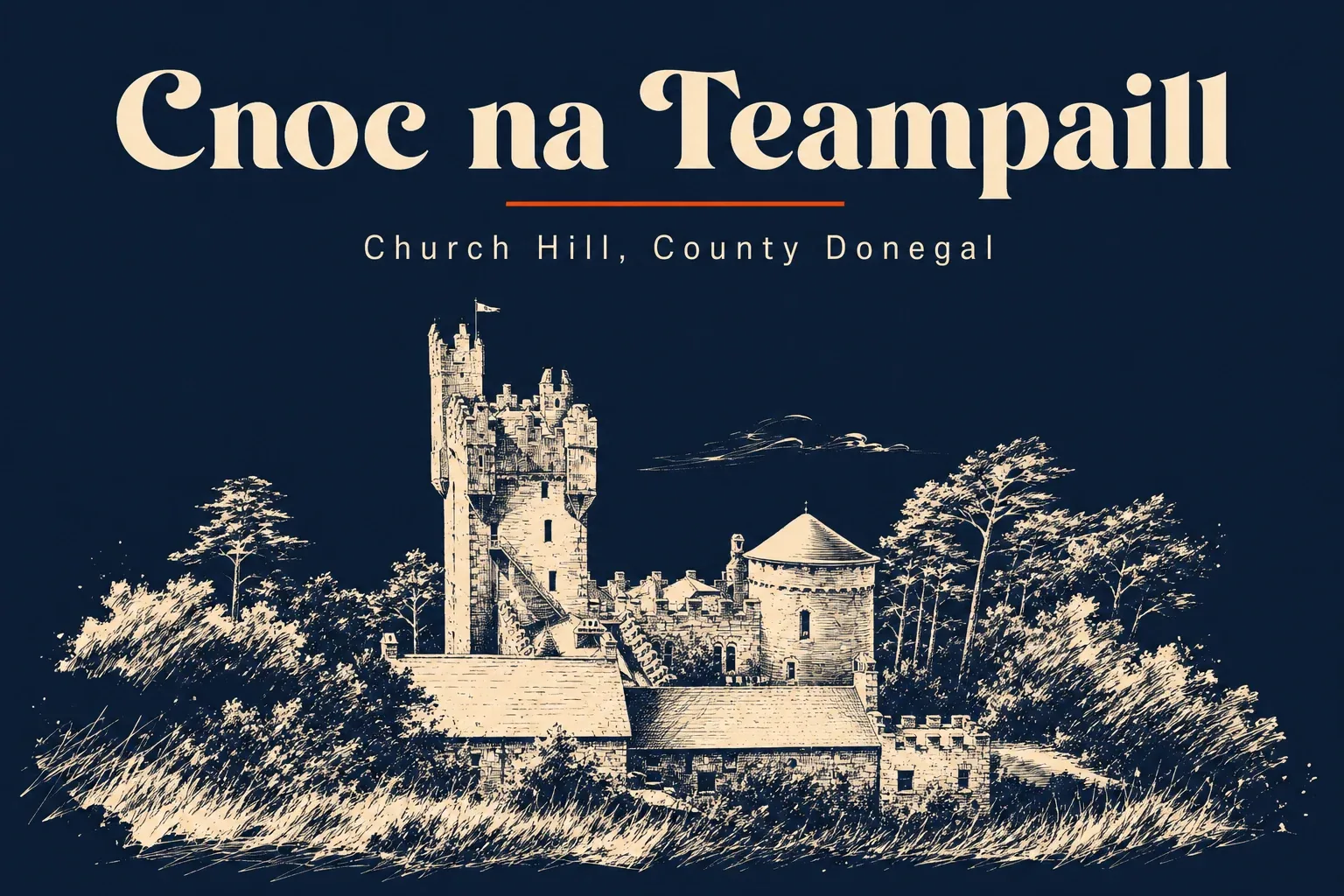
County Donegal Ireland · Co. Donegal · Church Hill Save · Share
POSTED FROM
CHURCH HILL
CO. DONEGAL · IE

Church Hill
Cnoc na Teampaill

The Wild Atlantic Way
STOP 09 / 12
Cnoc na Teampaill · Co. Donegal

Where a saint was born and an artist collected beauty. Lough Gartan still watches over both.

Church Hill sits on elevated ground—the Irish name means 'summit of the bog'—overlooking Lough Gartan and the Derryveagh Mountains. Three things happen here: pilgrims walk the ancient circuit around the lake where Saint Colmcille was born, art lovers visit the Glebe Gallery to see Picasso and Kokoshka in a rectory overlooking the same water, and everyone else gets access to one of Ireland's greatest stretches of mountain wilderness. It's not three separate visits. It's one place doing three things at once.

What matters: this is still a working village of 300 people. Callaghan's Bar has a session on Wednesday nights. The heritage centre draws 50,000 visitors a year but doesn't feel crowded. The Gartan Outdoor Centre runs kayaking and climbing off the lake. Come for the saints and the art, but stay for the walks. Or come for the walks and find the saints and the art waiting.

The Colmcille Heritage Centre tells the story straight—how a prince from the Uí Néill dynasty grew up here and later carried Christianity to Scotland. The Glebe House is Derek Hill's ordinary Tuesday morning made permanent: tea in the dining room, his paintings stacked against the walls, Italian gardens, William Morris textiles, the lake light that made him stay. Glenveagh Castle is a mile and a half through the park, reached by shuttle bus. Walk any of those paths and you're walking ground Colmcille knew.

Population
300
Founded
521 AD (St Colmcille birthplace)
Coords
55.0047° N, 8.3167° W
01 / 09

At a glance.

Three things every local will eventually mention. Read these and you've already understood more than most day-trippers do.

02 / 09

The pubs.

None of these are themed Irish pubs, because they don't need to be. A few that earn the trip:

Callaghan's Bar

Locals, music, proper talk
Community pub

The village's actual heart. Stone architecture, low-set, the kind of place that belongs to rural Ireland. Wednesday nights traditional music—fiddles, bodhrán, locals and visitors sorting themselves out the way it works. Derek Hill used to come here. The signed print on the wall proves it. Order a pint and settle in.

03 / 09

Where to eat.

PlaceTypeLocal note
Callaghan's Bar Pub food Homemade soup, sandwiches, scones, traditional pub meals. Nothing fancy. That's the point. The modern lounge hasn't killed the character—the original fireplace still works.
Colmcille Heritage Centre Café Café Overlooking Lough Gartan. Local ingredients, traditional Irish dishes. You eat looking at the view that made Colmcille stay.
Nellie's Restaurant (Glenveagh) Visitor centre dining €€ Five minutes from the church. In the national park visitor centre. Traditional and contemporary options, mountain views, families welcome.
04 / 09

Where to sleep.

PlaceTypeLocal note
Keelogs Cottage Self-catering Landscaped gardens, woodland views, modern inside, traditional outside. The kind of place that lets you disappear into rural Donegal properly.
Gartan Outdoor Education Centre Residential rooms Ensuite rooms right on Lough Gartan. Lake views, mountain views, access to kayaking and climbing. Meals included in activity packages.
Holiday homes scattered round the village Self-catering Several properties, countryside settings, that mix of character and modern comfort. Book early in summer.
05 / 09

Stories & lore.

The reason to come back. The things every local will eventually tell you about, usually after the second pint.

521 AD, a royal child on a sacred lake

Colmcille's birth

A prince of the Uí Néill dynasty was born on these shores in 521 AD—Colmcille, meaning 'dove of the church.' He grew up walking these hills, swimming in the lake, becoming the scholar and missionary who would leave Donegal at 42 and establish the monastery on Iona in Scotland. From there, he brought Christianity to Scotland and northern England. Fifteen centuries later, pilgrims still circle the Gartan Stone—a flagstone marked by coin offerings and devotions—at his traditional birthplace. The Colmcille Heritage Centre sits on the lough shore, telling his story through exhibits and artifacts. You can walk the ancient turas circuit, the pilgrimage path that medieval pilgrims walked, and understand why this corner of Donegal became one of early Christian Europe's most significant places.

1954–1980. An English painter collects art and paints light.

Derek Hill's years at Glebe House

Derek Hill discovered this Regency rectory, built in 1828 as a Church of Ireland manse, in 1954. He had studied in Paris, traveled Europe, and was captivated by the light over Lough Gartan. He lived here for 26 years. He painted the landscape. He collected art—Picasso, Kokoshka, Freud, Augustus John, Renoir, Jack Yeats. He decorated the rooms with William Morris textiles and oriental furniture. He entertained artists and writers. When he donated the house, its contents, and the gardens to the Irish state in 1981, he ensured that all of it—the taste, the pictures, the views from the windows—stayed together. You walk into his Tuesday morning and it hasn't been rearranged. The Glebe Gallery now shows the collection in rooms that still feel like his rooms, with the lake light he spent three decades painting.

16,000 hectares. A Victorian castle. Eagles returned.

Glenveagh National Park

The national park wraps around Church Hill like a fortress. It contains the largest red deer herd in Ireland, golden eagles (reintroduced from the 2000s onward and now breeding), native oak woodlands, and Glenveagh Castle—a romantic Victorian fantasy built by John George Adair in the 1870s after he evicted the tenants. You reach the castle by shuttle bus along Lough Veagh. The gardens are there—the Italian Terrace, the Gothic Orangery, the views. Walking trails suit all abilities, from lakeside flat to serious mountain scrambles. Access is free. The castle and shuttle cost five euros. Glenveagh itself costs nothing but your time, and there's a lot of it to spend.

Medieval pilgrimage. Still walking it.

Lough Gartan's sacred circuit

The turas—the ancient pilgrimage circuit around Lough Gartan—was established in medieval times. Pilgrims would walk the marked path, stop at the Gartan Stone (Leac na Cumha, the Flagstone of Sorrows), visit holy wells, touch ancient burial grounds, and pray. They do it still. The path is marked and free. It passes archaeological evidence of continuous human settlement since before Colmcille's birth—Bronze Age sites, early Christian church foundations, medieval settlements. The landscape itself is the heritage. You walk what medieval pilgrims walked. The light on the water is the light that made Derek Hill paint.

06 / 09

Things to do outside.

Wear waterproofs. Bring a sandwich. Tell someone where you're going if it's the mountain.

Lough Gartan pilgrimage circuit The turas. Marked path round the lake. Passes the Gartan Stone, ancient burial grounds, holy wells, sites tied to Colmcille's childhood. Self-guided, free, suitable for all ages. Do it slowly.
3–4 kmdistance
90 minutestime
Glenveagh National Park trails Lakeside walks to serious mountain scrambles. The Visitor Centre sits within the park. Free entry to the park itself. The shuttle to Glenveagh Castle costs €5. Native oak woodland, views of the Derryveagh Mountains. Watch for red deer.
Various: 2–8 kmdistance
1–4 hourstime
Glebe House gardens and woodland walks The grounds around Derek Hill's house. Landscaped gardens, views of Lough Gartan, the woodland he painted. Guided house tours only (the interior is Derek's interior). But the gardens are worth a slow wander.
1–2 kmdistance
time
Derryveagh Mountains from Church Hill Well-marked trails from the village. Everything from gentle hill walks to serious scrambles. On a clear day, views across northwest Ireland. Errigal (Donegal's highest peak) is nearby but a serious undertaking.
5–12 km depending on routedistance
3–5 hourstime
07 / 09

When to go.

There is no bad time. There are different times.

Spring
Mar–May

Light returns. Pilgrimage season reopens. The gardens at Glebe House come alive. Lough Gartan unfreezes itself.

◉ Go
Summer
Jun–Aug

Busier. Book accommodation ahead. The Churchill Fair (third weekend in July) and Earagail Arts Festival (July 12–26) mean the region hums. Long evenings. Worth the crowds.

◐ Mind yourself
Autumn
Sep–Oct

The locals' favourite. Storms, big skies, the mountains cloud-wreathed. Heritage sites are quieter. Sessions begin again.

◉ Go
Winter
Nov–Feb

Glenveagh visitor centre closes some days. Glebe House is open but limited. The heritage centre keeps hours. But if you want the lakes and mountains to yourself, this is it.

◐ Mind yourself
08 / 09

What to skip.

Honestly? Don't bother.

If a local was sitting beside you, this is the bit where they'd lean in.

×
Rushing through all three heritage sites in a single afternoon

Colmcille deserves slow walking. Derek Hill deserves sitting in the rooms and understanding his taste. Glenveagh deserves either a real expedition or a real coffee stop, not both in ninety minutes. Pick two. Spend time.

×
Visiting Glenveagh without checking the shuttle times to the castle

The castle shuts when the shuttle stops running. Summer and shoulder season it runs regular. Winter it's reduced. Check before you plan the day.

×
Treating Callaghan's as a tourist photo opportunity

It's a real pub where real people sit on real Wednesday nights playing real music. You're welcome to join. Ordering a pint and listening is the etiquette. A selfie and leaving is not.

+

Getting there.

By car

Letterkenny (15 min west on the R251). Donegal Town (1 hour south). Sligo (90 min southwest). Derry/Londonderry (75 min north).

By bus

Bus Éireann from Letterkenny, several daily. Regular connections to Dublin, Belfast, Derry.

By train

Nearest station is Letterkenny. Then bus or taxi.

By air

Donegal Airport (40 min). Derry Airport (75 min). Dublin (3 hours). Shannon (3.5 hours).