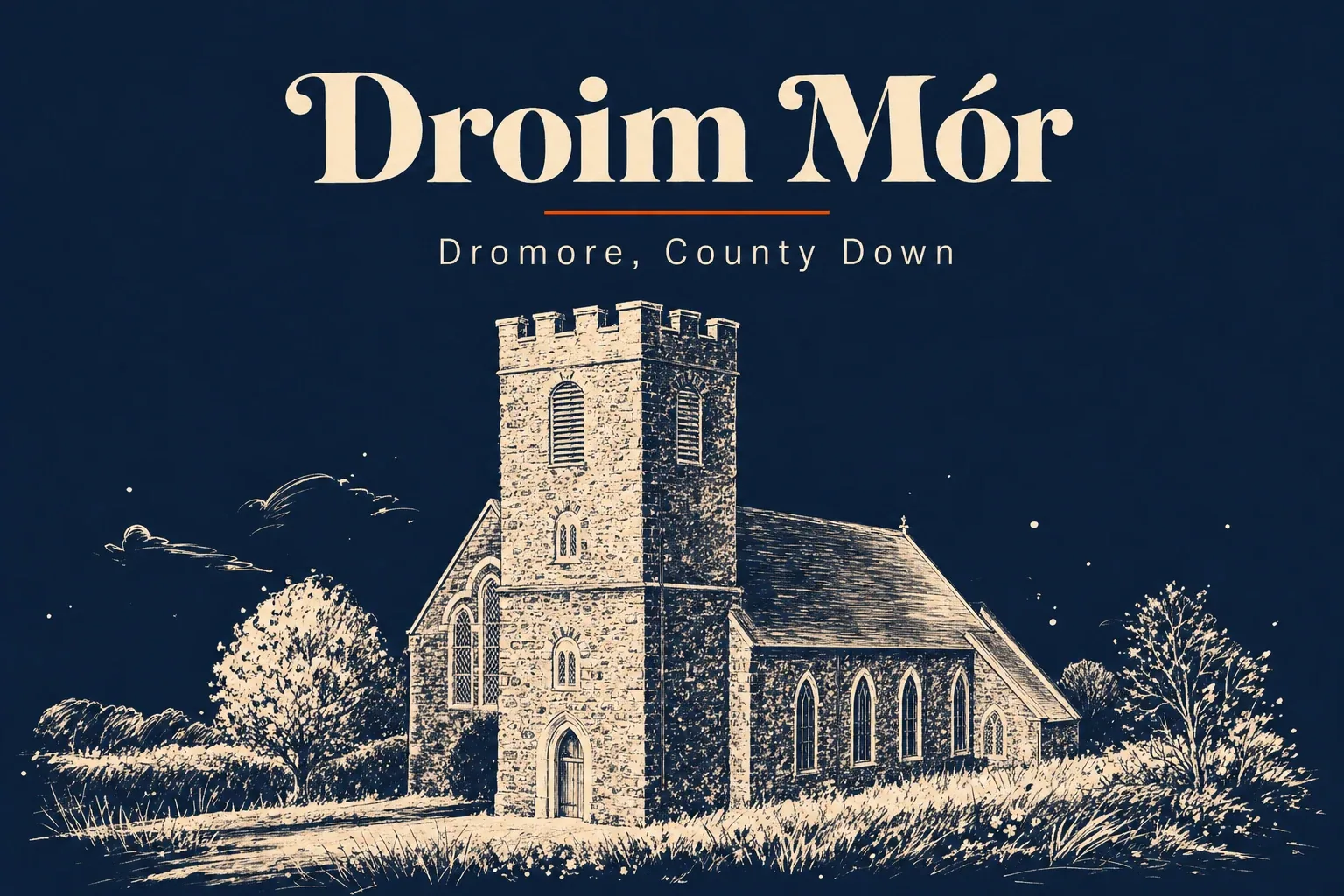
Droim Mór · Co. Down
A working market town with a cathedral, a Norman mound, and a river the A1 used to roar past.
Dromore is a small cathedral town nineteen miles southwest of Belfast, sitting on a bend in the River Lagan where the road from Dublin to Belfast has always crossed. The A1 used to come straight through the Square. Now the dual carriageway lifts the through-traffic over the back of the town and Dromore is a quieter place than it was - which suits it.
The shape of the town is older than you think. Saint Colman set up a daub-and-wattle church here around the year 510 and the seat of the diocese has been here ever since. The Normans came in the 1170s and built the Mound - a textbook motte and bailey on the east side of the town, still standing, still climbable. The English burned the cathedral in 1641; Bishop Jeremy Taylor - Caroline divine, author of "Holy Living" and "Holy Dying" - rebuilt it in 1661 and is buried inside the south wall.
What is here now: a market square with stocks still set into the kerb, the Town Hall with its clock tower, a handful of pubs around the Square, and one good restaurant. The real find is the riverside path - the Lagan Walkway runs west from Regents Bridge through Dromore Town Park and under the seven-arch viaduct of the old Belfast-to-Banbridge railway, which last carried a train in 1956. Don't come for a weekend. Come for an afternoon, do the historic trail, and have your dinner at Mulhollands.